
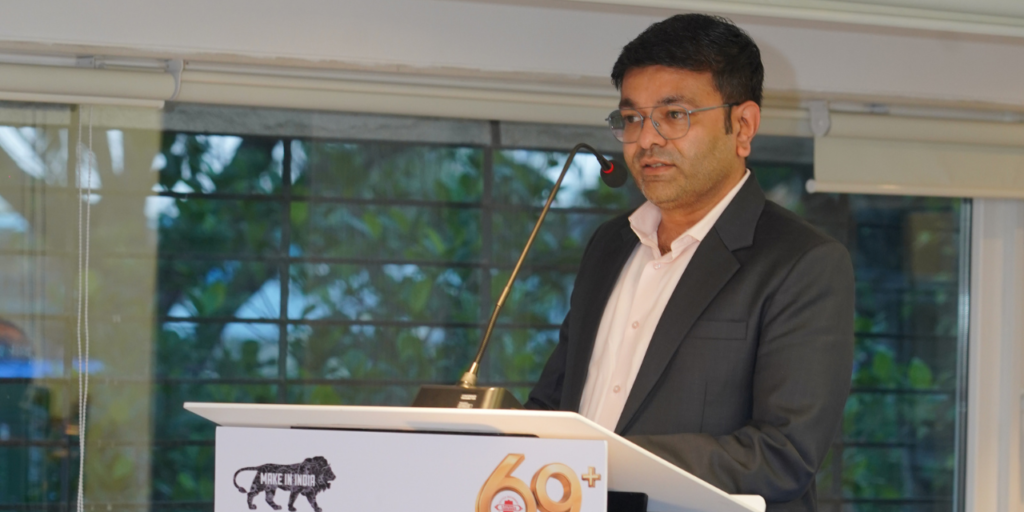
At the association’s 66th AGM, Prashant Mangukia highlighted rising machinery imports, domestic demand of ₹32,397 crore and the need to strengthen technology, exports and R&D.
The Indian textile engineering industry needs stronger domestic manufacturing, technological advancement and export capabilities to compete globally, said Prashant Mangukia, Chairman of the Textile Machinery Manufacturers’ Association (India) [TMMA(I)], at the association’s 66th Annual General Meeting. He highlighted the opportunities created by changing global supply chains and called for greater competitiveness among Indian textile machinery manufacturers.
Addressing members and industry representatives, Mangukia reviewed the challenges faced by the sector during FY2025–26. He also outlined five priorities for the industry, including manufacturing, modernisation, quality, exports, research and development.
Global Supply Chain Changes Create Opportunities for India
Mangukia described FY2025–26 as a year of resilience and uncertainty. Geopolitical tensions, tariff uncertainties, changing trade policies and fragmented supply chains have influenced global manufacturing and sourcing decisions.
He noted that businesses are increasingly adopting China+1, near-shoring and friend-shoring strategies. These shifts present opportunities for India to strengthen its position in global manufacturing.
However, he stressed that Indian manufacturers must compete on technology, quality, productivity, delivery and reliability to benefit from these changes.
He also highlighted the rapid transformation of manufacturing. According to Mangukia, the textile engineering industry must accelerate innovation and automation while improving its global competitiveness.
India’s Economic Growth Supports Textile Engineering
India’s real GDP grew by 7.7% in FY2025–26, compared with 7.1% in the previous year, according to figures cited in the Chairman’s address.
Domestic consumption, investment, manufacturing and services supported this growth. Mangukia noted that infrastructure investment, manufacturing expansion and deeper integration with global value chains could create opportunities for the textile engineering sector.
He emphasised that growth in the textile industry can generate demand for textile machinery. However, Indian manufacturers must be prepared to capture a larger share of this opportunity.
Domestic Textile Machinery Demand Reaches ₹32,397 Crore
Despite the opportunities, Mangukia described FY2025–26 as a challenging year for the textile engineering industry. Production and capacity utilisation declined by double digits, while exports remained under pressure.
He highlighted India’s domestic textile machinery demand of approximately ₹32,397 crore. Despite this sizeable market, Indian manufacturers supplied less than 25% of the demand by value.
Imports increased sharply to approximately ₹26,999 crore, predominantly in the weaving and knitting machinery segments.
Mangukia said these figures highlight the need to improve the competitiveness of domestic manufacturers. He called for machinery that offers advanced technology, greater efficiency, reliability and the ability to compete in international markets.
He emphasised that the industry’s objective should extend beyond increasing production to developing better and more competitive machines.
Five Priorities for the Indian Textile Engineering Industry
Mangukia identified five areas that require collective attention from the industry.
1. Strengthening domestic manufacturing
He called for an ecosystem that encourages Indian textile machinery manufacturing. Manufacturers must continue improving their capabilities to meet evolving market requirements.
2. Technology and modernisation
The industry needs to keep pace with rapid technological changes. Mangukia stressed that technology must become a competitive advantage for Indian textile machinery manufacturers.
3. Quality and a level playing field
Customers need access to advanced machinery at competitive prices. At the same time, Indian manufacturers must have a fair opportunity to compete in the domestic market.
4. Expanding exports
Mangukia identified exports as a major opportunity for the sector. As global supply chains change, Indian manufacturers must look beyond the domestic market.
He called for stronger international marketing, project exports, export finance and global partnerships. He also emphasised the ambition of making Indian-designed and Indian-manufactured machines trusted worldwide.
5. Investment in R&D, innovation and skills
The Chairman highlighted the need for stronger collaboration between industry, academia and technology institutions. He also stressed the importance of developing skilled professionals to support innovation and improve competitiveness.
TMMA(I) to Continue Supporting Industry Development
Mangukia said India has a large domestic market, an ambitious textile industry, growing engineering capabilities and a strong entrepreneurial base. He called for greater speed, scale and confidence to convert these strengths into global opportunities.
He urged the industry to move from cost competitiveness towards technology competitiveness. This transition, he said, would help position Indian textile engineering as a global technology partner rather than only a supplier to the domestic textile industry.
He reaffirmed TMMA(I)’s role in representing industry interests before the Government, facilitating dialogue between machinery manufacturers and textile users, supporting technology and market development, sharing industry intelligence and creating opportunities for collaboration.
Mangukia also acknowledged the continued engagement of the Ministry of Textiles, Ministry of Commerce and Industry, DPIIT, BIS, the Textile Commissionerate and other government departments and agencies. He thanked association members and the Managing Committee for their contributions and continued support.
Export and R&D Awards to Recognise Industry Achievements
The AGM also included the presentation of the Export and R&D Awards, recognising members’ achievements in exports, research, development and technological advancement during 2025–26.
Mangukia congratulated the award winners and acknowledged their contributions to the capabilities and innovation of Indian textile machinery manufacturers.
He invited the Chief Guest, Durai Palanisamy, Chairman of SIMA Mills and Executive Director of Pallava Group, Coimbatore, to present the awards and address the gathering after the business session.
Concluding his address, Mangukia called on the industry to work collectively towards stronger global competitiveness and leadership. He emphasised the need to build technological capabilities that match India’s ambitions and turn current challenges into future opportunities for the Indian textile engineering industry.