
The rapid expansion of artificial intelligence (AI) is changing how data centers manage heat, energy and water resources. As AI accelerators operate at higher power densities, traditional room-cooling systems are increasingly challenged to manage the heat generated by high-density computing racks.
Liquid cooling technologies are gaining importance because they bring heat capture closer to the chip. However, liquid cooling does not automatically eliminate facility-level water consumption. Operators must still remove heat through dry coolers, chilled-water systems, hybrid solutions or evaporative cooling towers. Each approach affects water consumption, energy demand, maintenance requirements and regulatory reporting.
Water management is consequently becoming a key consideration in data center design and operations. In Europe, operators with installed IT capacity of 500 kW or more are required to report sustainability information annually to the European Database on Data Centres. A 2024 delegated regulation also establishes water-use reporting requirements, including water usage effectiveness (WUE). Singapore has established a WUE benchmark of 2.0 cubic metres per megawatt-hour (m³/MWh) or lower.
These developments are increasing the need for measurable water-performance indicators, reliable monitoring and auditable compliance records.
Compliance Creates Opportunities Beyond Cooling Equipment
The growing focus on water and cooling compliance is creating opportunities across equipment, software, analytics and specialised services. Although hyperscale operators can standardise servers and computing infrastructure, water and cooling requirements vary according to local climate, water quality, utility capacity and permitting conditions.
Data center operators therefore require region-specific regulatory interpretation, consistent data definitions, monitoring systems and annual reporting support.
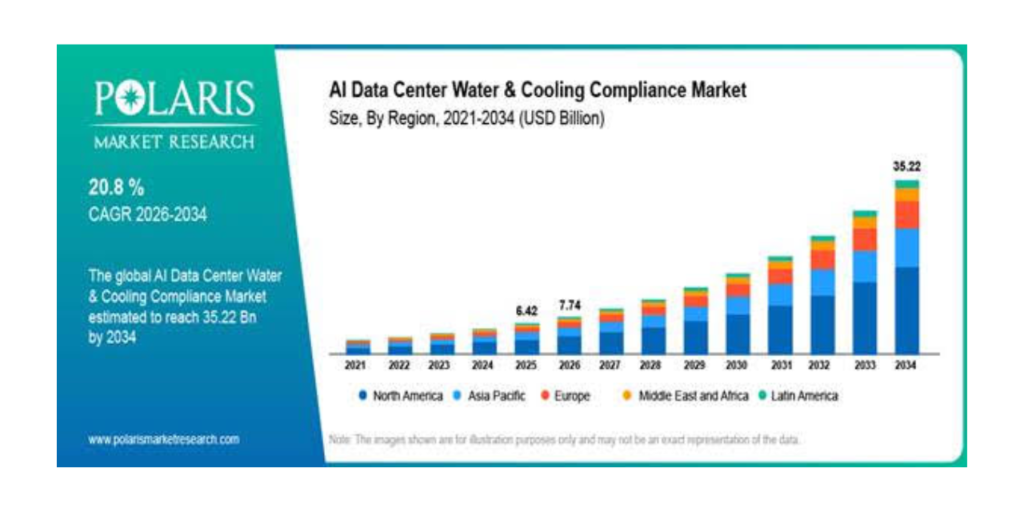
According to the market projections cited by Polaris Market Research, metering, sensors and analytics are expected to be the fastest-growing solution layer, with a CAGR of 22.85%. Cooling and heat-rejection equipment accounted for the largest market share in 2025, at 47.36%.
Zero-water and dry-cooling solutions are projected to grow at a CAGR of 24.63%, while direct-to-chip liquid cooling is expected to register a CAGR of 26.35%.
These developments offer opportunities for water-treatment companies, instrumentation suppliers, controls specialists and managed-service providers supporting data center operators.
Retrofit Costs Remain a Major Challenge
Despite the growth opportunities, upgrading existing facilities presents financial and technical challenges. Direct-to-chip cooling systems, coolant distribution units and water-recycling infrastructure can require substantial upfront investment.
Older data centers designed around chilled-water or evaporative cooling systems may need extensive modifications, including new pipework, leak detection, filtration, control systems and changes to heat-rejection capacity.
The use of treated or reclaimed water also introduces considerations involving corrosion, scaling and water-quality management. Requirements vary according to the water source and the design of the cooling system.
Operators must therefore evaluate retrofit costs alongside the potential consequences of permitting delays, regulatory requirements and increased community scrutiny over water consumption.
Regional Market Dynamics: North America Leads, Asia Pacific Expands
North America accounted for 39.27% of the global market in 2025, with the United States contributing 72.47% of the regional share. The region’s position reflects the expansion of hyperscale data centers alongside growing pressure on local utility infrastructure.
Europe held a 24.18% market share, supported by regulatory requirements and sustainability reporting obligations.
Asia Pacific is projected to record a CAGR of 23.79%, driven by data center expansion and increasing attention to water efficiency in markets such as Singapore and Malaysia.
Latin America is forecast to grow at a CAGR of 20.61%. In the absence of a region-wide WUE requirement, hyperscaler standards and project-financing criteria are influencing water-management practices.
The Middle East and Africa accounted for 3.14% of the market in 2025. Water scarcity across parts of the region is increasing interest in zero-water cooling designs and alternative approaches to heat management.
Competitive Landscape: Focus Shifts Towards Measurable Performance
Competition in the AI data center water and cooling compliance market spans thermal management, liquid cooling, water treatment, recycling and monitoring technologies.
Vertiv introduced its CoolChip CDU 2300 in May 2026. Companies including CoolIT, LiquidStack, Submer and Iceotope are active in direct-to-chip and immersion cooling technologies, while Veolia, Ecolab and Xylem bring expertise in water treatment and reuse.
Hyperscale technology companies are also exploring approaches to reducing cooling-related water consumption. Microsoft has described an AI-optimised data center design that uses no water for cooling, while Amazon Web Services plans to quadruple the number of its data centers using recycled-water cooling from 24 by 2030.
These developments highlight a broader shift in the competitive landscape. Alongside cooling capacity, operators increasingly need to demonstrate water efficiency, energy performance and compliance through verifiable operational data.
Integrated Water and Cooling Planning to Gain Importance
Water and cooling systems are expected to be planned and managed as interconnected parts of data center infrastructure. Continuous WUE monitoring, automated compliance reporting and AI-assisted cooling optimisation are likely to become increasingly important as regulatory and operational expectations evolve.
Reclaimed-water systems and zero-water cooling designs are also expected to gain traction, although their suitability will depend on local conditions, facility requirements and investment costs.
The market projections cited by Polaris Market Research indicate that guideline-driven frameworks, which link incentives and permits to water-efficiency objectives, are expected to grow at a CAGR of 18.35%. A September 2026 report from the Pacific Institute also called for standardised water-use reporting.
However, high capital requirements, legacy infrastructure and differences in local water conditions are likely to result in uneven adoption. No single cooling technology is suitable for every data center location.
Conclusion
The expansion of the AI data center water and cooling compliance market reflects a wider shift in infrastructure planning, where water management is becoming as important as computing capacity and energy efficiency.
As AI workloads increase, data center operators and technology suppliers will face growing pressure to demonstrate responsible water use through measurable performance indicators and auditable reporting. Investments in advanced cooling, water recycling, monitoring and compliance services are expected to play an increasingly important role in the development of sustainable AI infrastructure.
Source: Polaris Market Research. For more information, visit https://www.polarismarketresearch.com/industry-analysis/ai-data-center-water-and-cooling-compliance-market