
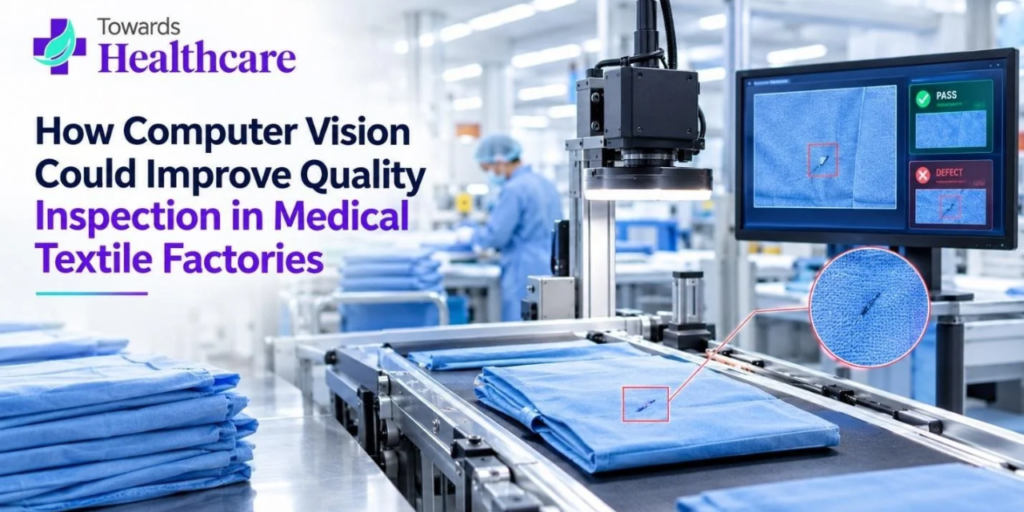
AI-powered inspection systems can help medical textile manufacturers detect visible defects, improve production consistency and reduce material waste, while complementing essential product testing.
Medical textiles used in surgical gowns, protective clothing, wound dressings and hospital disposables must meet specific quality requirements. Even small manufacturing defects can affect product consistency and reliability. Computer vision combines industrial cameras, image processing and artificial intelligence (AI) to detect visible defects during production, offering manufacturers another way to strengthen quality control.
As medical textile production becomes increasingly automated, computer vision could help manufacturers identify defects earlier, monitor production processes and improve inspection efficiency.
Why Medical Textile Inspection Needs Better Technology
Traditional fabric inspection often depends on human observation. Although experienced inspectors can identify many defects, repetitive inspection tasks and high production volumes can make it difficult to detect every small or less visible irregularity.
A 2024 review published in Electronics discusses the use of computer vision and deep learning to automate fabric defect detection. The research highlights challenges such as variations in fabric texture, small defects and limited training data.
For medical textiles, inspection requirements depend on the intended use of the product. Visible defects, including holes, tears and stitching irregularities, can often be assessed through image-based inspection. However, critical properties such as filtration efficiency, fluid resistance, material strength and sterility require separate testing and validation.
How Computer Vision Works in Textile Factories
Computer vision systems capture images of fabrics or finished products using industrial cameras. Image-processing algorithms or trained AI models then analyse the images to identify irregularities that may indicate manufacturing defects.
These systems can support several types of inspection.
Fabric defects: Detection of holes, tears, broken yarns and irregular surface patterns.
Material inconsistencies: Identification of variations in texture, colour and fabric structure.
Garment defects: Inspection for visible stitching problems, misplaced seams and incomplete components.
Production irregularities: Monitoring recurring defect patterns that may indicate problems with machinery or processing conditions.
When a potential defect is detected, the system can flag the affected area for further examination. This enables quality teams to investigate problems before products advance to subsequent manufacturing stages.
Applications Across Medical Textiles
Surgical Gowns and Drapes
Computer vision can help identify visible fabric damage, stitching defects and assembly irregularities in surgical gowns and drapes before packaging. Early detection can reduce the likelihood of visibly defective products progressing through production.
However, visual inspection alone cannot establish whether a gown or drape provides the required barrier protection.
Nonwoven Medical Materials
Nonwoven fabrics are used in products such as masks, protective clothing and medical disposables. Camera-based inspection systems can monitor surface irregularities and identify visible defects during material production and conversion.
The effectiveness of these systems depends on the material structure, defect characteristics, lighting conditions and inspection speed.
Wound-Care Products
For textile-based wound dressings, vision systems can check visible dimensions, cutting accuracy, surface consistency and other defined manufacturing characteristics.
These checks can complement additional tests required to assess the product’s performance and suitability for its intended application.
Production Monitoring and Process Control
Recording the location, frequency and type of detected defects can help manufacturers identify recurring production problems.
When inspection data is analysed alongside machine and process information, manufacturers may be able to identify patterns associated with equipment settings, material variations or specific production stages.
Challenges Manufacturers Need to Address
Despite its potential, computer vision requires careful implementation to deliver reliable results in medical textile manufacturing.
Fabric variation: Different fibres, colours, textures and surface structures can affect image analysis. Inspection systems must be configured for the materials and defects they are expected to identify.
Training data: AI models require representative images of both defective and acceptable materials. Insufficient examples of uncommon defects can limit detection performance.
Implementation costs: Industrial cameras, computing equipment, software and integration with existing production lines require investment.
False detections: Inconsistent lighting, changes in material appearance and unfamiliar defect types can lead to missed faults or unnecessary product rejections.
Medical quality requirements: Automated visual inspection must operate within documented quality systems and complement relevant product-specific testing, validation and traceability requirements.
Manufacturers also need to establish measurable inspection criteria and verify system performance under actual production conditions.
Opportunities Across the Medical Textile Value Chain
The development of automated inspection creates opportunities for several participants in the medical textile industry.
Textile manufacturers: Integrate inspection systems into production lines to improve consistency and identify defects earlier.
AI technology providers: Develop vision systems tailored to nonwovens, protective garments and specialised medical fabrics.
Medical-device companies: Collaborate with textile suppliers to define inspection criteria for textile-based components and finished products.
Testing laboratories: Combine automated visual inspection with physical and performance testing to support product validation.
Equipment suppliers: Develop inspection solutions suited to different fabric types, manufacturing processes and production scales.
A 2025 review published in The Journal of The Textile Institute identifies computer vision and machine learning as important approaches to automated fabric defect detection. It also highlights continuing challenges involving model selection and training data.
Together, these developments point to the potential for more automated and data-supported quality inspection across textile manufacturing.
What Comes Next for Medical Textile Inspection?
Computer vision could help medical textile factories move beyond sample-based visual checks towards more consistent, data-supported inspection. Its effectiveness will depend on accurate defect detection, integration with manufacturing systems and validation against product-specific quality requirements.
For manufacturers, the technology offers a way to strengthen visual inspection and collect useful production data. However, it should be treated as one component of a broader quality assurance system rather than a replacement for specialised performance testing.
As AI models and industrial imaging technologies develop, computer vision may find wider applications across nonwoven production, protective clothing, surgical textiles