
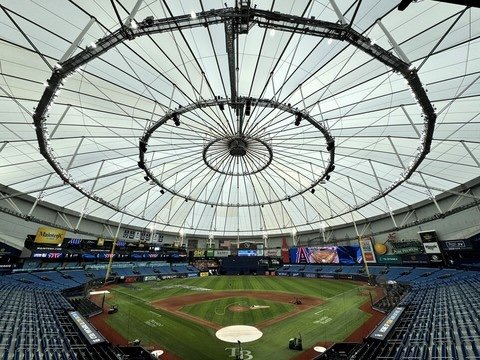
Glass fiber yarn manufactured in Aiken, South Carolina, forms the reinforcement base of a high-performance composite membrane designed to improve the Florida stadium’s durability and weather resistance.
AGY, a manufacturer of advanced specialty glass fibers, has supplied the glass fiber yarn used as the base reinforcement for the new permanent roof at Tropicana Field in St. Petersburg, Florida. The yarn reinforces Serge Ferrari Group’s Tenseo Xtrem GF 7000 composite membrane, which covers approximately 485,000 square feet and is designed to withstand demanding weather and structural conditions.
New Roof Replaces Hurricane-Damaged Membrane
On October 14, 2026, AGY announced that its glass fiber yarn, manufactured in Aiken, South Carolina, forms the structural foundation of the composite membrane installed at Tropicana Field. The new roof replaces the stadium’s previous membrane, which was destroyed by Hurricane Milton in October 2024.
The replacement roof enabled the Tampa Bay Rays to return to Tropicana Field for the opening of the 2026 Major League Baseball season.
The roof comprises 24 translucent composite membrane panels covering approximately 45,000 square metres, equivalent to nearly 485,000 square feet. Each panel measures approximately 330 feet in length and weighs around 5,000 pounds (2,268 kilograms).
Glass Fiber Yarn Supports Structural Performance
The roof membrane uses Serge Ferrari Group’s Tenseo Xtrem GF 7000, a high-performance architectural material made from woven glass fiber fabric coated with polytetrafluoroethylene (PTFE). The material is subsequently sealed with Serge Ferrari’s Pro Shield Max fluorinated ethylene propylene (FEP) surface treatment.
AGY’s specialty glass fiber yarn provides the reinforcement for the woven fabric, contributing to the strength, dimensional stability and durability required for large-scale permanent tensile structures.
“We are proud that AGY glass fiber yarn was selected as the base reinforcement for the Tenseo Xtrem GF 7000 membrane used in this landmark project,” said Patrick Hunter, Chief Commercial Officer and President of AGY.
“The Tropicana Field roof demonstrates how advanced glass fiber yarns enable composite systems that must perform reliably under demanding structural, environmental and weather conditions.”
Accelerated Manufacturing and Installation Schedule
The project required a compressed engineering, manufacturing and installation schedule. While a permanent roof of this scale could normally take several years to complete, the final membrane panel was secured in November 2025, ahead of schedule.
Final stretching and sealing operations continued into early December, allowing interior stadium renovations to progress in preparation for the Tampa Bay Rays’ return.
The membrane material was manufactured at Serge Ferrari Group’s facility in Germany before being shipped to Enclos Tensile Structures for fabrication and assembly.
During production, Serge Ferrari wove the glass fiber yarn into fabric, applied the PTFE coating and sealed the material using its specialised FEP surface treatment. The finished membrane provides waterproofing, durability and long-term aesthetic performance. Its surface also allows rainwater to naturally remove dirt over time.
Modernised Design for Weather Resistance
Although the new roof has a visual appearance similar to that of the original, its engineering has been updated to address stronger winds, severe storms and revised safety requirements.
The completed membrane roof has an expected service life exceeding 20 years. Its design aims to improve the stadium’s resilience while reducing long-term maintenance requirements.
Commenting on AGY’s contribution, Hunter added: “This project highlights the essential role specialty glass fiber yarn plays in the performance of advanced architectural composites. We are pleased that glass fiber yarn manufactured by AGY in Aiken, South Carolina, is part of a structure that will protect the stadium, its players and its fans for years to come.”
The Tropicana Field project demonstrates the application of specialty glass fiber yarn in architectural composite systems, where reinforcement materials contribute to the structural performance and durability of large-scale roofing membranes.