
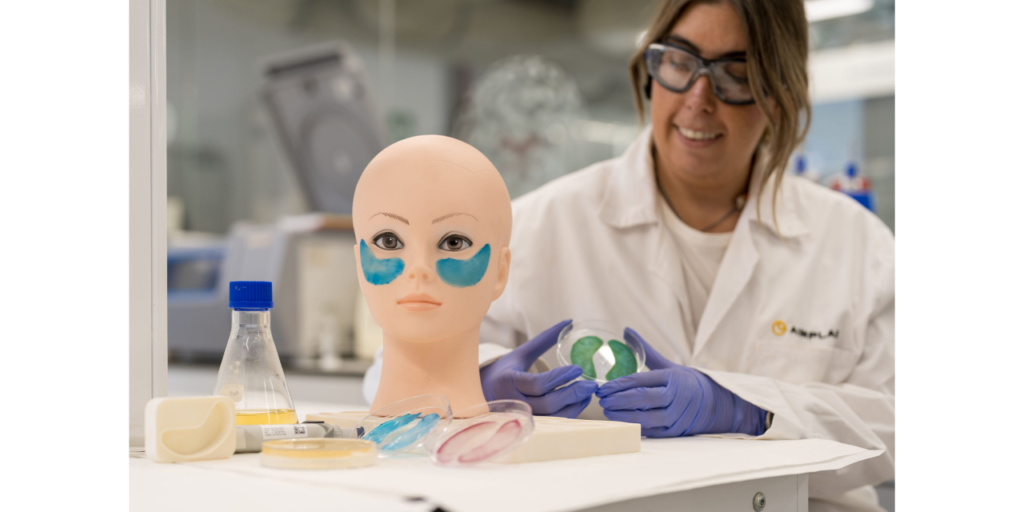
Spain’s Aimplas Plastics Technology Centre is researching the use of bacterial cellulose to develop biodegradable cosmetic facial masks. The material’s high water-retention capacity, flexibility and biocompatibility could also make it suitable for medical applications.
Unlike conventional cellulose, which comes from plants, bacterial cellulose is produced by microorganisms through fermentation. Certain bacteria, particularly those belonging to the Komagataeibacter genus, produce a three-dimensional network of fine cellulose nanofibrils as they grow.
These microorganisms are commonly associated with fermentation processes used to make vinegar, kombucha and nata de coco.
The resulting material can absorb and retain large quantities of water. It is also flexible enough to adapt closely to the contours of the skin.
Aimplas is studying these properties to develop bio-based hydrogel facial masks. The masks could carry active skincare ingredients to support skin hydration and recovery following sun exposure.
“Bacterial cellulose has very interesting properties for the development of more sustainable, high-performance cosmetic products,” says María José de Manuel, biotechnology researcher at Aimplas.
“Its extraordinary water-retention capacity, together with its flexibility and ability to adapt to the skin, make it an ideal material for facial masks and as a support for incorporating cosmetic active ingredients.”
Potential Applications Beyond Cosmetics
Bacterial cellulose could also support the development of new medical materials, particularly for wound management.
Its biocompatibility and nanoporous structure can help maintain a moist environment. The material can also act as a carrier for therapeutic compounds.
Potential applications include dressings for burns, chronic wounds and ulcers. Researchers are also examining patches that can release active ingredients in a controlled manner.
In addition, bacterial cellulose could serve as a supporting material for tissue regeneration.
Production and Material Advantages
Bacterial cellulose differs from plant-derived cellulose in its composition and production.
Plant cellulose is generally associated with lignin and hemicellulose, which are components of plant cell walls. Bacterial cellulose does not contain these materials, reducing the need for additional purification processes.
Its production through fermentation also provides a way to manufacture cellulose without directly depending on forestry resources. However, the overall environmental benefits will depend on production methods, resource consumption and process efficiency.
For the cosmetics industry, bacterial cellulose could offer a biodegradable alternative to conventional sheet masks made with synthetic fibres.
Its ability to retain water and conform to the skin may provide additional functional benefits for skincare applications.
Aimplas Advances Research into Bio-Based Materials
Aimplas is continuing to investigate bacterial cellulose as part of its wider research into advanced bio-based materials.
The work covers potential applications in cosmetics, healthcare and biotechnology. By exploring microbial production processes and material performance, the research aims to identify new uses for cellulose-based materials in these sectors.
Source: Aimplas