
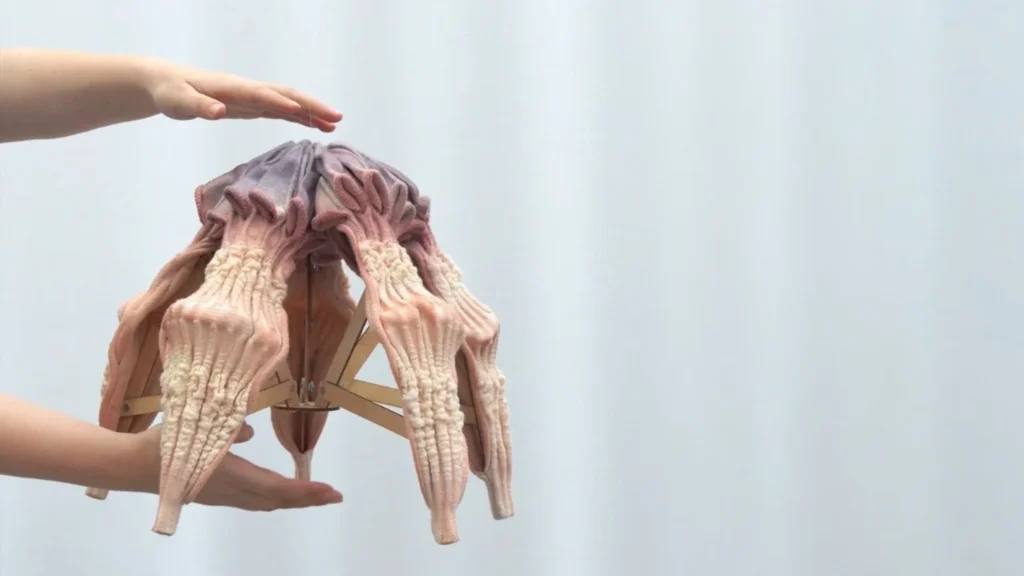
Designer Katrijn Westland combines knitted fabrics, sensors and soft robotics to create textile companions that respond to touch, movement, warmth and light.
Can textiles offer more than comfort and decoration? Designer Katrijn Westland explores this idea through Soft Companions, a collection of interactive textile forms presented at Dutch Design Week 2026.
The project brings together textile design, soft robotics and sensory interaction. Its creature-like forms can breathe, move, produce warmth and light, and respond to human touch. Through these features, Westland explores how textiles can encourage connection and create new experiences of care.
Turning Everyday Textiles into Interactive Forms
Textiles are commonly used in homes and public spaces as curtains, upholstery, blankets and other interior materials. Most serve a practical or decorative purpose.
Westland takes a different approach with Soft Companions. She combines naturally dyed knitted fabrics with electronic textiles, sensors, pneumatic systems and soft mechanical components. These technologies allow the textile forms to respond to their surroundings.
The companions can slowly inflate and deflate, creating breathing-like movements. Some respond to touch and grooming through gentle vibrations or movement. Others produce warmth or turn towards a light source.
Their movements can also follow the rhythm of human breathing. This creates an interaction that develops gradually through physical contact.
The designs do not use cartoon-like faces or exaggerated features. Instead, they have abstract shapes and irregular knitted surfaces. This keeps the focus on the texture and natural appearance of the materials.
Touch and Movement Create Sensory Interaction
The experience of interacting with Soft Companions is designed to be slow and gentle. Users do not need to operate them through a series of commands.
A touch may trigger a soft vibration, similar to purring. Holding one of the breathing forms can help users become aware of their own breathing rhythm. The companions are designed to encourage continued interaction rather than demand constant attention.
Westland’s background as a nurse has influenced the project’s approach to care. The work focuses on simple actions such as touching, grooming and soothing.
It also explores how these actions can create a sense of connection between people and materials. The user interacts with the textile form, which responds through movement, warmth or vibration.
This approach could be relevant to homes, healthcare facilities and shared public spaces. In these settings, responsive textile objects may offer additional opportunities for sensory interaction.
How Responsive Textiles Can Shape Interior Spaces
Soft Companions also explores a new role for textiles in architecture and interior design.
Knitted fabrics are often used as surface coverings or comfort materials. In this project, they become interactive elements that can influence how people experience a space.
The combination of natural dyes and responsive technology brings together traditional textile qualities and modern systems. The knitted structures provide the soft surfaces, while sensors and pneumatic components enable movement and other responses.
The companions are larger than personal accessories but smaller than furniture. They can rest on a person’s lap, sit across a shoulder or be placed in a corner of a room.
Their ability to respond to light and nearby interaction gives them a changing presence within an interior. The project also considers how such forms could be used in residential spaces and care facilities.
Exploring Care Through Material Interaction
A key idea behind Soft Companions is that care can be a two-way experience.
Rather than treating textiles as passive materials, Westland presents them as forms that invite attention and respond to human interaction. Touch, temperature, movement and rhythm become important parts of this exchange.
The project explores how people might experience connection through interaction with non-human forms. It does not suggest replacing human relationships. Instead, it considers how companionship can extend beyond traditional forms of communication.
The materials also play an important role in this experience. Their irregular knitted surfaces, variations in natural dyes and gentle movements give the companions an organic appearance.
This approach differs from the polished look often associated with smart devices. It places greater emphasis on touch, material character and physical presence.
A Softer Direction for Responsive Design
Responsive environments, biophilic design and the relationship between people and materials are receiving growing attention in architecture and design. Soft Companions approaches these themes through fabric.
Instead of placing technology only in walls, ceilings or conventional electronic devices, Westland integrates responsive systems into knitted textiles. This allows a familiar material to take on new functions.
The project raises questions about how textiles can contribute to spaces designed around sensory experiences and care. It also shows how soft materials can combine traditional textile techniques with emerging technologies.
Through Soft Companions, Katrijn Westland explores the potential of textiles beyond their conventional uses. The project presents fabric as an interactive medium that can encourage touch, movement and a different understanding of companionship.