
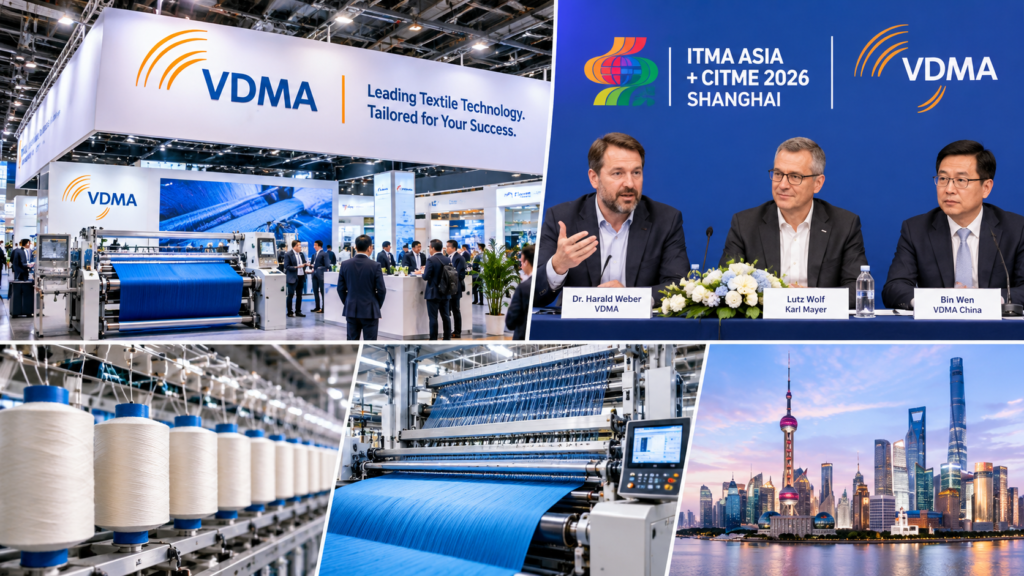
More than 40 German exhibitors will showcase textile machinery and technology across over 2,100 square metres in Shanghai, with a focus on automation, digitalisation, spinning, nonwovens and sustainable production.
The German textile machinery industry is highlighting its technological capabilities and business outlook at ITMA ASIA + CITME 2026 in Shanghai, China. During its press conference on 20 November 2026, the German Engineering Federation (VDMA) presented its latest economic survey, industry trends and the participation of German machinery manufacturers at the exhibition. The presentation also highlighted developments in automation, digital manufacturing, textile recycling and advanced machinery solutions, alongside the industry’s outlook for China and other international markets.
The German Engineering Federation (VDMA) has highlighted the strength of Germany’s textile machinery industry at ITMA ASIA + CITME 2026, showcasing its technological capabilities, market developments and business expectations.
According to the VDMA presentation, more than 40 German exhibitors are participating in the exhibition across over 2,100 square metres. Germany is the largest foreign exhibiting country by exhibition floor space. Additional VDMA member companies are also participating through their Chinese subsidiaries.
The German exhibitors represent a broad range of textile machinery segments, including spinning, man-made fibre production, nonwovens, weaving, braiding, knitting and hosiery, finishing and dyeing. Technologies for textile recycling and the processing of recycled materials are also part of the showcase.
The VDMA press conference featured Dr Harald Weber, Managing Director of VDMA Textile Machinery, and Lutz Wolf, CEO of Karl Mayer. Their presentations covered the economic situation, business expectations, technological developments and the importance of the Chinese market.
VDMA Economic Survey Highlights Industry Challenges
The VDMA’s third-quarter 2026 economic survey presented a mixed picture of the German textile machinery industry’s business situation.
According to the survey, 64% of respondents rated their current business situation as bad, while 22% considered it satisfactory and 12% described it as good. The remaining responses included very bad and very good assessments.
However, expectations for future business development were more encouraging. Around 64% of respondents expected conditions to remain unchanged, while 26% anticipated improvement. Only 6% expected a deterioration.
These findings indicate that although companies continue to face difficult business conditions, expectations for the coming period remain relatively stable.
China Business Climate Shows Signs of Improvement
The VDMA Business Climate Survey for China, conducted in autumn 2026, showed an improvement compared with spring 2026.
In spring, 33% of companies described the business situation as bad, 40% rated it satisfactory and 27% considered it good.
By autumn, the share of companies reporting bad business conditions had declined to 14%. Meanwhile, 64% described the situation as satisfactory and 21% rated it good.
Business expectations for the following six months also remained stable.
The autumn survey showed that 43% of companies expected business conditions to improve, while another 43% anticipated no significant change. Only 14% expected conditions to worsen.
The findings suggest greater confidence among German textile machinery companies operating in China.
Germany’s Textile Machinery Exports Reach €1.9 Billion
The VDMA presentation also highlighted Germany’s international textile machinery trade.
Germany’s textile machinery exports reached approximately €1.9 billion in 2025. The presentation identified China as an important destination for German machinery exports.
Exports to China amounted to approximately €538 million, representing 29% of Germany’s total textile machinery exports. This was equivalent to 24% of China’s textile machinery imports, excluding the additional production of German companies operating in China.
The figures underline the importance of the Chinese market for German textile machinery manufacturers and their international business operations.
German Manufacturers Focus on Customer-Specific Technology Solutions
The VDMA highlighted a shared approach among its members: developing machinery and technology solutions that address customers’ specific production requirements.
The industry’s approach focuses on three major areas:
-
Customer-focused engineering: Developing customised machinery and solutions that meet individual manufacturing requirements.
-
Lifecycle support: Providing support throughout the machinery lifecycle, from product development and installation to on-site services.
-
Automation and digitalisation: Combining engineering expertise with advanced automation and digital technologies to improve process stability, productivity and resource efficiency.
These priorities reflect the industry’s focus on delivering efficient and sustainable manufacturing solutions.
Karl Mayer Presents Its Technology Programme at ITMA ASIA 2026
Karl Mayer, a leading textile machinery manufacturer and VDMA member, presented its innovation strategy and exhibition programme at ITMA ASIA 2026.
The company’s showcase covers warp knitting and warp preparation technologies, alongside new developments in textile applications.
Its exhibition programme includes:
-
Two warp knitting machines in Hall 4, Booth C18.
-
One warp preparation machine in Hall 3, Booth A24.
-
Eight additional machines presented through a product show at Karl Mayer China in Changzhou, Jiangsu.
The exhibition highlights include two new tricot machines designed to improve production flexibility and productivity.
Karl Mayer is also presenting textile innovations involving natural fibres and its WovenLike collection. Another highlight is the latest-generation WARPDIRECT system, featuring an advanced sizing solution.
Karl Mayer Strengthens Its Position in China
China continues to play an important role in Karl Mayer’s global business strategy.
The company has maintained operations in China since 1995. Its local presence includes approximately 750 employees and a production and development site covering 175,000 square metres.
Karl Mayer’s operations in the country also include a Textile Innovation Center (TIC), supporting product development and textile innovation.
The company’s continued investment in China reflects the importance of being close to customers and responding to regional manufacturing requirements.
Automation and Digitalisation Transform Textile Manufacturing
The VDMA presentation also highlighted examples of technological developments across different textile machinery segments.
Man-Made Fibre Production
Advanced automation is helping manufacturers improve production speed, consistency and resource efficiency.
Key developments include fully automated string-up systems that reduce start-up times and operator intervention. Automation also helps minimise material waste, improve productivity and reduce dependence on skilled labour for repetitive operations.
Spinning Preparation
Automated material handling is becoming increasingly important in spinning mills.
Automation solutions can manage sliver transportation throughout the spinning preparation process, ensuring reliable material distribution and reducing manual handling.
These systems support continuous production, minimise downtime and improve overall operational efficiency.
Finishing and Dyeing
Automation and real-time process control are helping textile manufacturers improve finishing and dyeing operations.
Intelligent monitoring systems support consistent product quality and allow production parameters to be adjusted automatically.
Connected production systems and digital technologies can also reduce waste, improve productivity and support more responsible energy consumption.
ITMA 2027: German Textile Machinery Industry Looks Ahead
The VDMA also presented its outlook for ITMA 2027, scheduled to take place from 16–22 September 2027 in Hannover, Germany.
Almost 200 exhibitors from Germany are expected to participate and present their latest technological developments.
The organisation is also planning a special delegation programme ahead of the exhibition. The programme will include visits to leading technology providers and research institutes.
In addition, the ITMA Party will provide an opportunity for international industry participants to connect and strengthen business relationships.
Strengthening Global Textile Machinery Partnerships
The VDMA’s participation at ITMA ASIA + CITME 2026 reflects the importance of international cooperation in advancing textile manufacturing technology.
German machinery manufacturers are focusing on customised engineering, automation, digitalisation and sustainable production to address changing industry requirements.
The business survey also indicates that while the global textile machinery sector continues to face challenges, expectations in China have improved compared with spring 2026.
With strong participation at ITMA ASIA + CITME 2026 and preparations underway for ITMA 2027 in Hannover, the German textile machinery industry continues to strengthen its engagement with global manufacturers and technology partners.