
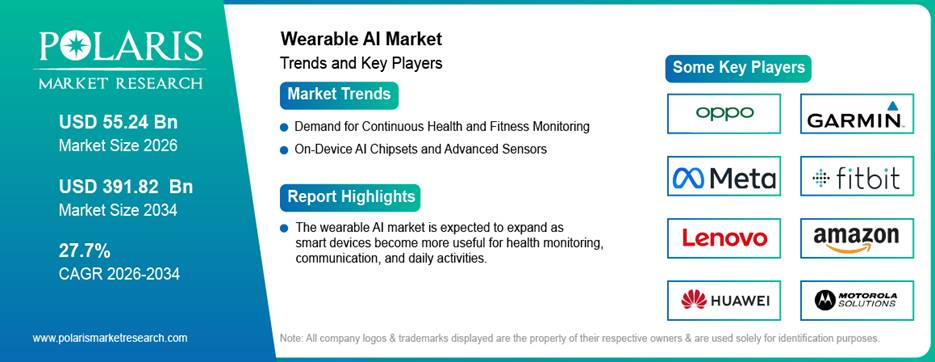
Rising demand for intelligent health monitoring, AI-powered smartwatches and connected devices is driving growth in the global wearable technology industry.
Artificial intelligence is changing how consumers use wearable technology. Smartwatches, fitness bands, smart glasses and AI-powered earbuds are evolving beyond basic tracking functions to offer personalised insights and intelligent features. According to Polaris Market Research, the global wearable AI market is projected to reach USD 391.82 billion by 2034, supported by growing demand for health monitoring, fitness management and connected devices.
Global Wearable AI Market Set for Strong Growth
According to Polaris Market Research, the global wearable AI market was valued at USD 43.33 billion in 2025. The market is expected to grow from USD 55.24 billion in 2026 to USD 391.82 billion by 2034, registering a compound annual growth rate (CAGR) of 27.7% during the forecast period.
The growth reflects the increasing adoption of artificial intelligence across consumer electronics, healthcare applications and connected devices. Wearable products are becoming more intelligent by combining sensors, data processing and AI-powered features to deliver personalised user experiences.
Demand for AI-Powered Health and Fitness Monitoring Increases
Health and fitness monitoring is one of the major factors supporting the growth of the wearable AI market.
Consumers are increasingly using smart devices to monitor heart rate, sleep quality, physical activity, body temperature and other health indicators. AI-powered algorithms analyse this information to identify patterns and generate personalised recommendations.
Smartwatches and smart rings are gaining popularity because they offer convenient access to daily health and activity information. Their features include sleep reports, workout recommendations and alerts about unusual changes in selected health indicators.
Healthcare providers are also exploring wearable AI solutions for remote patient monitoring. These technologies can help medical professionals access relevant patient information beyond traditional clinical settings.
AI and Sensor Innovations Expand Wearable Capabilities
Advancements in artificial intelligence, sensor technology and semiconductors are improving the performance of wearable devices.
Advanced processors and neural processing units allow wearable products to handle AI-related tasks while maintaining compact designs and efficient power consumption.
On-device AI is another important development. It enables wearables to process certain information locally instead of depending entirely on cloud-based systems. This can improve response times, reduce connectivity requirements and support data privacy.
According to Polaris Market Research, the on-device AI segment accounted for 59.18% of the global wearable AI market share in 2025.
Generative AI is also creating new opportunities for wearable technology. Voice assistants, real-time language translation, personalised recommendations and conversational interfaces are making devices more interactive.
AI-powered smart glasses and earbuds are emerging as important product categories, offering users hands-free access to digital information.
Smartwatches Lead While Smart Earwear Gains Momentum
Smartwatches held a significant share of the wearable AI market, accounting for 27.62% in 2025.
Their popularity is supported by multiple functions, including fitness tracking, health monitoring, smartphone notifications and wireless connectivity.
Meanwhile, the smart earwear segment is projected to register a CAGR of 26.94% during the forecast period.
Growing demand for intelligent audio features, voice assistance, noise reduction and real-time translation is supporting this segment’s expansion.
These developments indicate that AI integration is creating opportunities beyond traditional wearable products, encouraging manufacturers to explore new applications and product designs.
Asia Pacific Expected to Record Strong Market Growth
Asia Pacific is projected to register a CAGR of 28.34% between 2026 and 2034, making it an important region for the wearable AI industry.
Rising smartphone penetration, increasing disposable incomes, expanding electronics manufacturing and growing awareness of digital healthcare are supporting regional demand.
China, Japan, South Korea and India are among the countries contributing to the adoption of AI-enabled wearable devices.
In India, increasing consumer interest in affordable smartwatches, fitness monitoring and connected healthcare solutions is creating additional opportunities for manufacturers and technology providers.
Data Privacy and Device Performance Remain Key Challenges
Despite its growth potential, the wearable AI market faces several challenges.
Data privacy, cybersecurity, battery life, sensor accuracy and device affordability remain important considerations for manufacturers and consumers.
The reliability of health-related information is particularly important when wearable devices are used for healthcare applications. Accurate sensors and appropriate validation are necessary to ensure that the information provided is dependable.
Manufacturers are expected to focus on improving sensor accuracy, developing energy-efficient processors and introducing more personalised AI capabilities.
Seamless integration with other connected devices, strategic partnerships and continued product innovation will also influence the industry’s competitive landscape.
Wearable AI Market Outlook
The wearable AI market is entering a period of significant expansion as artificial intelligence becomes increasingly integrated into everyday devices.
Growing applications in healthcare, consumer electronics, fitness and workplace safety are creating new opportunities for technology developers and manufacturers.
With continued improvements in AI processing, sensor technology and device connectivity, intelligent wearables are expected to become an increasingly important part of connected living.