
Engineered textile structures are combining protection, comfort, filtration and smart functionality for healthcare applications
Medical and protective clothing has evolved from basic fabric barriers into engineered textile systems designed to manage fluids, microorganisms, particles, heat, moisture and mechanical stress. Surgical gowns, isolation gowns, protective coveralls, masks and surgical drapes increasingly rely on specialised fibres, nonwoven structures, coatings, membranes and functional finishes to deliver application-specific performance.
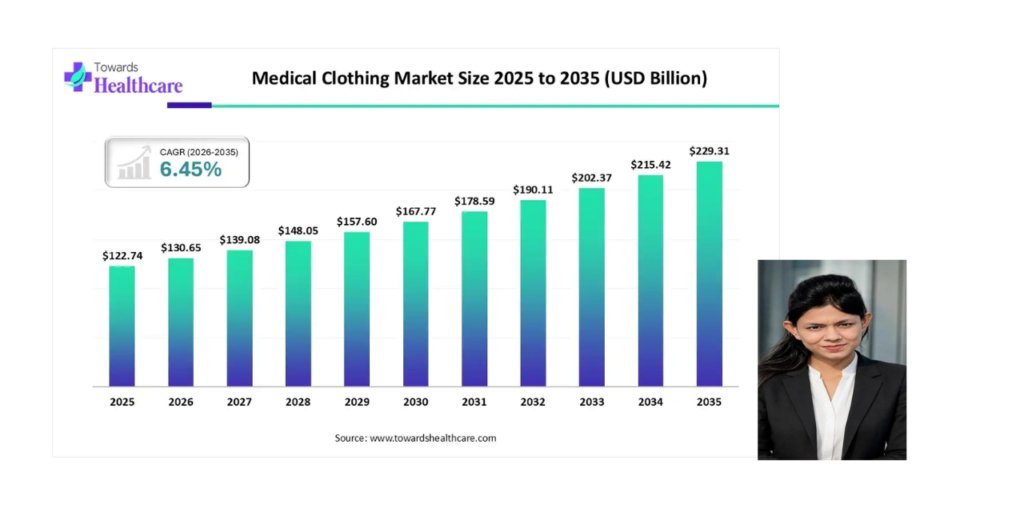
According to Towards Healthcare Research and Consulting, the global medical clothing market was estimated at USD 122.74 billion in 2025 and is projected to grow from USD 130.65 billion in 2026 to approximately USD 229.31 billion by 2035, representing a CAGR of 6.45% from 2026 to 2035.
What Makes a Textile High-Performance?
High-performance textiles are engineered to provide properties that conventional fabrics may not consistently deliver. Their performance depends on factors including fibre type, fabric construction, pore structure, coatings, finishing processes and the number of material layers.
Materials such as polypropylene, polyester and polyethylene, along with specialty fibres, are widely used in medical applications. Nonwoven structures are particularly important because manufacturers can control fibre arrangement, basis weight, thickness, pore structure and filtration characteristics.
For protective clothing, important performance parameters include:
- Liquid penetration resistance
- Tensile strength
- Tear resistance
- Abrasion resistance
- Air permeability
- Moisture-vapour transmission
The required combination varies according to the application. A surgical gown used during a procedure may require different barrier and breathability characteristics from an isolation gown or protective coverall.
Multilayer Structures Improve Protection
One of the key developments in medical and protective textiles is the use of multilayer structures. Rather than requiring one fabric to perform every function, individual layers can be engineered for filtration, strength, fluid resistance and wearer comfort.
Nonwoven technologies such as spunbond and meltblown play an important role in these structures. Spunbond layers can provide strength and structural support, while meltblown layers use very fine fibres to enhance filtration performance.
The widely used SMS (spunbond-meltblown-spunbond) structure combines these characteristics in a lightweight construction and is used in applications including masks, surgical gowns, drapes and other disposable medical products.
Balancing Protection and Comfort
Protection is only one consideration when designing medical clothing. Garments worn for extended periods also need to manage heat, moisture and air movement.
High resistance to liquids can restrict airflow and increase heat and moisture accumulation inside a garment. This has increased interest in breathable protective materials and microporous membranes, which can restrict liquid penetration while allowing water vapour to pass through.
For healthcare workers wearing protective clothing for several hours, balancing barrier performance, air permeability and moisture management is therefore an important aspect of textile design.
Antimicrobial and Functional Textiles
Functional finishes can provide medical textiles with properties beyond basic physical protection.
Antimicrobial treatments can be designed to inhibit or reduce microbial growth on textile surfaces, depending on the active technology and intended application. Other treatments can provide properties such as:
- Water repellency
- Oil resistance
- Antistatic performance
- Flame resistance
- Improved durability
Functional performance also needs to be considered throughout a product’s lifecycle. Manufacturers need to assess durability following washing or sterilisation, compatibility with the textile, potential skin exposure, environmental considerations and applicable regulatory requirements.
Smart Textiles Bring Electronics into Medical Clothing
Another area of development is the integration of electronic functionality into textile structures.
Conductive fibres, flexible sensors, printed electronics and electronic components can be incorporated into garments to collect physiological information. Depending on the design, smart garments can potentially monitor parameters such as heart rate, respiratory activity, body temperature and movement.
These technologies are creating opportunities for medical clothing to combine physical protection with data collection. Connected garments could find applications in areas such as remote patient monitoring, rehabilitation and elderly care.
Applications of High-Performance Medical Textiles
High-performance textile technologies are being applied across a range of healthcare and protective products:
- Protective apparel: Engineered barriers for surgical and isolation environments.
- Medical masks: Specialised fibre structures supporting particle filtration and airflow.
- Surgical drapes: Materials designed to help control fluid penetration during clinical procedures.
- Wound-care products: Textile structures supporting absorbency, protection and controlled interaction with wounds.
- Smart garments: Integration of sensors and conductive materials for physiological monitoring.
- Reusable medical clothing: Durable structures designed to withstand repeated cleaning and sterilisation.
Key Advantages
High-performance textiles offer several potential advantages for medical and protective clothing:
Better protection: Engineered structures can provide resistance to fluids, particles and contaminants.
Lightweight design: Advanced fibres and nonwoven technologies can provide functionality without excessive garment weight.
Improved durability: High-performance materials can provide enhanced tensile, tear and abrasion resistance.
Application-specific engineering: Textile structures can be developed around the protection requirements of different healthcare environments.
Greater comfort: Breathable structures and moisture management can help reduce heat and humidity during extended wear.
Smart functionality: Sensors and conductive materials can introduce monitoring capabilities into medical clothing.
Challenges for Medical and Protective Textiles
Despite their performance advantages, advanced medical textiles face several challenges.
Manufacturing complexity: Multilayer fabrics, membranes, coatings and specialised finishes require tighter process control.
Material costs: Advanced fibres and functional technologies can increase production costs.
Healthcare waste: Large-scale use of disposable medical textiles contributes to healthcare waste volumes.
Recycling challenges: Laminated and chemically treated materials can be difficult to separate and recycle.
Performance trade-offs: Increasing filtration or fluid resistance can sometimes reduce breathability.
Sterilisation requirements: Reusable products must maintain their performance after repeated cleaning and sterilisation cycles.
Regulatory considerations: Medical textile products must meet applicable safety, performance and product-specific requirements.
Future Direction of Medical Clothing
The development of medical clothing is increasingly focused on multifunctional textile systems that combine protection, comfort, sensing and sustainability.
Research and product development are exploring recyclable and bio-based fibres, breathable protective membranes, advanced antimicrobial technologies, sensor-integrated fabrics and textile structures designed for improved end-of-life management.
High-performance textiles are consequently becoming an important link between traditional textile engineering and healthcare technology. The focus is moving beyond basic protection towards textile materials engineered for specific functions while remaining practical, comfortable and suitable for increasingly connected healthcare environments