
Construction Textiles (Buildtech) have emerged as a critical segment within the technical textiles industry, playing an increasingly important role in modern construction, infrastructure development, and civil engineering. As a specialized and rapidly evolving domain of technical textiles, Buildtech encompasses a wide range of applications across buildings, roads, bridges, tunnels, railways, airports, dams, drainage systems, and other infrastructure projects. By providing enhanced strength, durability, reinforcement, filtration, separation, waterproofing, insulation, and protection, construction textiles contribute significantly to improving structural performance, extending service life, reducing maintenance requirements, and enhancing the overall efficiency of infrastructure.
With the growing emphasis on resilient and sustainable infrastructure, Buildtech is witnessing continuous advancements in material science, geosynthetic technologies, high-performance fibres, composite materials, and innovative textile-based construction solutions. These developments are enabling the industry to address complex engineering requirements while supporting faster, safer, and more resource-efficient construction practices. Today, the sector offers a diverse portfolio of advanced products, including architectural membranes, roofing and waterproofing textiles, concrete textiles, reinforcement fabrics, insulation materials, and other functional textile solutions used across a wide range of construction and infrastructure applications.
The growing scale of infrastructure development in India, driven by investments in roads, highways, railways, urban infrastructure, housing, water management, and other major projects, is creating significant opportunities for the Construction Textiles (Buildtech) sector. The increasing adoption of geosynthetics and other technical textile solutions is also transforming conventional construction practices by offering improved performance, cost efficiency, resource conservation, and longer infrastructure life. At the same time, the sector presents considerable potential for domestic manufacturing, technology development, import substitution, and the creation of globally competitive Indian products.
As India continues to expand and modernize its infrastructure, the demand for high-performance construction textiles is expected to grow significantly. The integration of sustainable materials, recycled inputs, circular economy principles, and advanced manufacturing technologies is further opening new avenues for innovation. Buildtech is therefore positioned not only as an important contributor to the construction industry but also as a key enabler of climate-resilient, resource-efficient, and future-ready infrastructure. The Construction Textiles (Buildtech) market in India was valued at INR 5532 crores in 2021 and is projected to reach INR 9102 crores by FY 2025-26, reflecting a robust compound annual growth rate (CAGR) of 10.47%. India’s Construction Textile exports were valued at INR 268 crores in FY 2026-27 (up to May ’27), accounting for approximately 4.1% of total Technical Textile exports. Meanwhile, imports stood at INR 380 crores, representing around 7.8% of total Technical Textile imports. These figures highlight a critical phase for India’s Buildtech sector. While domestic consumption is expanding rapidly alongside the country’s growing construction industry, the high volume of imports indicates continued dependence on foreign high-performance materials. This trade imbalance underscores the urgent need for import substitution and presents significant opportunities for strengthening domestic manufacturing capabilities.
In this edition, we take a closer look at the diverse product segments shaping the Buildtech sector, exploring breakthrough innovations, evolving construction requirements, and emerging market dynamics. We examine how Construction Textiles are transforming traditional approaches to infrastructure development while addressing challenges related to durability, sustainability, cost efficiency, resource optimization, and stringent performance requirements.
To gain deeper insights into current market trends, growth opportunities, technological advancements, investment potential, and challenges in the Construction Textiles sector, we interviewed some of the leading manufacturers and industry experts in the field – Nobletex Industries Ltd., Shreeram Nets Pvt. Ltd., and Garware Technical Fibres Ltd.
Their valuable perspectives provide a comprehensive view of the industry’s evolving landscape and aim to inspire stakeholders, manufacturers, technology providers, and entrepreneurs to explore and invest in the growing Construction Textiles (Buildtech) domain.
A. AWNINGS AND CANOPIES

Shri. Paresh Chaudhary
Managing Director
Nobletex Industries Ltd.
What is the current market size and estimated CAGR of Awnings and Canopies in India and globally, and is there a demand-supply gap in India? If yes, how much is imported?
The awnings & canopies segment continues to be a niche but steadily growing category within the Buildtech technical textile sector in India. Growth is being driven by commercial buildings, hospitality, retail, institutional projects, outdoor recreational spaces and premium residential developments. From our experience, the demand is gradually shifting from price-driven products towards higher performance fabrics offering superior UV resistance, weatherability, colour retention and longer service life. Although the basic coated fabric requirements can largely be met domestically, a significant share of premium outdoor fabrics continues to be imported, particularly where long warranties and stringent international performance specifications are required. This presents a strong opportunity for Indian manufacturers to develop high-value import substitutes and strengthen domestic capabilities.
What are the primary raw materials used in manufacturing Awnings and Canopies in India? Are they produced in India, or are many of them imported & at what cost?
The primary materials used include high-tenacity polyester woven fabrics, PVC-coated polyester fabrics, PU-coated polyester fabrics for lightweight applications, solution-dyed acrylic fabrics, PVDF or acrylic lacquer top-coated PVC fabrics, and PTFE-coated glass fibre fabrics for specialised architectural applications. India has a well-established supply chain for polyester base fabrics, PVC resins, plasticisers and most coating chemicals. However, premium solution-dyed acrylic fabrics, PTFE-coated fabrics and certain speciality top-coated outdoor fabrics are still largely dependent on imports. The industry has an opportunity to develop indigenous premium coated fabrics with improved UV stability, anti-fungal performance, stain resistance and extended outdoor durability, thereby reducing dependence on imports while enhancing export competitiveness.
What are the recent innovative trends in this product segment, and are any of these niche or innovative products being exported?
Recent innovation is increasingly focused on enhancing fabric performance, sustainability, and service life rather than only structural design. Key developments include improved UV-resistant PVC-coated fabrics, PVDF and acrylic lacquer top coatings for better cleanability and colour retention, solution-dyed outdoor fabrics, low-VOC and phthalate-free coating systems, recycled polyester-based coated fabrics, anti-fungal and anti-microbial finishes, and digitally printable coated fabrics for customised branding. Export demand is primarily for premium coated fabrics that consistently meet international requirements for weather resistance, colour fastness, dimensional stability, and long-term outdoor performance. Indian manufacturers with robust quality systems have a good opportunity to increase their presence in these specialised markets.
Are all required IS standards available in this product segment? If not, please mention the Standards that you want BIS to develop.
While BIS has established several standards covering textile test methods, there is scope to develop product-specific standards for coated outdoor fabrics used in awnings and canopies. Industry would benefit from standards covering UV weathering performance, colour fastness after prolonged outdoor exposure, waterproofness, fungal and mildew resistance, and classification based on expected outdoor service life.
Are all critical testing facilities available in Indian Labs?
Most routine textile testing facilities are available in India through NABL-accredited laboratories and textile research associations for tensile strength, tear strength, coating adhesion, waterproofness, colour fastness and flame retardancy. However, specialised facilities for long-term accelerated weathering, outdoor exposure validation, and certification of premium architectural outdoor fabrics remain relatively limited. Strengthening these capabilities within India would reduce dependence on overseas laboratories, accelerate product development and improve the global competitiveness of Indian coated technical fabric manufacturers.
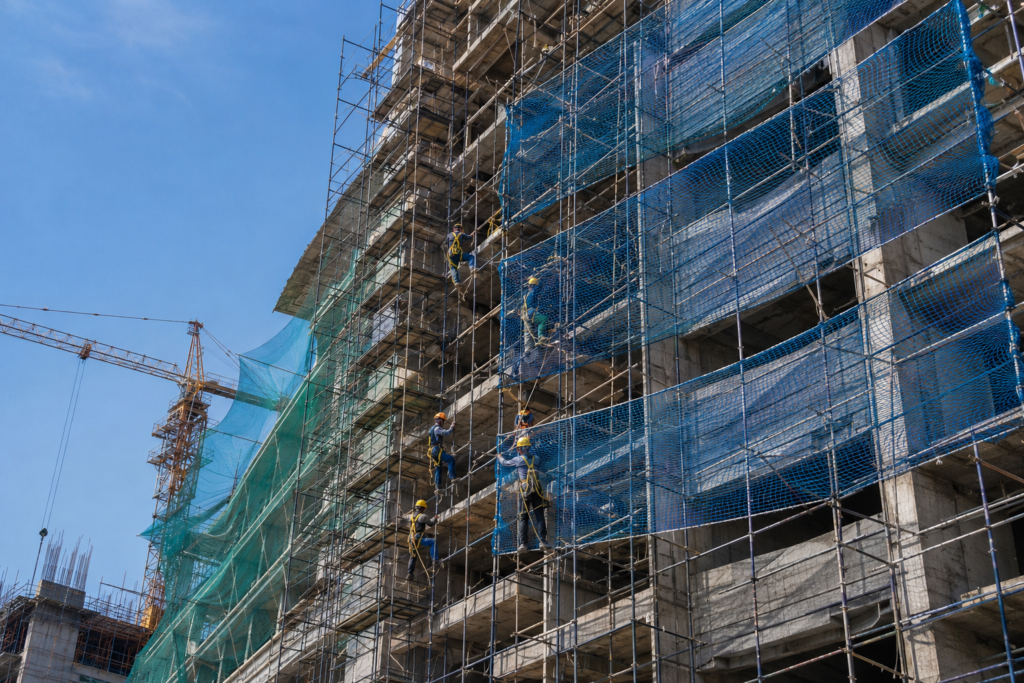
B. SCAFFOLDING NETS

Shri. Abhishek Gupta
Director
Shreeram Nets Pvt. Ltd.
What is the current market size and estimated CAGR of Scaffolding Nets in India and globally, and is there a demand-supply gap in India? If yes, how much is imported?
India’s Market size is good & is growing rapidly, as today realtors are benefiting from nettings; usage is increasing. Technical understanding is going higher in users, but the right Indian standards need to be introduced to maintain standards amongst manufacturers. Indian market would be approx. 2000 – 3000 crores annually & is increasing. Currently, India doesn’t import scaffolding nets as India is producing more than consumption; in fact, India is exporting good qty’s all over the world.
What are the primary raw materials used in manufacturing Scaffolding Nets in India? Are they produced in India, or are many of them imported & at what cost?
HDPE is mainly used to produce scaffolding nets & raw material is produced by Indian producers like Reliance, Haldia, GAIL, etc. There is also imported materials as well, but majorly Indian demand is fulfilled by Indian producers.
What are the recent innovative trends in this product segment, and are any of these niche or innovative products being exported?
Yes. As the Indian market continues to emerge and evolve, India is increasingly moving towards Western standards. In scaffolding nets, the FR netting market is also gaining momentum, with Aashirwad FR Nets being one of the leaders in FR netting production. We are proud to state that our nettings are tested to NFPA 701 and UL 94 VTM-0 standards, enabling us to export FR nettings from India.
Are all required IS standards available in this product segment? If not, please mention the Standards that you want BIS to develop.
BIS standard for nettings is IS 16007: 2017 Part 1& 2, but this is for agriculture nets. For the scaffolding & construction industry, some parameters need to be changed; also, an IS for safety nets needs to be introduced in India. This is a very big gap.
Are all critical testing facilities available in Indian Labs?
Partially yes, partially no. Testing facilities for scaffolding nets/fabrics are available in India. However, as a safety net manufacturer, we require dynamic drop tests, pull tests, and static tests for safety netting. Unfortunately, there are currently no dedicated testing facilities in India that offer these specific tests.
C. INSECT NETS

Shri. Rajendra Ghadge
Assistant General Manager – QA
Garware Technical Fibres Ltd.
What is the current market size and estimated CAGR of Insect Nets in India and globally, and is there a demand-supply gap in India? If yes, how much is imported?
The global anti-insect nets market is estimated at around USD 2.33 billion in 2026 (carving out a ~21% share of the broader USD 11 billion global agricultural nets sector) and is projected to reach approximately USD 2.93 billion by 2030, growing at a CAGR of 5.8%-8.45%. Key growth drivers include stricter pesticide residue limits, increasing organic cultivation, and the growing adoption of physical crop-protection solutions. The Indian agriculture nets market is estimated at USD 300-350 million (₹2,500-2,900 crore), with anti-insect nets accounting for approximately 20%-22%, translating to a market of around USD 60-75 million (₹500-625 crore). The segment is expected to grow at a CAGR of 5.8%-7.9% through 2032, supported by protected cultivation, organic farming, and BIS standards for agrotextiles. India faces a demand–supply gap in high-performance anti-insect netting, particularly 40-60 mesh, UV-stabilized, anti-viral and monofilament nets. While domestic manufacturers largely cater to standard shade and woven nets, premium technical-grade products remain dependent on imports. China is the major supplier, while premium and specialized agricultural nets are also imported from Israel, Europe and Taiwan. Imports are estimated to meet around 35%-45% of India’s demand for specialized agrotextiles, including premium insect nets, anti-hail nets and thermal screens. Government initiatives under the National Technical Textiles Mission (NTTM) and BIS certification are expected to encourage domestic manufacturing and reduce import dependence.
What are the primary raw materials used in manufacturing Insect Nets in India? Are they produced in India, or are many of them imported & at what cost?
The primary raw materials for manufacturing insect and agricultural nets in India are High-Density Polyethylene (HDPE) granules, UV stabilization additives, colour masterbatches, and alternative polymer options like Polypropylene, nylon, or polyester monofilament yarns. Domestic Production: A significant portion of base polymer granules (like HDPE and Polypropylene) is produced locally within India by major petrochemical players. Imports: High-grade virgin polymers, specific specialty UV-stabilizer masterbatches, or premium optical additives are frequently imported from countries like South Korea, Thailand, Singapore, and China when domestic high-performance specifications are required. Cost Factor: Raw HDPE and polymer costs fluctuate with global crude oil prices, generally translating to raw material polymer costs ranging between ₹90 to ₹140 per kilogram locally, whereas finished agricultural insect nets sell wholesale in domestic markets from roughly ₹25 to ₹55 per square meter depending on the mesh density (e.g., 40-mesh vs. 50-mesh).
What are the recent innovative trends in this product segment, and are any of these niche or innovative products being exported?
Recent innovative trends in the agricultural insect net segment focus on eco-friendly materials, optical pest-disorientation technology, and high-ventilation fine meshes. These high-performance, residue-free crop protection products are actively exported to premium international horticulture and organic farming markets. Innovative Trends: Optical and Color-Specific Netting: Advanced monofilament nets incorporate specialized optical additives or reflective color shades (like pearl or specific spectral tints) to visually disorient and repel pests like thrips and whiteflies without closing the mesh so tightly that airflow is restricted, High-Airflow Fine Mesh: Engineered structures (such as Biorete Air Plus-style configurations) maximize ventilation while maintaining tight physical exclusion against microscopic vectors carrying plant viruses, Biodegradable and Bio-Based Polymers: Transitioning away from conventional high-density polyethylene (HDPE), new pilot lines use bio-based polymer blends designed to safely decompose or recycle cleanly after several active growing seasons, Smart Integration: Early trials combine IoT-enabled micro-sensors with retractable net frameworks to monitor localized humidity and pest pressures dynamically. Niche Product Exports: Export Status: Yes, specialized anti-insect and anti-viral nets are actively exported by key agrotextile manufacturers (such as Garware Technical Fibres and various specialized Indian and global technical textile exporters) to regions with strict residue limits like the European Union, North America, and high-tech greenhouse hubs in the Middle East & Target Value: They are marketed heavily to export-oriented horticulture and organic growers who need certified residue-free fruit, vegetable, and floriculture yields.
Are all required IS standards available in this product segment? If not, please mention the Standards that you want BIS to develop.
The Bureau of Indian Standards (BIS) has established the core standard IS 16513:2016 for insect nets used in agriculture and horticulture. However, gaps remain for specialized or multi-functional variants. Available Standards: IS 16513:2016: Covers general specifications, mesh size, UV stability, and tensile strength for agricultural and horticultural insect nets. Standards BIS Should Develop: Mesh-Specific Sub-Classifications: Detailed mesh-count performance metrics (e.g., 40-mesh vs. 50-mesh thresholds) for specific micro-pests like thrips and whiteflies; Smart/Functional Insect Nets: Standards for photo-selective or insecticide-impregnated anti-insect nets & Recyclability & Degradation Guidelines: End-of-life environmental safety and polymer degradation criteria for eco-friendly agro-textiles.
Are all critical testing facilities available in Indian Labs?
Yes, critical testing facilities for agricultural insect nets are available in India. The Bureau of Indian Standards (BIS) enforces rigorous quality criteria under IS 16513:2016 for agricultural and horticultural insect nets. A network of NABL-accredited and BIS-recognized laboratories across the country is fully equipped to conduct these evaluations. Indian laboratories certified for agro-textiles routinely test insect nets for the following mandatory specifications: Mesh Size & Aperture Dimensions: Counting threads per inch and measuring hole size to ensure specific target pests are locked out, Tensile Strength & Elongation: Measuring breaking load and tear resistance under physical stress, Mass per Unit Area (GSM): Verifying the density and weight specifications of the fabric & UV Stability & Weather Resistance: Conducting accelerated laboratory weathering and ultraviolet degradation simulation to check lifespan under direct sunlight.
D. TARPAULINS
Shri. Bharat Powar
Assistant General Manager – QA,
Garware Technical Fibres Ltd.
What is the current market size and estimated CAGR of Tarpaulins in India and globally, and is there a demand-supply gap in India? If yes, how much is imported?
Tarpaulins are primarily manufactured using PE, PVC, and canvas materials. The global tarpaulin market is valued at approximately USD 7.8 billion, with an estimated CAGR of 4.5%-5.5%. The Indian market is valued at around ₹457 crore (USD 55 million) and is growing at a CAGR of 6.5%-7.5%. The global PVC-coated tarpaulin market is estimated at around USD 5.7 billion, growing at a CAGR of 4.5%-5.5%. In India, the market is valued at approximately ₹250 crore, with a higher growth rate of 9%-10%. India experiences a structural demand-supply deficit, particularly regarding high-performance polymer types used to fabricate heavy-duty tarpaulins. While India has an immense domestic manufacturing ecosystem for processing basic Polyethylene (PE) and woven sacks, it faces limitations in the domestic supply of raw components and specialty technical textiles. Yes, there is a significant, structural demand-supply gap in India for high-quality PVC-coated tarpaulins and the base raw materials. The gap isn’t just about weaving the fabric; it stems from a severe domestic deficit of PVC resin. Polyvinyl Chloride (PVC) tarpaulins account for nearly 55-60% of heavy-duty applications due to their waterproofing capabilities. India has a massive domestic PVC supply gap of nearly 2.8 million metric tons (MMT), meaning domestic processors rely heavily on external supply chains.
What are the primary raw materials used in manufacturing Tarpaulins in India? Are they produced in India, or are many of them imported & at what cost?
The primary raw materials for HDPE tarpaulins in India are HDPE, LDPE, UV stabilizers, masterbatch, and reinforcing woven yarns. PVC-Coated Tarpaulin – Base Fabric: Polyester fabric, providing high tear strength; Coating/Resin: Polyvinyl Chloride (PVC) compound & Plasticizers & Additives: Phthalates for flexibility, UV stabilizers, anti-fungal/fire-retardant chemicals and colour masterbatch. Production & Sourcing: Polyester/nylon scrim is largely produced domestically, although specialty high-tenacity yarns are sometimes imported. India has domestic PVC manufacturing capacity through companies such as Chemplast Sanmar, Reliance, DCW and Finolex, but remains a net importer of PVC resin, with substantial imports from China. Cost Factor: Raw polymer and chemical prices are highly influenced by crude oil prices. Finished PVC-coated tarpaulin wholesale prices generally range from ₹175-₹300/kg, depending on GSM and grade.
HDPE Tarpaulin – India has substantial domestic polymer production through major petrochemical companies such as Reliance Industries, IOCL, GAIL, and Haldia Petrochemicals, which supply HDPE, LDPE, and PP resins. However, specialty polymer grades, high-end cross-laminated XF films, and heavy-duty formulations with specific weatherability or flame-retardant properties are often imported from China, Saudi Arabia, South Korea, Thailand, Singapore, and the Middle East. Approximate Raw Material Prices: HDPE Granules/Raffia Grade: ₹100-₹115/kg, LDPE Granules (for coating): ₹115-₹130/kg, Finished HDPE Woven/Laminated Fabric: ₹100-₹170/kg, depending on GSM and virgin/reprocessed material. Cost Factor: Polymer prices fluctuate significantly with global crude oil prices. Finished HDPE tarpaulin wholesale prices generally range from ₹125-₹200/kg, depending on GSM and grade.
What are the recent innovative trends in this product segment, and are any of these niche or innovative products being exported?
Innovative Trends: Development of eco-friendly, solar-reflective, anti-microbial, and extreme cold-crack resistant PVC formulations alongside lightweight modular insulated tarps, Modular bio floc aquaculture liners, advanced UV-stabilized anti-aging sheets, cold-crack resistant formulations for high-altitude logistics, and flame-retardant industrial grades, Cross-Laminated Multi-Layer Films: Fusing multiple layers of cross-cut films together under advanced technology to provide maximum multi-directional tear strength and high puncture resistance, Eco-Friendly and Recyclable Blends: Transitioning toward sustainable, REACH and RoHS-compliant virgin and recyclable polymer matrices that reduce environmental impact without sacrificing tensile strength, Smart Agriculture & Aquaculture Integration: Manufacturing specialized UV-stabilized pond liners, fumigation covers, modular vermibeds, and controlled-climate poultry curtains rather than basic rain-covers and Ultrasonically Sealed Reinforcements: Upgrading from traditional stitched hems and metal grommets to ultrasonically welded seams and reinforced plastic eyelets for superior leak-proof performance.
Niche Exports – Disaster Relief and Humanitarian Shelters: High-durability, heavy-duty black/white reinforced polyethylene sheets engineered for long-term outdoor exposure are actively exported to international aid agencies and UN bodies for refugee and emergency shelter. Agri-Tech and Geomembrane Liners: Specialized pond-lining and agricultural-drying membranes are exported to growing markets across Africa, Southeast Asia, and the Middle East.
Are all required IS standards available in this product segment? If not, please mention the Standards that you want BIS to develop.
Current Status: Basic specifications exist under standards like IS 7903 (High Density Polyethylene Woven Tarpaulins), IS 2089 (Canvas Slacks/Tarpaulins), and IS 14597 – Synthetic Tarpaulin Heavy Duty protective cover made from coated Nylon or Polyester fabrics. Proposed BIS Developments: Lower GSM, like 550 to be included in IS 14597/1 – Presently, minimum 600 gsm above.
Are all critical testing facilities available in Indian Labs?
Availability: Standard mechanical tests (tensile strength, weight per square meter, water resistance) are widely available at NABL-accredited national and regional polymer testing laboratories. Gaps: Advanced specialized testing—such as accelerated long-term UV weathering resistance, high-end toxic leaching for food-grade grain fumigation, and extreme sub-zero flexibility behaviour—can face infrastructure limitations or long turnaround times outside major metropolitan testing centers.