
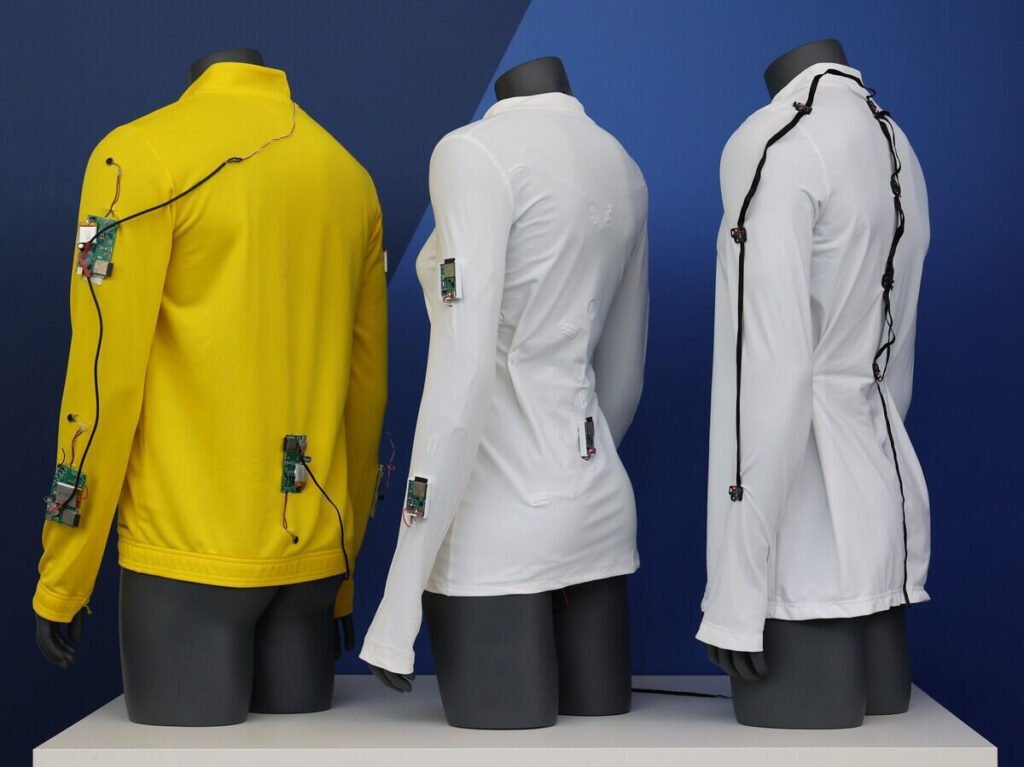
The PhysioTaix research project integrates washable textile sensors and AI-powered movement analysis to help patients perform prescribed exercises and support physiotherapists in tracking recovery.
Researchers at RWTH Aachen University in Germany are developing a washable smart jacket that uses integrated textile sensors to monitor rehabilitation exercises in real time. Developed through the PhysioTaix research project by ITA – the Institute for Technical Textiles at RWTH Aachen University – the wearable technology aims to help patients perform prescribed movements correctly at home while providing physiotherapists with additional information to assess rehabilitation progress.
Smart Jacket Integrates Sensors into Textiles
The PhysioTaix project focuses on integrating movement-monitoring technology directly into a garment, reducing the need for multiple individual sensors attached to different parts of the body.
The smart jacket tracks patients’ movements as they perform prescribed rehabilitation exercises. The collected data is transmitted to an application, where artificial intelligence (AI) analyses how the movements are performed.
Patients can receive immediate feedback to help them understand whether they are completing exercises correctly. Physiotherapists can also use the recorded information as an additional source of objective data when evaluating patients’ progress.
By incorporating sensors into a wearable garment, the researchers aim to make movement monitoring more convenient for patients and easier to integrate into rehabilitation routines.
Supporting Rehabilitation Beyond Clinical Appointments
Physiotherapy often requires patients to repeat prescribed exercises regularly between appointments. However, without direct supervision, patients may find it difficult to determine whether they are performing movements correctly.
The PhysioTaix smart jacket is designed to address this challenge by providing movement feedback outside the clinical environment.
The technology could help patients monitor their exercise performance at home while giving therapists additional information about activities performed between consultations.
Unlike wearable devices intended for continuous personal health tracking, the jacket has a specific purpose: monitoring rehabilitation exercises over a defined period.
This targeted approach focuses on a practical healthcare requirement rather than continuous monitoring without a clearly defined objective.
Washable and Reusable Smart Textile Technology
Washability and reusability are important considerations in the development of wearable technology for healthcare applications.
The PhysioTaix jacket is being designed to withstand washing while retaining its integrated sensing capabilities. This feature is intended to support repeated use in rehabilitation settings.
Integrating sensors into the garment also reduces the need for patients to position several separate devices on their bodies before exercising.
The researchers are working with rehabilitation centres, healthcare professionals and other specialists to develop and evaluate the jacket and its accompanying application.
Further testing is taking place at the modular smart textiles workshop at the Digital Innovation Centre Europe (DICE) in Aachen, Germany.
AI-Based Movement Analysis for Physiotherapy
Artificial intelligence plays a role in analysing the movement data collected by the jacket’s textile sensors.
The application processes the data to assess how patients perform their prescribed exercises and provide feedback. This information could complement the observations made by physiotherapists during clinical appointments.
The approach aims to make movement information more accessible during home-based rehabilitation, where direct professional supervision is not always available.
However, the practical value of the technology will depend on its ability to measure movements reliably and provide useful feedback in real-world rehabilitation settings.
The researchers will also need to assess how easily patients can use the garment and application as part of their regular exercise routines.
PhysioTaix Project Continues Until February 2027
The PhysioTaix research project is scheduled to continue until February 2027. Following this phase, potential applications are expected to be assessed further in collaboration with clinics and health insurance providers.
This evaluation will be important in determining whether the technology can be integrated into existing rehabilitation services.
Although smart garments capable of collecting movement and physiological data have been developed for various applications, widespread healthcare adoption depends on more than technical performance alone.
The PhysioTaix project will need to demonstrate that the jacket provides meaningful benefits to patients, physiotherapists and healthcare providers, while remaining practical to use and maintain.
By combining textile-integrated sensors, AI-based analysis and washable garment construction, the project explores how smart textiles could support rehabilitation beyond traditional clinical settings.