
Automotive Aramid Fiber Market to Reach USD 1.62 Billion by 2034
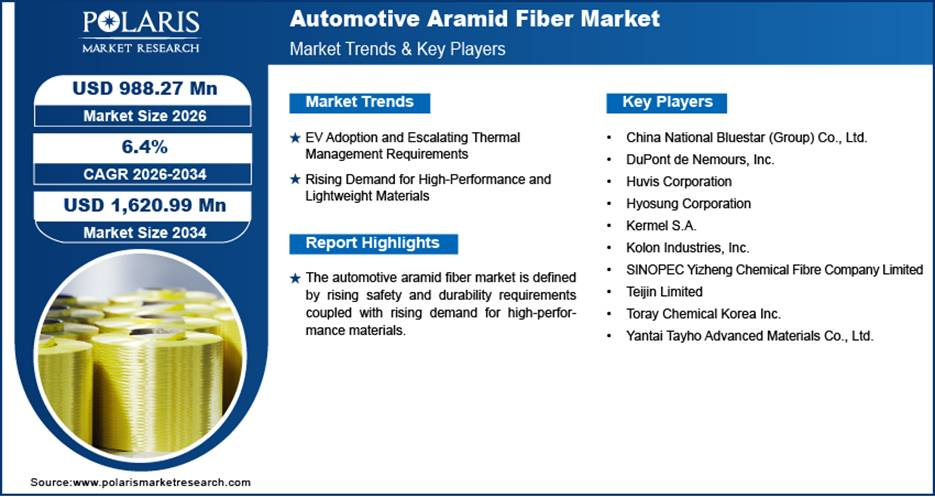
The global automotive aramid fiber market is expected to expand as automakers increasingly adopt high-performance materials for vehicle components. According to Polaris Market Research, the market was valued at USD 929.82 million in 2025 and is projected to reach USD 1,620.99 million by 2034, growing at a CAGR of 6.4% from 2026 to 2034.
The growth is supported by rising electric vehicle production, increasing demand for thermal management solutions and the need for advanced materials in safety-critical automotive applications.
Automotive Aramid Fiber Market: Key Report Highlights
The Polaris Market Research report examines aramid fiber demand across several automotive applications, including tires, braking systems, hoses, belts, insulation and composite reinforcement.
It covers both para-aramid and meta-aramid fibers, analysing their use across different material forms and applications.
The report also evaluates the competitive landscape, including major suppliers, production capabilities, material developments and pricing strategies.
Its regional assessment covers North America, Europe, Asia Pacific, Latin America, and the Middle East and Africa. The analysis considers automotive production trends, regulatory requirements and electric vehicle adoption across these markets.
Key Factors Driving Automotive Aramid Fiber Market Growth
Several factors are contributing to the growing demand for aramid fibers in automotive manufacturing.
1. Electric Vehicle Adoption and Thermal Management
The expansion of electric vehicle production is increasing the need for advanced materials that can withstand demanding thermal conditions.
Aramid fibers are used in insulation, shielding and reinforcement applications. Their thermal and mechanical properties make them suitable for components exposed to elevated operating temperatures.
2. Growing Demand for High-Performance Materials
Automotive manufacturers are increasingly focusing on lightweighting, durability and vehicle safety.
Aramid fibers offer high strength and resistance to mechanical stress and heat. These characteristics support their use in automotive components that require reliable performance under demanding conditions.
3. Material Substitution in Critical Applications
Aramid fibers are finding applications in components where conventional materials may not provide the required combination of strength, heat resistance and durability.
Their adoption is particularly relevant in safety-critical and thermally exposed automotive applications.
4. Sustainability and Material Innovation
Developments in recyclable and lower-impact aramid fibers are creating opportunities for the automotive industry to address environmental and lifecycle requirements.
Material innovation is also supporting the development of advanced automotive components with improved performance characteristics.
Key Market Segments: Para-Aramid and Meta-Aramid Fibers
By Type
Para-aramid fiber accounted for the largest market share in 2024. Its high tensile strength, impact resistance and fatigue resistance support its use in tires, braking system components and reinforcement applications.
Meta-aramid fibers are gaining attention for their thermal stability and flame-resistant properties. These characteristics make them suitable for applications requiring protection against elevated temperatures.
By Application
Brake pads and clutch facings represent an important application segment. Demand is supported by the need for materials that maintain stability under high loads and operating temperatures.
Other significant applications include tire reinforcement and thermal insulation. Demand for these applications is also expected to benefit from the development of electric vehicles and their specific material requirements.
Asia Pacific Leads the Automotive Aramid Fiber Market
Asia Pacific
Asia Pacific held the largest share of the global automotive aramid fiber market in 2024.
The region’s position as a major automotive manufacturing hub supports demand for advanced materials. High vehicle production volumes, established supplier networks and expanding electric vehicle manufacturing in China, Japan, South Korea and India are contributing to market demand.
North America
North America is anticipated to register the highest growth during the forecast period.
Increasing electric vehicle adoption, demand for performance-oriented vehicles and higher material specifications are expected to support regional market expansion.
The report also examines market developments across Europe, Latin America, and the Middle East and Africa.
Automotive Aramid Fiber Market Outlook Through 2034
The automotive aramid fiber market is moving towards greater use in specialised, high-value applications rather than widespread replacement of conventional materials.
Vehicle electrification is changing thermal and mechanical requirements across automotive components. This is creating opportunities for aramid fibers in insulation, reinforcement and protective applications.
However, material costs and competition from alternative fibers continue to influence adoption. As a result, manufacturers are likely to focus on applications where aramid fibers offer specific performance advantages.
The combination of electric vehicle development, advanced composites and sustainability-focused material innovation is expected to support the market’s growth through 2034.
Major Companies in the Automotive Aramid Fiber Market
According to Polaris Market Research, key companies operating in the global automotive aramid fiber market include:
- China National Bluestar (Group) Co., Ltd.
- DuPont de Nemours, Inc.
- Huvis Corporation
- Hyosung Corporation
- Kermel S.A.
- Kolon Industries, Inc.
- SINOPEC Yizheng Chemical Fibre Company Limited
- Teijin Limited
- Toray Chemical Korea Inc.
- Yantai Tayho Advanced Materials Co., Ltd.
Automotive Aramid Fiber Market: Report Coverage
The market report provides a detailed assessment of the industry across four major segmentation categories.
By Type
- Para-Aramid Fiber
- Meta-Aramid Fiber
By Fiber Form
- Aramid pulp
- Staple fiber
- Yarn and fabric
- Chopped fiber
By Application
- Brake Pads and Clutch Facings
- Tires and Tire Reinforcement
- Hoses, Belts and Gaskets
- Heat Shields and Insulation
- Automotive Composites and Structural Components
By Region
- North America: U.S. and Canada
- Europe: Germany, France, UK, Italy, Spain, Netherlands, Russia and Rest of Europe
- Asia Pacific: China, India, Japan, Malaysia, South Korea, Indonesia, Australia and Rest of Asia Pacific
- Latin America: Mexico, Brazil, Argentina and Rest of Latin America
- Middle East and Africa: Saudi Arabia, UAE, South Africa, Israel and Rest of Middle East and Africa
The report covers revenue estimates in USD million for the 2021–2034 period.
Access the Full Automotive Aramid Fiber Market Report
The Polaris Market Research report provides further insights into market size, growth forecasts, competitive positioning, regional developments and emerging opportunities in automotive aramid fiber applications.
Source: Polaris Market Research
Read the full report or request a free sample: https://www.polarismarketresearch.com/industry-analysis/automotive-aramid-fiber-market