
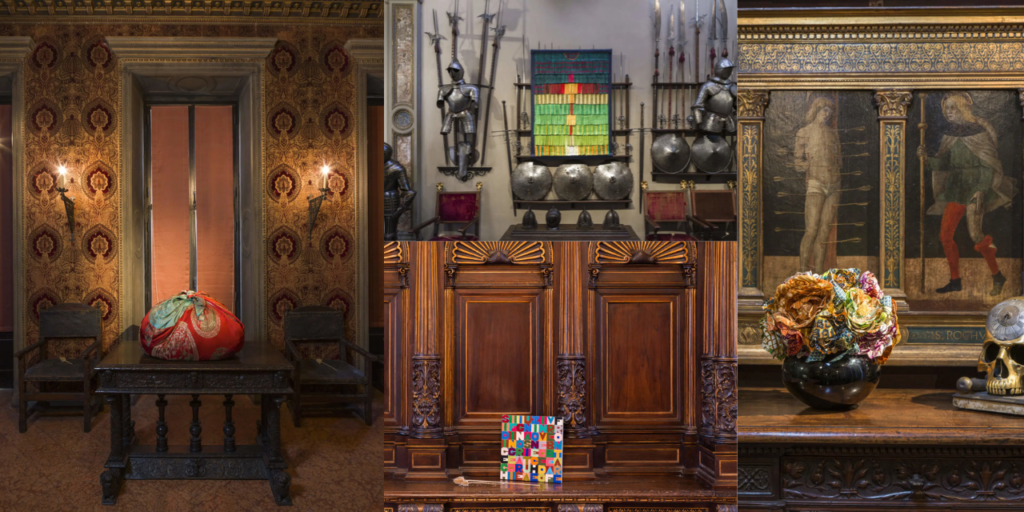
The Bagatti Valsecchi Museum in Milan, Italy, will host Trama e Ordito: Between Pistoletto, Buren and Boetti from the Canclini Collection from November 27, 2026, to May 16, 2027. Curated by Antonio D’Amico, the exhibition will bring together approximately 50 works exploring the relationship between contemporary art, textiles, craftsmanship and cultural heritage.
The exhibition marks the centenary of Canclini Tessile, a company founded in 1925 in the Como silk-producing district. It draws on the Canclini Collection, a private collection examining how textiles can function as both artistic materials and vehicles for conceptual expression.
Contemporary Art Meets Textile Heritage
The exhibition will feature works by internationally recognised artists, including Michelangelo Pistoletto, Daniel Buren, Alighiero Boetti, Jannis Kounellis, Andy Warhol, Christian Boltanski, Maria Lai, Yayoi Kusama and Tracey Emin.
Their works explore how thread, weave, fabric and colour can move beyond traditional decorative applications to become independent forms of artistic expression. Through these materials, artists examine themes such as memory, identity, social relationships, symbolism and the connection between material and creative gesture.
The exhibition will be presented within the museum’s Neo-Renaissance interiors, creating a dialogue between contemporary artistic practices and the historical setting of the Bagatti Valsecchi residence.
Historical Interiors Provide the Setting
The Bagatti Valsecchi Museum preserves the legacy of brothers Fausto and Giuseppe Bagatti Valsecchi, who designed their residence in the style of late Renaissance architecture and interiors.
Historical tapestries from the sixteenth century and nineteenth-century wall hangings inspired by antique designs provide an important context for the exhibition. These textiles, characterised by decorative patterns and symbolic narratives, demonstrate the longstanding role of fabric in shaping interior spaces.
Historically, textiles served purposes beyond decoration. They covered walls, adorned doors and separated rooms, contributing to the visual identity and organisation of domestic environments. The exhibition connects this historical use of textiles with contemporary artistic experimentation, highlighting the continuing significance of applied arts across different periods.
Maria Lai’s Work Reflects the Meaning of Weaving
One of the exhibition’s notable works is Formiche (2009) by Maria Lai, an artist who shared a personal and cultural connection with the Canclini family.
Lai’s statement, “To be is to weave,” provides a conceptual perspective on the exhibition. Weaving is presented not only as a technical process but also as a means of establishing relationships, transmitting knowledge and building communities.
The inclusion of Lai’s work reflects the exhibition’s broader interest in the cultural and human dimensions of textile production, connecting traditional craftsmanship with contemporary artistic ideas.
The Canclini Collection Connects Art and Manufacturing
The Canclini Collection emerged from the relationship between textile manufacturing and artistic research. Canclini Tessile specialises in high-end fabrics, with its manufacturing expertise, material knowledge and production capabilities forming an important part of the company’s identity.
The collection explores the creative possibilities of textiles through works that often result from direct collaboration with artists. These collaborations give fabric a conceptual and poetic dimension, placing emphasis on craftsmanship, material transformation and the relationship between industrial knowledge and artistic expression.
According to Simone Canclini, the collection focuses on works that engage with textiles and themes associated with the company’s entrepreneurial experience, including time, memory, material transformation and the value of human labour.
“Every acquisition stems from an encounter and a cultural resonance even before an aesthetic one,” Canclini says.
Exhibition Programme and Publication
Throughout the exhibition period, the museum will organise guided tours, textile technique workshops, educational activities for schools and families, meetings with scholars, art historians and curators, lectures, and interdisciplinary events.
The programme will include Ricamare le idee (Embroidering Ideas), a sewing workshop combining a guided museum tour with an opportunity for participants to personalise a tote bag through embroidery. The activity will conclude with a toast.
A series of music and aperitif events is also planned. Each event will combine guided visits to works from the Canclini Collection, musical interludes and an aperitif in the Salone d’Onore.
The exhibition will be accompanied by a catalogue published by Silvana Editoriale. The press conference is scheduled for November 25, 2026, at 11 a.m., followed by an invitation-only opening on November 26 at 6 p.m.
Through its combination of contemporary artworks, historical interiors and textile craftsmanship, Trama e Ordito will examine the evolving relationship between art, materials and manufacturing culture at the Bagatti Valsecchi Museum in Milan.