
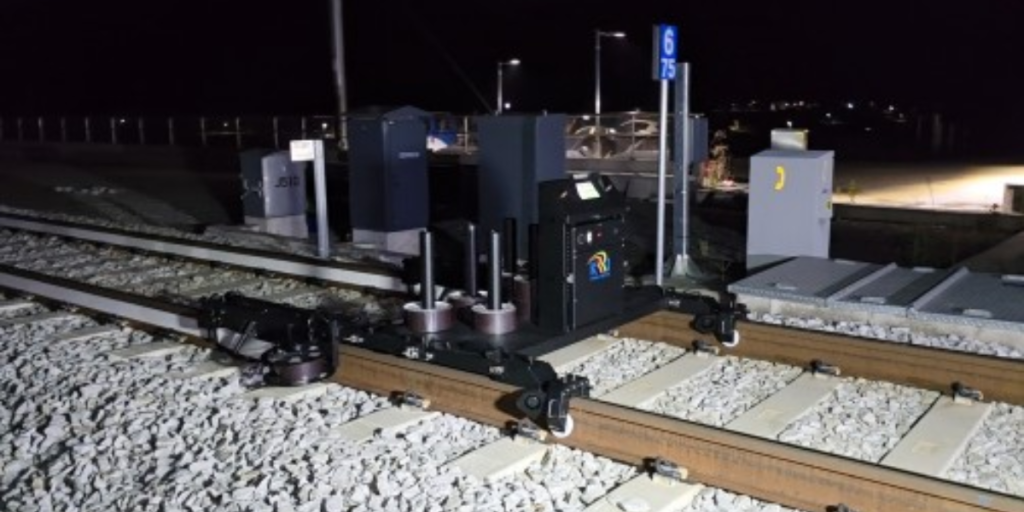
The Korea Railroad Research Institute (KRRI) has developed a rail-mounted thermal-blocking textile with an automated installation and retrieval system to reduce railway rail temperatures during extreme summer heat. Field demonstrations recorded a maximum rail temperature reduction of 10.9°C, while certified testing confirmed performance durability for more than 10 years.
KRRI Develops Thermal-Blocking Textile for Railway Tracks
As extreme heat waves intensify due to recent climate change, railway rail temperatures can exceed 60°C during summer, increasing the risk of track deformation. These conditions can lead to speed restrictions, delays and safety concerns.
To address the issue, the Korea Railroad Research Institute (KRRI), President Sagong Myung, has developed what it describes as the world’s first rail-mounted thermal-blocking textile with an automated installation and retrieval system.
Rail temperature reduction during summer currently relies almost entirely on water-spraying systems. According to KRRI, these systems involve high installation costs and continuous water consumption, creating a need for a water-free alternative.
Textile Uses Solar-Reflective Coating and Magnetic Attachment
KRRI’s technology works by attaching a specialised heat-blocking textile to railway rails using magnetic force. The textile is designed to block solar radiation and features a multilayer structure incorporating a special coating that reflects more than 85% of solar radiation, together with magnets and fiberglass layers.
Once installed, the system does not require additional operating costs and is designed to avoid operational failure while providing stable temperature-control performance.
Field Tests Demonstrate Temperature Reduction
Field demonstrations were conducted on the Gwangju Line of the conventional railway network in the summer of 2024 and on the Jungbu Inland High-Speed Line in the summer of 2025.
The demonstrations recorded a maximum rail temperature reduction of 10.9°C, with no performance degradation observed after testing.
The technology was applied to both conventional and high-speed railway rails. Conventional railway rails used in the testing weigh 50 kg per meter, while high-speed railway rails weigh 60 kg per meter.
Certified testing by the Korea Testing & Research Institute (KTR), with certificates obtained on August 7, 2025 and October 17, 2025, confirmed durability with performance maintained for more than 10 years.
Automated Installation and Retrieval System
KRRI has also developed an integrated “all-in-one automated system” covering the installation and retrieval stages of the thermal-blocking textile.
The equipment can perform several operations, including cleaning foreign substances from rail surfaces, applying the textile and retrieving it after the summer season.
Its modular structure enables two operators to transport, assemble and disassemble the equipment. The system can operate at speeds exceeding 2 km per hour, which KRRI says reduces both operating time and cost.
System Tested Against High-Speed Train Winds
KRRI also verified the safety and durability of the thermal-blocking textile under high-speed railway operating conditions.
The system remained securely attached under opposing winds generated by KTX trains travelling at 300 km/h.
The magnetic attachment force was optimised to withstand wind speeds of up to 66 m/s, equivalent to 1.5 times stronger than high-speed train-induced wind. Additional dual fastening mechanisms were also incorporated to maintain the textile’s attachment during high-speed train operations.
Patents Receive Awards and Technology Gains NET Certification
The technology received recognition at the 2025 Seoul International Invention Exhibition, held from December 3 to 6, 2025, at COEX Hall C, Seoul, and hosted by the Korean Intellectual Property Office and the Korea Invention Promotion Association.
The patent covering the thermal-blocking textile received the Grand Prize, while the patent for the automated equipment received the Silver Prize.
The technology was also recognised at the 2025 New Technology Commercialization Promotion Conference, held on December 10, 2025, at Peace & Park Convention, Seoul, and hosted by the National Institute of Standards and Technology (NIST) and the Korea Industrial Technology Association.
At the conference, the technology obtained National New Excellent Technology (NET, Ministry of Trade, Industry and Energy Certification No. 1594).
The NET system is jointly operated by the Korean Agency for Technology and Standards and the Korea Industrial Technology Association and is awarded to technologies newly developed in Korea or technologies that significantly improve existing technologies.
Technology Transfer Agreement Signed
KRRI has finalised a technology transfer agreement with PITCHCABLE Co., Ltd., CEO Lim Dong-wook, covering the heat-blocking textile and its installation and retrieval technology.
The agreement links the technology with commercialisation and completes the research-to-application cycle.
The technology was developed through KRRI’s in-house research programme under the National Research Council of Science & Technology (NST), Chairman Kim Young-sik.
Research Project
The development formed part of five projects, including the Development of an All-in-one, Railway Site-Specific System for Commercialization of Thermal-blocking Textiles.
- Research Period: May 2022 – December 2025
- Principal Investigator: Chief Researcher Kang Dong-hoon
KRRI Outlines Future Applications
Chief Researcher Kang Dong-hoon at KRRI stated, “This technology goes beyond simply lowering rail temperatures—it presents a new paradigm for protecting railway safety in the era of climate crisis. We plan to expand its application beyond railways to various fields that require heat mitigation, such as building exteriors and roadside facilities.”
President Sagong Myung of KRRI said, “This is a demand-driven research outcome that allows the public to use railways with confidence even during extreme summer heat. In an era where climate crisis directly translates into national risk, we will further advance this technology to ensure safe railway operations and expand its application to overseas markets.”