
The AquaWeave project uses biodegradable yarns made from seaweed, shrimp shells and gelatin to create textiles that swell, stretch and change shape when exposed to different conditions.
Researchers at Cornell University in the US have developed shape-shifting fabrics using biodegradable yarns made from seaweed, shrimp shells and gelatin. The experimental textiles can swell, stretch or dissolve when exposed to water or specific environmental conditions. The technology could open new possibilities for wearable electronics, smart textiles and human-computer interaction.
The research was led by Cindy (Hsin-Liu) Kao, Associate Professor of Human Centered Design and Director of the Hybrid Body Lab at Cornell University, along with her students. Their work resulted in AquaWeave, a collection of woven textiles that can transform into different structures, including tubes, flaps and domes.
The researchers aim to use these materials in wearable devices that can physically change their shape to perform different functions. For example, a smartphone could potentially transform into a massage pad when required.
How AquaWeave Fabrics Change Shape
The development of AquaWeave began when the research team noticed unusual properties in their experimental yarns. What initially appeared to be material limitations became useful features for creating responsive textiles.
The team tested how each biodegradable yarn reacted to different environmental conditions.
- Seaweed-based yarn: Swells when exposed to liquids.
- Shrimp-shell yarn: Stretches under acidic conditions.
- Gelatin yarn: Dissolves when exposed to water.
Researchers then combined these properties with different weaving patterns to control how the fabrics changed shape. By adjusting the textile structures, they created materials that could form different shapes and develop openings as certain yarns dissolved.
Traditional Weaving Meets Advanced Textile Technology
To develop the fabrics, Kao’s team worked with experienced weavers and used a computerised TC2 jacquard loom. The digital weaving machine can produce complex textile structures by combining different yarns, circuits and wiring.
The weavers explored several ways to use the bio-based yarns. One developed a ribbed texture that used the swelling properties of seaweed yarn. Another created a fabric that curled into a specific pattern.
A third developed a three-layer textile that changed shape to reveal its internal structure.
Kao highlighted the importance of collaboration between researchers and skilled weavers. She noted that working with professionals outside the research field helped the team discover new ways to use the bio-based yarns.
Ancient Weaving Techniques Inspire Modern Wearable Devices
Kao’s interest in traditional craftsmanship began in 2018 during a visit to a 1,200-year-old Nishijin weaving workshop in Kyoto, Japan. The workshop, operated by its ninth generation of weavers, inspired her to explore how traditional weaving methods could support modern wearable technologies.
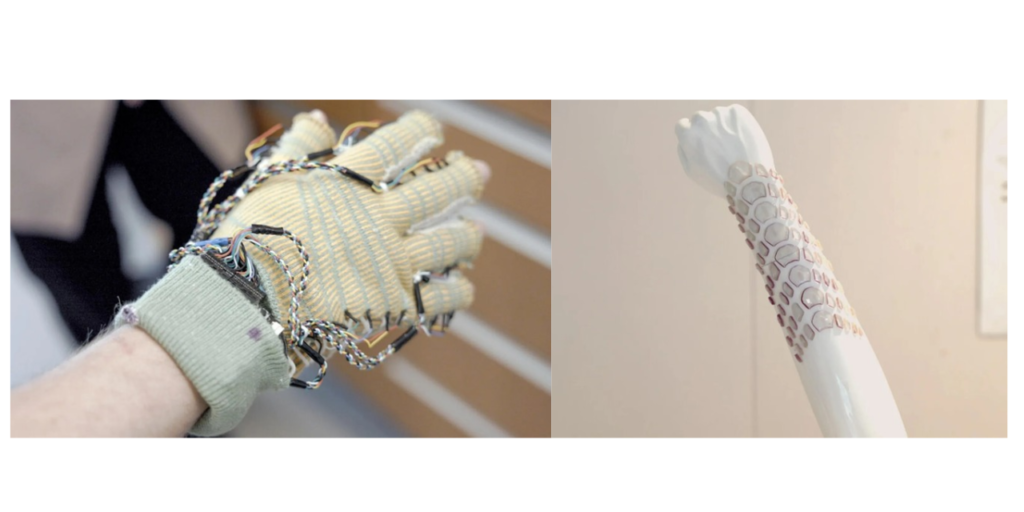
This approach later contributed to the development of WovenProbe, a bandage-like wearable device designed to track hand movements.
The device uses seven small circuit boards connected by more than three dozen wires woven into the fabric. Its weaving structure creates openings around the finger joints, allowing users to move their hands comfortably while wearing the device.
Kao’s Hybrid Body Lab has also developed SkinLink, a modular toolkit that enables researchers to assemble skin-mounted electronic devices within minutes. Potential applications include detecting falls, improving posture and providing illumination in low-light conditions.
Another project, EdemaFlex, uses more than 36 actuators across the fingers and palm to help reduce swelling.
Applications in Smart Textiles and Wearable Electronics
The AquaWeave research demonstrates how biodegradable materials and traditional weaving techniques can contribute to the development of responsive textiles. By combining material properties with engineered textile structures, researchers are exploring fabrics that can adapt to changing conditions and perform specific functions.
Potential applications include wearable electronics, interactive clothing, skin-mounted devices and human-computer interfaces.
Lead author Jingwen Zhu, now an Assistant Professor at the University of California, Davis, presented the research on November 4, 2026, at the ACM UIST 2026 conference in Detroit.
The project highlights the potential of combining bio-based yarns, digital weaving and traditional textile craftsmanship to develop new materials for future wearable technologies.