
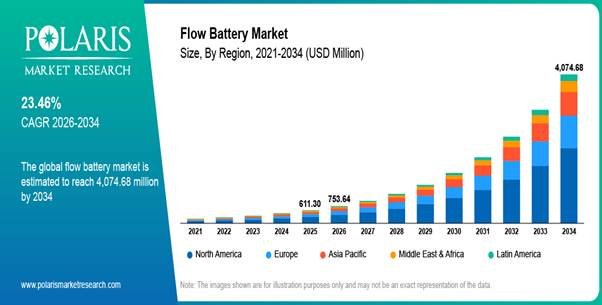
Polaris Market Research & Consulting has released its Flow Battery Market Report 2026–2034, projecting the global flow battery market to reach USD 4,074.68 million by 2034, up from USD 611.30 million in 2025.
According to the report, the market is expected to expand at a CAGR of 23.46% from 2026 to 2034. Increasing renewable energy investment, the expansion of EV charging infrastructure and growing deployment of grid-scale energy storage are identified as key factors supporting market growth. Asia Pacific is the leading regional market.
Flow Battery Market Shows Growing Commercial Activity
The flow battery market has seen increasing commercial activity, particularly in grid-scale and long-duration energy storage applications.
In March 2025, Japan’s Ministry of Economy approved the first-ever redox flow battery from Sumitomo Electric as a grid-scale battery for a power system stabilisation project.
In November 2025, India’s first and largest MWh-scale vanadium redox flow battery (VRFB) system, with a capacity of 3 MWh, was inaugurated on November 11, 2025. The project supports the development of long-duration energy storage solutions in India.
In May 2026, ESS Tech successfully commissioned two ESS Iron flow battery units in California’s Central Valley as part of its expansion strategy in the flow battery market.
“With the help of renewable energy integration, long-duration storage demand, and advancements in electrolyte technology, flow batteries are emerging as a scalable energy storage solution. Firms with superior battery technology, production, and installation capabilities will gain a competitive advantage with rising adoption,” said Apurva Agarwal, Senior Electronics & Semiconductor Analyst.
Key Investment Signals for Flow Batteries
The report identifies several investment themes influencing the flow battery industry in 2026.
Grid-scale energy storage expansion is being supported by a rapid increase in long-duration energy storage projects, creating opportunities for flow battery manufacturers.
Utility and renewable energy integration is another major area of demand. Greater use of renewable energy is increasing the need for storage systems capable of storing solar and wind power.
Technology commercialisation and cost reduction are being driven by developments in electrolyte chemistry and manufacturing processes. These developments could strengthen the competitive position of flow batteries through improved efficiency and reduced lifecycle costs.
Supply chain and material security are also gaining importance, with increasing interest in electrolyte production and sourcing of battery components. This is encouraging the development of robust supply chain strategies and localised manufacturing capabilities.
Renewable Energy Integration Drives Demand
The increasing deployment of renewable energy is supporting demand for flow battery technology. Flow batteries can provide energy storage for intermittent renewable sources such as solar and wind and can support grid stability.
As renewable energy capacity expands, long-duration storage solutions are becoming increasingly important for balancing electricity supply and demand.
EV Charging Infrastructure Supports Adoption
The expansion of EV charging infrastructure is another factor contributing to flow battery demand.
According to the report, flow batteries can support charging station operators by storing large amounts of energy for extended periods and helping provide high-power charging capacity.
The continued growth of EV charging networks could therefore create additional applications for flow battery-based energy storage systems.
Grid-Scale Storage Creates New Opportunities
The deployment of grid-scale energy storage projects is creating opportunities for flow battery manufacturers.
Growing renewable energy capacity and energy transition policies are encouraging utilities to explore long-duration storage solutions. Flow batteries are among the technologies being developed and deployed to address these requirements.
Flow Battery Market Report Coverage
The Polaris Flow Battery Market Report 2026–2034 covers market sizing, segmentation, regional analysis, competitive landscape and technology assessment across the flow battery value chain.
The report is intended for energy storage companies, utility providers, investors, government agencies and renewable energy developers seeking information on market opportunities, technology developments, deployment trends and competitive positioning.
The report includes market size and CAGR by type, application and end user; regional analysis across five regions with country-level breakdowns; 12 company profiles with financial benchmarking; regulatory environment analysis by country; and technology and innovation analysis. The report is available in PDF and Excel formats, with customisation available by country, region and segment.
Key Companies
Companies profiled in the report include Invinity Energy Systems, ESS Tech, Inc., Sumitomo Electric Industries, Ltd., CellCube Energy Storage GmbH, Largo Inc., VRB Energy, Elestor B.V., Jena Flow Batteries GmbH, Stryten Energy LLC, Quino Energy Inc., StorEn Technologies Inc. and Redox One.
Market Segmentation
The report segments the flow battery market by type, application, end user and region.
By Type:
- Lithium-linked Flow Battery
- Iron-based Flow Battery
- Vanadium Flow Battery
- Sodium-based Flow Battery
- Hybrid Flow Battery
By Application:
- Grid Storage
- Renewable Energy Storage
- EV Batteries
- Microgrid Applications
By End User:
- Utilities
- Automotive OEMs
- Renewable Energy Developers
- Government & Research Institutions
By Region:
- North America
- Europe
- Asia Pacific
- Middle East & Africa
- Latin America
The regional analysis includes country-level coverage across markets including the US, Canada, Germany, France, UK, Italy, Spain, Netherlands, Russia, China, Japan, India, Malaysia, South Korea, Indonesia, Australia, Vietnam, Saudi Arabia, UAE, Israel, South Africa, Mexico, Brazil and Argentina.