
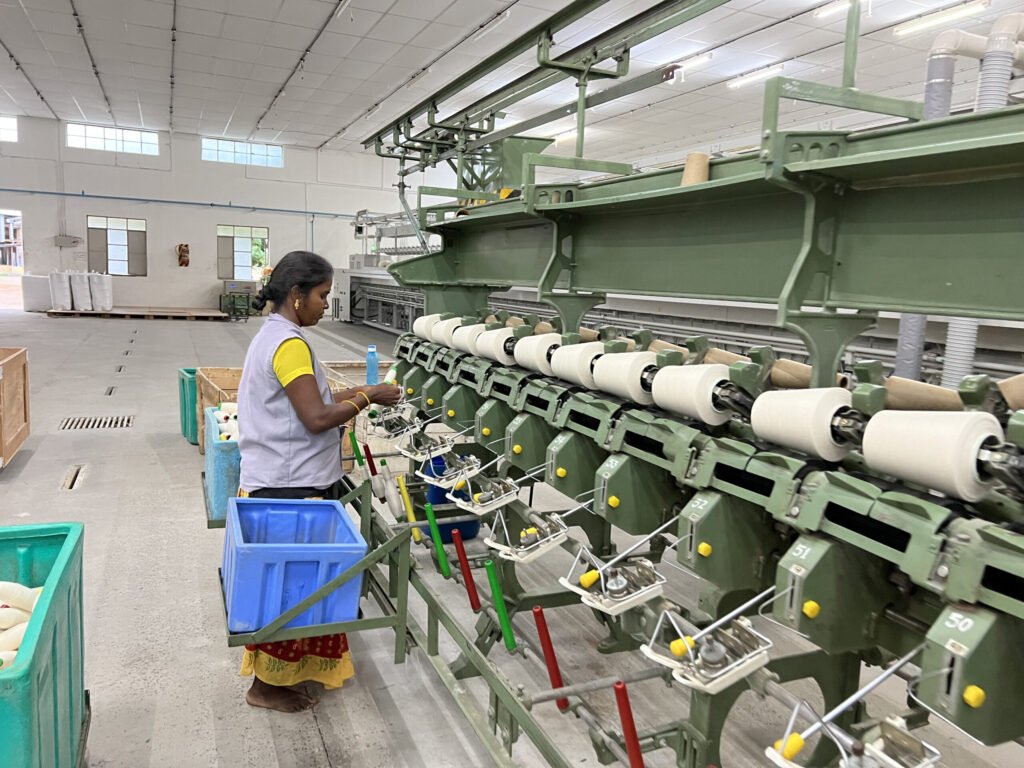
Government initiatives provide financial assistance, skilling, infrastructure and market support to strengthen handloom, handicrafts, technical textiles and large-scale textile manufacturing across India.
The Government of India has implemented a range of schemes and initiatives aimed at strengthening the country’s textile industry through financial assistance, manufacturing incentives, skill development, infrastructure support, research and market development.
The programmes cover several segments of the textile value chain, including man-made fibre (MMF) textiles, technical textiles, handlooms and handicrafts. Among the major initiatives are the Production Linked Incentive (PLI) Scheme, National Technical Textiles Mission (NTTM), SAMARTH – Scheme for Capacity Building in Textile Sector, National Handloom Development Programme, Raw Material Supply Scheme (RMSS) and National Handicrafts Development Programme (NHDP).
Several of these initiatives have also supported textile workers, weavers and artisans in Uttar Pradesh, including the Bhadohi region.
Support for Handloom Sector
Under the Raw Material Supply Scheme (RMSS) and National Handloom Development Programme, financial assistance is provided to eligible handloom agencies and workers for a range of activities.
Support includes raw materials, upgraded looms and accessories, solar lighting units, workshed construction, skill development, product diversification, design innovation, technical and common infrastructure, publicity and brand development.
The programmes also support the promotion of handloom products through the India Handloom Brand (IHB), Handloom Mark (HLM) and geographical indication (GI) tags, as well as e-commerce and domestic and overseas marketing.
From 2014-15 to 2025-26, the following support was provided for the upliftment of handloom weavers in Uttar Pradesh:
- 86 Small Handloom Clusters and one Mega Handloom Cluster received financial assistance of Rs. 96.34 crore, benefiting 25,885 handloom workers.
- 143 marketing events were organised to promote the sale of handloom products.
- 13 Handloom Producer Companies were formed to improve productivity, marketing capabilities and incomes.
- Six Urban Haats are functional at Varanasi, Agra, Bareilly, Rampur, Ayodhya and Jhansi, with Rs. 2.67 crore released.
- 6,865 weavers and handloom entities have been onboarded on the Government e-Marketplace (GeM) for marketing handloom products.
- 21,566 beneficiaries received loans under the Weavers’ MUDRA Scheme.
- 17,391 beneficiaries were enrolled under the Pradhan Mantri Jeevan Jyoti Bima Yojana and Pradhan Mantri Suraksha Bima Yojana.
- A total of 732.39 lakh kg of yarn was supplied under Transport Subsidy and Price Subsidy.
Handicraft Development Support in Bhadohi
The National Handicrafts Development Programme (NHDP) provides need-based financial assistance for end-to-end support to artisans across India, including Bhadohi in Uttar Pradesh.
During 2025-26, three Guru Shishya Hastshilp Prashikshan training programmes and one toolkit distribution programme were implemented, benefiting 138 artisans.
Two Craft-Based Resource Centres (CBRCs) were also sanctioned to the Indian Institute of Carpet Technology (IICT) during 2025-26.
In addition, Uthan Carpet Producer Company Limited (UCPC) was formed for the handmade carpet sector associated with the Bhadohi GI craft during 2022-23. Eleven different interventions were sanctioned to UCPC to strengthen the Bhadohi carpet cluster.
PLI Scheme for MMF and Technical Textiles
The Production Linked Incentive (PLI) Scheme focuses on addressing structural gaps in India’s man-made fibre textile sector and strengthening global competitiveness through scale, technology and value addition.
The scheme covers MMF fabrics, MMF apparel and technical textiles.
According to the information provided, incentives amounting to Rs. 386.30 crore have been released under the scheme across India to date.
Of the 170 companies selected under the scheme, 15 companies are from Uttar Pradesh.
The PLI scheme is intended to support large-scale manufacturing and enhance the competitiveness of India’s textile industry in international markets.
SAMARTH Supports Textile Skill Development
The SAMARTH – Scheme for Capacity Building in Textile Sector provides demand-driven and placement-oriented skill development programmes.
The scheme is designed to support skill development in the textile sector by connecting training with industry requirements and employment opportunities.
As of 22 July 2026, a total of 1,34,503 beneficiaries had been trained and passed under the programme in Uttar Pradesh.
Within Bhadohi district, 151 beneficiaries had been trained and passed under SAMARTH.
National Technical Textiles Mission
The National Technical Textiles Mission (NTTM) is another major government initiative focused on strengthening India’s technical textiles ecosystem.
The mission covers areas including research, innovation and development, promotion and market development. Its objectives include supporting the development and adoption of technical textile products and technologies across different application sectors.
Technical textiles have applications across areas such as infrastructure, healthcare, agriculture, transportation, protective applications and other industrial sectors.
Strengthening the Textile Value Chain
The range of government programmes covers different stages of India’s textile value chain, from raw material and manufacturing to skills, infrastructure, product development and market access.
For the handloom and handicraft sectors, programmes provide support to workers and artisans through raw materials, training, infrastructure, marketing and financial assistance. Meanwhile, initiatives such as PLI and NTTM focus on manufacturing competitiveness, technology and the development of higher-value textile segments.
The data from Uttar Pradesh also indicates the scale of support being directed towards handloom workers, artisans, textile manufacturers and skilled workers across different programmes.
As these schemes continue to support different segments of the industry, their implementation remains an important component of India’s broader efforts to strengthen textile manufacturing, traditional crafts, technical textiles and the wider textile value chain.