
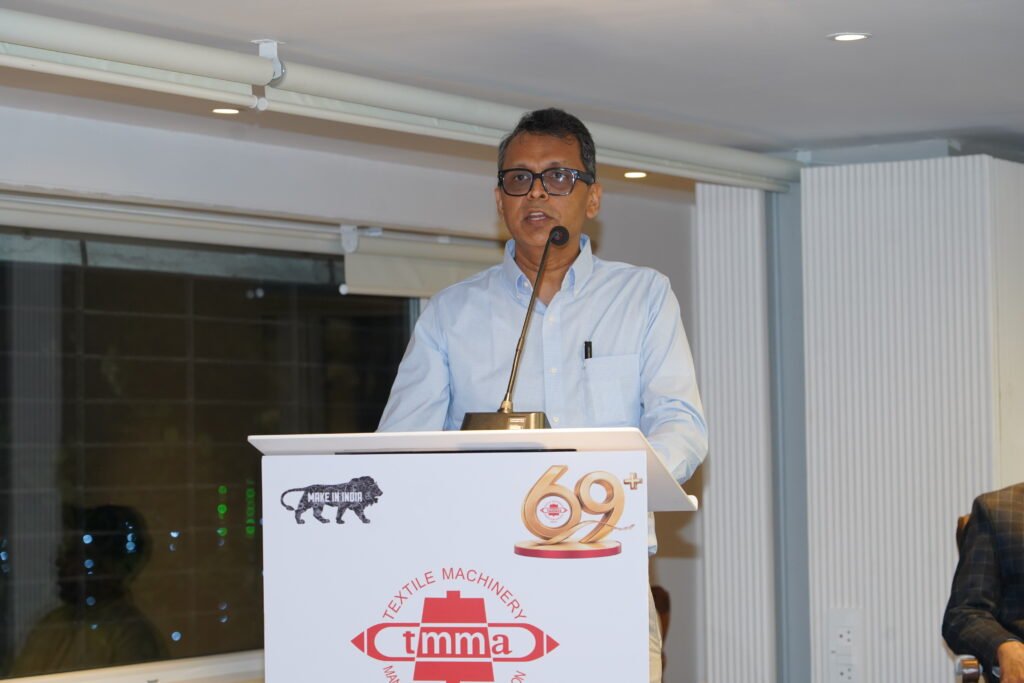
At TMMA(I)’s 66th Annual General Meeting, the speaker highlighted the need for machinery modernisation, Industry 4.0 adoption, stronger customer partnerships and globally competitive Indian textile machinery.
The Indian textile industry is entering a phase of potential growth, supported by free trade agreements (FTAs), government policies and changing global sourcing strategies. However, maintaining global competitiveness will require textile manufacturers to modernise existing capacities, adopt affordable automation and improve the integration of digital data across manufacturing processes.
Addressing the Textile Machinery Manufacturers’ Association (India) at its 66th Annual General Meeting, the speaker highlighted the opportunities emerging for textile machinery manufacturers and suppliers. The speech also emphasised the importance of research and development (R&D), technology validation on production floors and closer collaboration between machinery manufacturers and textile mills.
FTAs and Global Sourcing Shifts Create New Opportunities
The speaker observed that the Indian textile industry is experiencing a period of renewed opportunity after facing challenges related to textile demand.
According to the speech, the signing of FTAs and new government policies are contributing to a more positive outlook. The China Plus One strategy is also gaining momentum, with brands and retailers exploring ways to shift part of their supply chains to India and reduce supply chain risks associated with Bangladesh.
These developments could create opportunities across the Indian textile value chain, including for machinery manufacturers and suppliers.
Modernisation Becomes Essential for Textile Mills
Alongside capacity expansion, investment in machinery modernisation is becoming increasingly important. The speaker referred to figures indicating that only around 15–20% of India’s installed spinning capacity is less than 10 years old.
This points to the need for textile mills to upgrade their machinery to remain globally competitive.
Traditionally, machinery purchasing decisions focused mainly on price, product quality and maintenance requirements. Today, mills must also evaluate automation capabilities, operating cost efficiency, digital connectivity and the ability to support informed production decisions.
The speaker noted that machinery that was competitive 15 years ago may no longer be suitable for today’s cost environment.
The latest 2,400-spindle LRJ90 frame from LMW was cited as an example of innovation aimed at improving cost competitiveness in the spinning industry.
Labour Availability Drives Demand for Automation
Labour availability has become a major concern for the textile industry, particularly in several textile clusters in southern India, where access to the local workforce is limited.
As a result, automation is becoming a critical factor in machinery investment decisions. However, the speaker stressed that automation must also be affordable.
Expensive automation does not necessarily deliver the right outcome for every manufacturer. The industry needs practical, effective and cost-efficient solutions that improve productivity while helping mills manage operating expenses.
The focus, therefore, should be on automation that meets real manufacturing requirements and strengthens competitiveness.
Integrating Digital Data Across Textile Manufacturing
The growing adoption of Industry 4.0 and artificial intelligence (AI) is expected to transform textile manufacturing. However, the speaker identified fragmented data systems as a major challenge.
Textile production involves multiple interconnected processes and often relies on machinery supplied by different manufacturers. In yarn manufacturing, for example, the sequence includes blow room, carding, drawing, simplex, comber, ring frame and winding.
When these machines come from different suppliers, integrating their digital data into a common system can be difficult.
The speaker called on machinery manufacturers to work towards solutions that allow machine-generated data to be integrated across the production chain. This would help textile mills convert digital data into useful information for decision-making.
Machinery buyers are increasingly considering how equipment can connect with enterprise resource planning (ERP) systems, how production data can be digitised and how that information can support operational improvements.
Improved interoperability and data integration will therefore be important considerations in the development of future textile machinery.
Domestic Machinery Manufacturing Must Focus on Competitiveness
The government is placing greater emphasis on manufacturing textile machinery in India, with schemes expected to support the initiative. According to the speaker, this could create opportunities for further investment in domestic machinery manufacturing.
However, the speech also raised an important question: why does India continue to import textile machinery when domestic manufacturers produce advanced equipment?
The speaker said that machinery buyers generally do not import equipment simply by choice, as the process involves documentation and other requirements, including those associated with the Export Promotion Capital Goods (EPCG) scheme.
The fundamental questions, according to the speech, are whether Indian machinery is competitive in price, whether it offers the best available technology and whether manufacturers communicate its benefits effectively to customers.
Even when a machine offers strong technical capabilities, customers need to understand its unique selling points (USPs) and the value it can deliver to their operations.
Customer Collaboration Can Improve Machinery Performance
The speaker urged textile manufacturers to support domestic machinery suppliers by allowing them to test and improve their equipment in actual production environments.
Working closely with customers can help machinery manufacturers identify technical issues, refine designs and develop machines that meet international performance expectations.
The speaker emphasised that newly developed machinery requires adequate testing before being introduced widely to the industry. Manufacturers should address operational challenges, build confidence with customers and ensure that equipment performs reliably on the shop floor.
Such partnerships can strengthen trust between machinery manufacturers and textile mills while helping domestic equipment become more competitive globally.
R&D and Industry 4.0 to Shape the Next Generation of Machinery
The R&D initiatives recognised at the AGM were highlighted as an important part of developing globally competitive technologies.
The speaker also noted that intelligent machinery is no longer merely a future concept. Equipment capable of adjusting operations and correcting itself automatically is already gaining wider acceptance.
The next step for machinery manufacturers will be to use AI and Industry 4.0 technologies to make machines more intelligent, responsive and efficient.
The speech concluded with an optimistic outlook for the Indian textile industry, while stressing that its ability to modernise, adopt new technologies and work collaboratively with machinery manufacturers will be critical to future growth.