
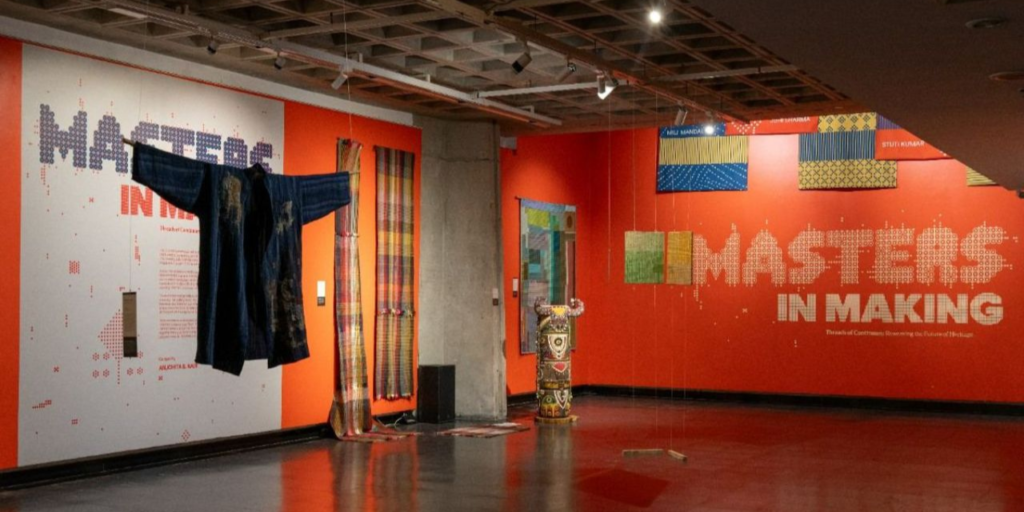
Indian textile traditions are finding new avenues of expression through contemporary art, as artists, artisans and craft-led organisations explore ways to connect inherited techniques with modern creative practices.
The exhibition Threads of Continuum: Reweaving the Future of Heritage, presented by Burgoyne Original Masters (BOM) and curated by Anjchita B Nair, brings together 20 artists, artisans, brands and collectives to examine this relationship.
The exhibition explores how weaving, embroidery, dyeing and indigenous material practices can move beyond conventional applications while retaining their cultural significance. It also highlights the role of artisan knowledge, community histories and material experimentation in shaping contemporary textile-based art.
For Aparupa Ray Ganguly, Curator and Creative Consultant at Burgoyne Original Masters, textiles provide a natural starting point for this initiative, given Burgoyne’s 120-year-old textile heritage.
“A textile is never simply a piece of fabric; it is the outcome of a complex relationship between material, memory, skill and the people who make it,” she explained.
Connecting Traditional Craftsmanship with Contemporary Practice
Through its Masters in Making grant initiative, Burgoyne Original Masters supports practitioners in developing their artistic practices and bringing their work to wider audiences.
The initiative encourages participants to reinterpret traditional techniques through installations, mixed media and interdisciplinary approaches. Rather than limiting textile heritage to historical preservation, the programme creates opportunities for traditional knowledge to engage with contemporary ideas and artistic experimentation.
“We often speak about preserving textile traditions, but I wanted us to also ask how these traditions might continue to evolve, and what new meanings they could acquire in the present,” Ganguly said.
According to curator Anjchita B Nair, the exhibition brings together diverse creative practices while allowing each participant’s individual approach to remain visible. Traditional weaving and embroidery appear alongside sculptural textiles and experimental installations, with colour, pattern, texture and scale establishing connections between the works.
One example is Jagrity Phukan’s The Touch of the Sun, which uses Muga and Eri silk to explore landscape, ecology and human emotion. The work demonstrates how textile materials and traditional craftsmanship can communicate ideas beyond their immediate physical and decorative functions.
Textiles as a Medium for Contemporary Art
The relationship between craft and contemporary art remains central to discussions about the recognition of textile-based practices. Although textiles are frequently associated with utility, fashion and cultural heritage, they can also address broader themes, including identity, labour, gender, power, memory, trade and belonging.
Nair argues that separating traditional craft from contemporary artistic practice can restrict how textile-based works are understood.
“A weaver working with a centuries-old technique can be just as innovative as an artist exploring an entirely new medium,” she shared.
The exhibition presents different approaches to textile-based creativity. Some works draw directly on inherited techniques, while others experiment with materials, scale and form. Their connection lies in the ways artists engage with traditional knowledge and translate it into contemporary artistic expression.
This approach positions textile craftsmanship as an evolving creative practice rather than a fixed historical tradition.
Recognising Artisans and Community Knowledge
The exhibition also draws attention to the individuals and communities whose skills and experiences contribute to textile production. Beyond the finished object, each textile can carry memories, inherited techniques and knowledge developed through generations of practice.
An example is Firewood Collection (Ancestral Story) by Porgai Artisans Association, created by Bhagyalakshmi, Kuppammal and Lavanya. The work draws on Kuppammal’s memories of gathering firewood and stories shared by village elders, connecting personal experiences with a broader collective narrative.
Crediting the individual makers alongside the association acknowledges their contribution to the work and highlights the cultural knowledge embedded in its creation.
Exhibition texts and conversations with participating artists further explain the materials, techniques and ideas behind the displayed works. This context encourages visitors to consider the time, labour and community histories involved in textile craftsmanship.
Ganguly emphasises that maintaining textile traditions does not require keeping them unchanged. Instead, their continued relevance depends on how thoughtfully contemporary practitioners engage with inherited knowledge and its cultural context.
The challenge is to create space for experimentation while recognising the communities and knowledge systems that sustain traditional practices.
Sustainable Applications and New Market Opportunities
The exhibition also examines how traditional textile techniques can find applications in contemporary design and commercial settings.
Nair highlights Indigene’s Modest Luxury, which repurposes leftover textiles through patchwork and Kantha embroidery, and Kalyani Prasad’s Kasota Saree Project, which reimagines a traditional woven textile for a new purpose while preserving its original weaving technique.
These projects illustrate how traditional skills can intersect with material reuse, contemporary design and sustainable textile practices.
When developed with consideration for the people and skills involved, such applications can create opportunities for traditional craftsmanship to reach new audiences. They can also support artisan livelihoods and strengthen recognition of the knowledge required to sustain textile traditions.
The relationship between galleries, markets and craft-led enterprises therefore forms another dimension of the discussion surrounding the future of Indian textile heritage.
Exhibition to Travel to Kochi in November 2026
The next chapter of Threads of Continuum: Reweaving the Future of Heritage is scheduled to take place in Kochi in November 2026, extending the exhibition’s conversation beyond Delhi.
For Burgoyne Original Masters, the initiative aims to encourage new relationships, critical engagement and further opportunities for participating practitioners.
By bringing together artists, artisans, traditional techniques and experimental approaches, the exhibition examines how India’s textile heritage can remain relevant within contemporary art. Its focus extends beyond preserving historic methods to recognising the people, materials and cultural knowledge that allow these practices to continue evolving.