
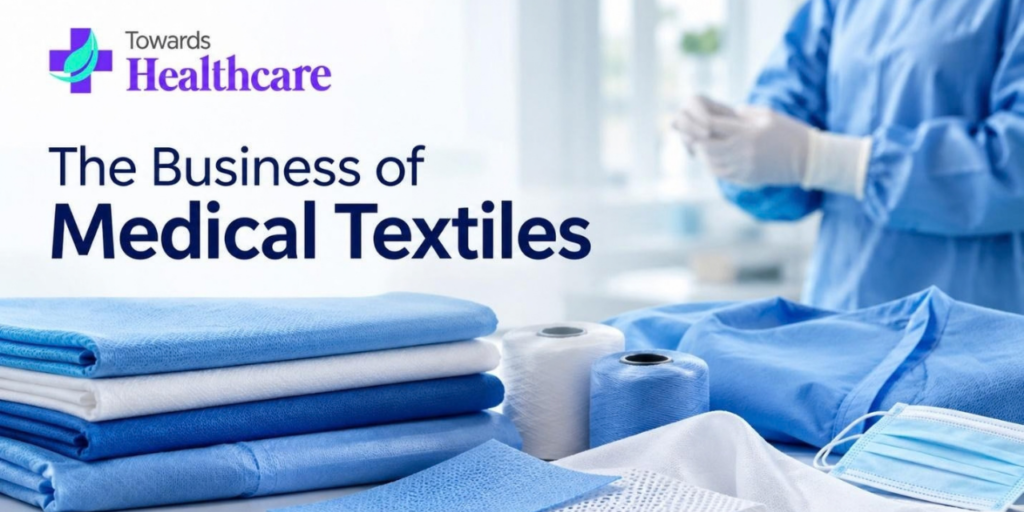
A medical gown, surgical drape, mask, or protective coverall may look like a simple textile product. Behind each product is a complex supply chain.
The medical textile industry brings together fiber producers, polymer companies, nonwoven manufacturers, fabric producers, coating specialists, garment manufacturers, and healthcare suppliers.
Today, companies compete on more than fabric production. Protection, durability, comfort, customization, and material innovation are becoming important factors across the market.
What Are Medical Textiles?
Medical textiles are textile-based materials designed for healthcare and medical applications.
They are used in surgical gowns, drapes, masks, wound-care products, protective clothing, hospital bedding, compression products, implants, and other healthcare applications.
Unlike conventional textiles, medical textiles must meet specific performance requirements. These can include:
- Hygiene and cleanliness
- Fluid resistance
- Mechanical strength
- Filtration
- Softness and comfort
- Sterilization compatibility
- Breathability
- Biocompatibility
The required properties depend on the intended medical application.
Who Makes the Materials?
The medical textile supply chain includes several layers of businesses. Each stage contributes to the performance of the final healthcare product.
Fiber and Polymer Producers
The supply chain often begins with raw materials.
Companies producing synthetic fibers, polymers, and specialty materials provide the basic building blocks for medical textiles.
Materials such as polypropylene, polyester, polyethylene, polyurethane, and specialty polymers can be engineered for different healthcare applications.
Their properties can influence strength, flexibility, filtration, barrier performance, and comfort.
Nonwoven Manufacturers
Nonwoven manufacturers convert fibers into engineered sheets and fabrics without conventional weaving or knitting.
This technology is important for many disposable healthcare products. These include surgical gowns, masks, drapes, caps, and protective covers.
Manufacturers can adjust fiber arrangement, density, bonding, and layering. These factors help create materials with specific performance characteristics.
Nonwovens can therefore play a major role in products where filtration and barrier protection are important.
Textile and Fabric Manufacturers
Other companies convert fibers and material structures into specialized fabrics.
Their products may focus on properties such as:
- Softness
- Strength
- Moisture management
- Fluid resistance
- Breathability
- Durability
These fabrics can then be supplied to medical garment manufacturers and healthcare-product companies.
Coating and Lamination Companies
Some medical textiles need additional layers to achieve the required performance.
Coatings, films, laminates, and membranes can add properties such as fluid resistance, barrier protection, flexibility, and controlled permeability.
This creates another specialized segment within the medical textile value chain.
Coating and lamination technologies can also allow manufacturers to develop materials for specific applications rather than relying on a single fabric structure.
Medical Garment Manufacturers
Medical garment manufacturers transform specialized materials into finished healthcare products.
These products can include surgical gowns, isolation gowns, coveralls, scrubs, masks, and other protective clothing.
At this stage, several factors can affect product performance. These include garment design, stitching, sealing, sizing, packaging, and sterilization.
Manufacturers must also select materials according to the intended use of the garment.
Why Material Selection Matters
Material selection directly affects how medical clothing performs.
For example, a surgical gown may require strong fluid resistance and barrier protection. A healthcare uniform may instead place greater emphasis on comfort, durability, and moisture management.
One material cannot meet every application requirement.
Manufacturers therefore need to select materials based on clinical requirements, exposure levels, operating conditions, and applicable regulatory standards.
This application-specific approach is creating opportunities for suppliers with specialized material technologies.
Where Is Innovation Happening?
Innovation in medical textiles is moving beyond conventional fabric development.
Companies are exploring a wide range of technologies and material structures, including:
- Engineered nonwovens
- Antimicrobial materials
- Advanced membranes
- Coated fabrics
- Recycled polymers
- Bio-based fibers
- Multifunctional textile structures
- Smart textiles
Smart textile technologies can also introduce sensing, monitoring, or electronic functions into textile-based products.
These developments are creating opportunities throughout the value chain. Material producers, textile manufacturers, technology companies, and finished-product manufacturers can all participate in this innovation cycle.
The Sustainability Challenge
Sustainability is becoming an important consideration for medical textile companies.
Healthcare facilities use large volumes of disposable gowns, masks, drapes, and other textile-based products. This creates interest in lighter materials, recyclable components, reusable medical clothing, recycled fibers, and more resource-efficient production.
However, sustainability must be considered alongside infection control and protective performance.
Medical textile manufacturers therefore face a complex challenge. They need to reduce environmental impact while maintaining the safety and performance required for healthcare applications.
What Does This Mean for Companies?
The medical textile opportunity extends beyond traditional textile manufacturing.
Companies can compete through several areas, including:
- Material innovation
- Specialized manufacturing
- Product design
- Sustainability
- Customization
- Application-specific performance
Material suppliers can develop differentiated fibers and polymers.
Textile manufacturers can create specialized fabric structures.
Garment manufacturers can use these materials to develop higher-performance healthcare products.
This creates a connected ecosystem. Innovation at one stage of the supply chain can influence product development at another stage.
What Lies Ahead?
The medical textile industry is likely to become increasingly specialized as healthcare applications evolve.
Protective healthcare clothing, advanced wound-care materials, smart textiles, sustainable fabrics, and high-performance nonwovens could create opportunities across the value chain.
For companies entering or expanding in this sector, understanding the complete ecosystem will be important.
This includes material suppliers, competitors, manufacturing capabilities, technology developments, customer requirements, regulatory needs, and emerging applications.
The future of medical textiles will therefore depend not only on producing better fabrics, but also on developing materials and products that meet specific healthcare needs.