Home / 6 PLI-Approved Textile Stocks to Watch as India Eases Incentive Rules
Below is a website-ready rewrite with improved readability, shorter sentences, clearer subheadings and better SEO structure. I have retained all six companies, financial figures, investment plans, PLI details and the disclaimer. The article remains analytical and does not present the stocks as investment recommendations. # 6 PLI-Approved Textile Stocks to Watch as India Eases Incentive Rules **India has reduced the minimum turnover requirement under Part 2 of its Textile PLI scheme from ₹200 crore to ₹100 crore. The revised rules could create new opportunities for textile manufacturers involved in MMF apparel, fabrics and technical textiles.** The Indian government has eased eligibility requirements under its Production Linked Incentive (PLI) scheme for textiles. The move aims to encourage fresh investments in man-made fibre (MMF) apparel, fabrics and technical textiles. On November 1, 2026, the Ministry of Textiles reopened applications under Round 4 of the Textile PLI scheme. It reduced the minimum turnover requirement under Part 2 from ₹200 crore to ₹100 crore. However, the minimum investment requirement remains unchanged at ₹50 crore. The final year for claiming incentives has also been extended to FY2033–34. Existing participants that have not claimed or received incentives may also migrate to the revised scheme, subject to specified conditions. This could give manufacturers more flexibility when reviewing their investment and expansion plans. But which listed textile companies already have a verified connection to the scheme? This article examines six listed textile manufacturers with documented PLI participation. The selection includes companies identified in government records as implementing PLI projects and those that have confirmed their approvals through stock exchange filings. The focus is on manufacturers with exposure to eligible MMF apparel, fabrics and technical textiles. Retail-focused and diversified businesses are excluded. It is important to note that PLI approval does not guarantee incentives. Actual benefits depend on eligible investments, qualifying product sales and compliance with the scheme's conditions. ## 1. Gokaldas Exports: PLI-Linked MMF Apparel Manufacturing and ₹150 Crore FY27 Capex Plan Gokaldas Exports manufactures and exports garments for international fashion brands. The company operates manufacturing facilities in India, Kenya and Ethiopia, with an annual production capacity of 92 million garments. Its subsidiary, Gokaldasexports Acharpura, participates in the government's Textile PLI scheme. The approved project in Madhya Pradesh covers MMF apparel, including outerwear, activewear and fashionwear. The company also has in-house capabilities in polyfill production, quilting, printing and garment finishing. ### Capacity Expansion Continues, but PLI Benefits Depend on MMF Apparel Sales According to its Q2FY27 investor presentation, Gokaldas Exports invested ₹106 crore during H1FY27. This included ₹67 crore for new capacity and projects. The company has planned total capital expenditure of ₹150 crore for FY27, subject to market conditions. In Q2FY27, consolidated revenue increased 13% year-on-year (YoY) to ₹1,113 crore. Net profit rose 410% to ₹41 crore. The India business recorded 10% growth, supported by stronger orders. Meanwhile, its African operations reported 32% growth. Improved profitability also reflected a favourable base and productivity gains. **Gokaldas Exports: Q2FY27 Financial Performance** | Metric | Q2FY27 | | -------------- | ------------ | | Revenue | ₹1,113 crore | | Revenue growth | 13% YoY | | Net profit | ₹41 crore | | Profit growth | 410% YoY | Source: Gokaldas Exports Q2FY27 Investor Presentation. The revised PLI framework could support eligible MMF investments. However, incentives will depend on qualifying production and turnover. Rising input costs, wages and freight expenses remain important challenges. Gokaldas Exports' share price declined 26.4% over the past year. ## 2. Pearl Global Industries: ₹725 Crore Expansion Plan and PLI-Linked MMF Apparel Manufacturing Pearl Global Industries manufactures and exports garments for international fashion brands. It operates manufacturing facilities across India, Bangladesh, Vietnam, Indonesia and Guatemala. The company participates in the Textile PLI scheme through Sead Apparels Private Limited in Madhya Pradesh. Its approved product categories include synthetic-fibre garments such as jackets, trousers, dresses and outerwear. This gives the company direct exposure to PLI-eligible MMF apparel manufacturing. ### ₹725 Crore Expansion Plan, but PLI Investment Remains Undisclosed According to its November 2026 investor presentation, Pearl Global plans to invest ₹675–725 crore between FY27 and FY30. The investment will support manufacturing expansion, supply-chain integration and operational efficiency. Its new Bangladesh facility is expected to add approximately 7 million garments annually at optimum utilisation. However, the company has not separately disclosed the investment committed to its Indian PLI project. In Q2FY27, consolidated revenue increased 37.2% YoY to ₹1,802 crore. Net profit rose 74.7% to ₹126 crore. Higher volumes, improved margins and a one-time tariff adjustment supported profitability. **Pearl Global Industries: Q2FY27 Financial Performance** | Metric | Q2FY27 | | -------------- | ------------ | | Revenue | ₹1,802 crore | | Revenue growth | 37.2% YoY | | Net profit | ₹126 crore | | Profit growth | 74.7% YoY | Source: Pearl Global Industries Q2FY27 Investor Presentation. The revised PLI framework could support its eligible Indian manufacturing operations. However, incentive payments will depend on qualifying investments and turnover. Rising working-capital requirements also remain a concern. Pearl Global Industries' share price increased 63% over the past year. ## 3. Sangam (India): Garment Utilisation Rises to 37%, ₹1,500 Crore Expansion Planned Sangam (India) is an integrated textile manufacturer. Its product portfolio includes polyester-viscose (PV) yarn, cotton yarn, suiting fabrics, denim and seamless garments. The company operates eight manufacturing facilities in Rajasthan. It participates in the Textile PLI scheme through its subsidiary, Sangam Ventures, which has approval under Part 2 for MMF apparel. Its seamless garment business contributes approximately 2% of total revenue. This provides direct exposure to the scheme, although garment manufacturing remains a relatively small part of its overall operations. ### Garment Utilisation Improves, with Further Expansion Planned According to its Q2FY27 earnings call, Sangam's garment capacity utilisation increased to 37%, compared with 22% a year earlier. Management expects full-year utilisation to reach 50–60%, supported by stronger orders in the second half. Separately, the company plans approximately ₹1,500 crore in capital expenditure by March 2029. The investment will cover manufacturing expansion, modernisation and renewable energy projects. However, the company has not separately disclosed the investment allocated to its PLI project. In Q2FY27, consolidated revenue increased 33% YoY to ₹1,045 crore. Net profit rose 130.9% to ₹53 crore. **Sangam (India): Q2FY27 Financial Performance** | Metric | Q2FY27 | | -------------- | ------------ | | Revenue | ₹1,045 crore | | Revenue growth | 33% YoY | | Net profit | ₹53 crore | | Profit growth | 130.9% YoY | Source: Sangam (India) Q2FY27 Investor Presentation. The revised PLI framework could support Sangam's MMF garment operations. However, low garment utilisation, rising debt and longer receivable cycles remain important factors to monitor. Sangam (India)'s share price increased 44.3% over the past year. ## 4. RSWM: ₹92 Crore Knitting Expansion and ₹208 Crore Garment Venture RSWM manufactures synthetic, blended and cotton yarns, denim and knitted fabrics. Its operations cover several stages of the textile value chain, with exports to more than 70 countries. The company was selected under Part 1 of the Textile PLI scheme for MMF fabrics. Its approved product categories include dyed synthetic fabrics, knitted fabrics and woven fabrics. ### Knitting Expansion Could Increase Fabric Revenue Contribution According to its Q2FY27 earnings call, RSWM's ₹92 crore knitting expansion is scheduled for completion by December 2026. Management expects fabrics to contribute approximately one-third of total revenue by Q1FY28, compared with around one-fourth currently. RSWM has also partnered with Spain-based NDS9 to develop premium denim and knitted garments. The first phase involves an investment of ₹208 crore, with operations expected by Q4FY28 or Q1FY29. In Q2FY27, revenue increased 15% YoY to ₹1,322.3 crore. Net profit rose approximately 289% to ₹24.5 crore. **RSWM: Q2FY27 Financial Performance** | Metric | Q2FY27 | | -------------- | -------------- | | Revenue | ₹1,322.3 crore | | Revenue growth | 15% YoY | | Net profit | ₹24.5 crore | | Profit growth | 289% YoY | Source: RSWM Q2FY27 Earnings Call Transcript. RSWM has verified participation under Part 1. However, the reduced turnover threshold applies to Part 2 and does not automatically change its existing approval. Any migration to the revised scheme will remain subject to the applicable conditions. Rising polyester costs and weak fabric margins are additional challenges. RSWM's share price increased 24% over the past year. ## 5. Borana Weaves: 384 New Looms Planned Under Its MMF Fabric Expansion Borana Weaves manufactures synthetic greige fabrics and polyester textured yarn in Surat, Gujarat. The company operates four manufacturing units with 1,212 water-jet looms. Its annual fabric production capacity stands at 38.9 crore metres. Synthetic greige fabrics contribute 92% of its revenue, giving the company direct exposure to MMF textile manufacturing. On July 2, 2026, Borana Weaves confirmed its approval under Round 3 of the Textile PLI scheme for MMF fabrics under Part 2. The approval establishes its participation in the scheme. However, incentive payments remain subject to investment, turnover and value-addition requirements. ### 384 New Looms Targeted for Commissioning by March 2027 According to its Q2FY27 investor presentation, Borana plans to add 384 water-jet looms at Unit 4. The company has divided the expansion into two phases: - **December 2026:** First 192 looms and three texturising machines targeted for commissioning. - **March 2027:** Remaining 192 looms targeted for commissioning. In Q2FY27, revenue increased 44.7% YoY to ₹138.2 crore. However, net profit declined 3.1% to ₹16.2 crore. **Borana Weaves: Q2FY27 Financial Performance** | Metric | Q2FY27 | | -------------- | ------------ | | Revenue | ₹138.2 crore | | Revenue growth | 44.7% YoY | | Net profit | ₹16.2 crore | | Profit growth | -3.1% YoY | Source: Borana Weaves Q2FY27 Investor Presentation. Delayed polyester yarn imports forced the company to make domestic purchases at costs 30–40% higher. This affected its profit margins. PLI participation and capacity expansion offer growth opportunities. However, raw material price fluctuations and delays in passing higher costs to customers remain key concerns. Borana Weaves' share price declined 15.1% over the past year. ## 6. Century Enka: Part 2 PLI Approval for Technical Textiles Century Enka manufactures nylon filament yarn and tyre cord fabrics used to reinforce automotive tyres. Its technical textile operations provide exposure to India's growing industrial textile market. On October 29, 2026, the company received approval from the Ministry of Textiles under Part 2 of the Textile PLI scheme for technical textiles. The approval confirms its participation. However, the company has not disclosed specific investment commitments or expected incentive amounts. ### Polyester Tyre Cord Sales Targeted for Q4FY27 According to its Q2FY27 earnings call, Century Enka expects commercial sales of polyester tyre cord fabric (PTCF) to begin in Q4FY27. Customer approvals are progressing, with higher capacity utilisation expected by H2FY28. In Q2FY27, revenue increased 37% YoY to ₹558 crore. However, net profit declined 17% to ₹19 crore. Tyre cord fabric sales increased 37% to ₹251 crore. Higher raw material and energy costs affected margins. Increased imports also impacted nylon tyre cord fabric volumes. The company expects additional hybrid power capacity to generate approximately ₹10 crore in annual savings. **Century Enka: Q2FY27 Financial Performance** | Metric | Q2FY27 | | -------------- | ---------- | | Revenue | ₹558 crore | | Revenue growth | 37% YoY | | Net profit | ₹19 crore | | Profit growth | -17% YoY | Source: Century Enka Q2FY27 Earnings Call Transcript. Its PLI approval strengthens its exposure to technical textiles. However, actual incentives will depend on qualifying investments and sales. Import competition, input costs and customer approval timelines remain important considerations. Century Enka's share price increased 3.4% over the past year. ## Conclusion: What the Revised Textile PLI Rules Mean for These Companies The reopening of the Textile PLI scheme with a lower turnover threshold could encourage fresh investments in MMF apparel, fabrics and technical textiles. For manufacturers already participating in the scheme, the revised provisions may provide greater flexibility. However, the benefits will depend on eligibility and compliance with migration conditions. The six companies discussed have documented links to the PLI scheme. Their exposure differs in terms of product categories, investment commitments and project execution. Importantly, the reduced turnover threshold applies to Part 2. It does not automatically benefit every existing participant. Investors and industry observers can monitor several factors when assessing the companies: - Growth in eligible MMF apparel, fabric and technical textile production. - Investment in new manufacturing capacity. - Capacity utilisation and qualifying product sales. - Compliance with PLI investment and turnover conditions. - Actual incentive claims and receipts. - Raw material costs, export demand and working-capital requirements. Ultimately, PLI approval is only the starting point. The financial benefits will depend on how effectively manufacturers convert investments into qualifying production, sales and sustainable profitability. ## **SEO details** **SEO Title:** 6 PLI-Approved Textile Stocks to Watch in India **Meta Description:** Explore six PLI-approved textile stocks as India lowers the Part 2 turnover threshold to ₹100 crore under the revised Textile PLI scheme. **Focus Keyphrase:** PLI-approved textile stocks **URL Slug:** `pli-approved-textile-stocks-india` **Image Alt Text:** Six Indian textile companies with approved participation in the Production Linked Incentive scheme. ### **Alternative SEO headlines** 1. 6 Textile Stocks to Watch After India's PLI Rule Changes 2. Textile PLI Scheme: 6 Listed Companies to Track 3. India Eases Textile PLI Rules: 6 Stocks in Focus 4. 6 Indian Textile Companies with PLI Scheme Approvals 5. Textile Stocks: New Opportunities Under Revised PLI Rules ### **Social media caption** 📊 India's revised Textile PLI scheme lowers the Part 2 turnover threshold from ₹200 crore to ₹100 crore. Explore six listed textile manufacturers with verified PLI participation and their latest expansion plans, financial performance and growth prospects. **Hashtags:** \#TextilePLI #TextileStocks #IndianTextileIndustry #GokaldasExports #PearlGlobal #RSWM #TechnicalTextiles #MMF **Tags:** Textile PLI Scheme, PLI-approved textile stocks, Gokaldas Exports, Pearl Global Industries, Sangam India, RSWM, Borana Weaves, Century Enka, MMF textiles, technical textiles, textile manufacturing **Category:** INDUSTRY UPDATES ### **Important editorial checks before publishing** The source article contains several stock-market and policy-specific claims. I recommend verifying these points before publishing: 1. **PLI scheme dates:** Confirm the Round 4 application reopening date, revised eligibility conditions and FY2033–34 incentive timeline against the Ministry of Textiles notification. 2. **Company approvals:** Retain the distinction between Part 1 and Part 2 approvals, especially for RSWM. 3. **Share-price performance:** All six one-year returns should be checked against the same market-data date. 4. **Financial figures:** Verify Q2FY27 revenue and profit numbers against the respective exchange filings. 5. **Investment disclaimer:** The original article's investment disclaimer and writer disclosure should be retained separately if this is being republished from Financial Express. The rewritten article is not an independent investment recommendation. **Suggested category:** INDUSTRY UPDATES, because the article primarily covers government policy changes and their implications for listed textile manufacturers.

6 PLI-Approved Textile Stocks to Watch as India Eases Incentive Rules

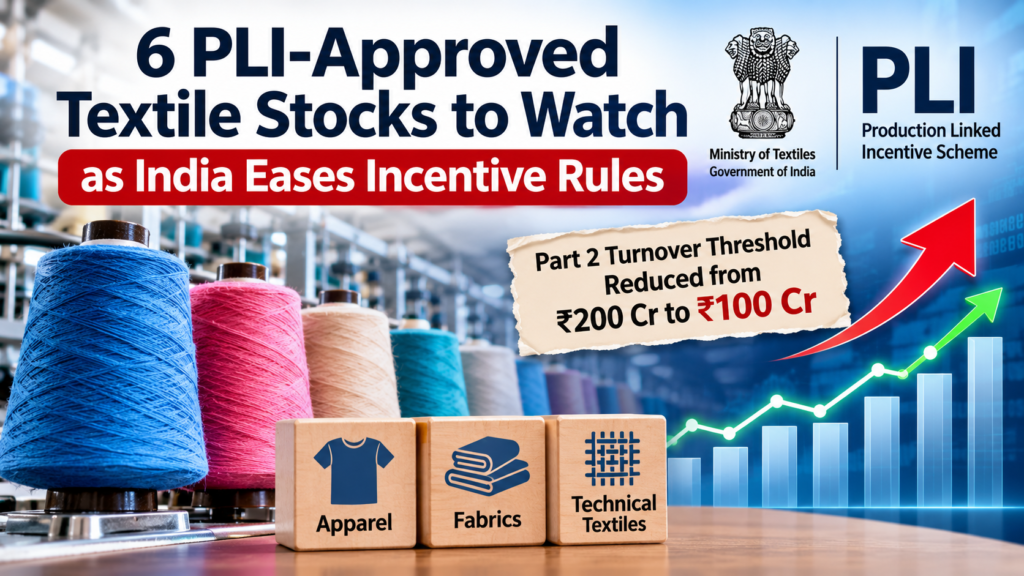
India has reduced the minimum turnover requirement under Part 2 of its Textile PLI scheme from ₹200 crore to ₹100 crore. The revised rules could create new opportunities for textile manufacturers involved in MMF apparel, fabrics and technical textiles.


The Indian government has eased eligibility requirements under its Production Linked Incentive (PLI) scheme for textiles. The move aims to encourage fresh investments in man-made fibre (MMF) apparel, fabrics and technical textiles.

On November 1, 2026, the Ministry of Textiles reopened applications under Round 4 of the Textile PLI scheme. It reduced the minimum turnover requirement under Part 2 from ₹200 crore to ₹100 crore. However, the minimum investment requirement remains unchanged at ₹50 crore. The final year for claiming incentives has also been extended to FY2033–34.

Existing participants that have not claimed or received incentives may also migrate to the revised scheme, subject to specified conditions. This could give manufacturers more flexibility when reviewing their investment and expansion plans.

But which listed textile companies already have a verified connection to the scheme?

This article examines six listed textile manufacturers with documented PLI participation. The selection includes companies identified in government records as implementing PLI projects and those that have confirmed their approvals through stock exchange filings.

The focus is on manufacturers with exposure to eligible MMF apparel, fabrics and technical textiles. Retail-focused and diversified businesses are excluded.

It is important to note that PLI approval does not guarantee incentives. Actual benefits depend on eligible investments, qualifying product sales and compliance with the scheme’s conditions.

1. Gokaldas Exports: PLI-Linked MMF Apparel Manufacturing and ₹150 Crore FY27 Capex Plan

Gokaldas Exports manufactures and exports garments for international fashion brands. The company operates manufacturing facilities in India, Kenya and Ethiopia, with an annual production capacity of 92 million garments.

Its subsidiary, Gokaldasexports Acharpura, participates in the government’s Textile PLI scheme. The approved project in Madhya Pradesh covers MMF apparel, including outerwear, activewear and fashionwear.

The company also has in-house capabilities in polyfill production, quilting, printing and garment finishing.

Capacity Expansion Continues, but PLI Benefits Depend on MMF Apparel Sales

According to its Q2FY27 investor presentation, Gokaldas Exports invested ₹106 crore during H1FY27. This included ₹67 crore for new capacity and projects.

The company has planned total capital expenditure of ₹150 crore for FY27, subject to market conditions.

In Q2FY27, consolidated revenue increased 13% year-on-year (YoY) to ₹1,113 crore. Net profit rose 410% to ₹41 crore.

The India business recorded 10% growth, supported by stronger orders. Meanwhile, its African operations reported 32% growth.

Improved profitability also reflected a favourable base and productivity gains.

Gokaldas Exports: Q2FY27 Financial Performance

Metric Q2FY27
Revenue ₹1,113 crore
Revenue growth 13% YoY
Net profit ₹41 crore
Profit growth 410% YoY

Source: Gokaldas Exports Q2FY27 Investor Presentation.

The revised PLI framework could support eligible MMF investments. However, incentives will depend on qualifying production and turnover. Rising input costs, wages and freight expenses remain important challenges.

Gokaldas Exports’ share price declined 26.4% over the past year.

2. Pearl Global Industries: ₹725 Crore Expansion Plan and PLI-Linked MMF Apparel Manufacturing

Pearl Global Industries manufactures and exports garments for international fashion brands. It operates manufacturing facilities across India, Bangladesh, Vietnam, Indonesia and Guatemala.

The company participates in the Textile PLI scheme through Sead Apparels Private Limited in Madhya Pradesh. Its approved product categories include synthetic-fibre garments such as jackets, trousers, dresses and outerwear.

This gives the company direct exposure to PLI-eligible MMF apparel manufacturing.

₹725 Crore Expansion Plan, but PLI Investment Remains Undisclosed

According to its November 2026 investor presentation, Pearl Global plans to invest ₹675–725 crore between FY27 and FY30.

The investment will support manufacturing expansion, supply-chain integration and operational efficiency.

Its new Bangladesh facility is expected to add approximately 7 million garments annually at optimum utilisation. However, the company has not separately disclosed the investment committed to its Indian PLI project.

In Q2FY27, consolidated revenue increased 37.2% YoY to ₹1,802 crore. Net profit rose 74.7% to ₹126 crore.

Higher volumes, improved margins and a one-time tariff adjustment supported profitability.

Pearl Global Industries: Q2FY27 Financial Performance

Metric Q2FY27
Revenue ₹1,802 crore
Revenue growth 37.2% YoY
Net profit ₹126 crore
Profit growth 74.7% YoY

Source: Pearl Global Industries Q2FY27 Investor Presentation.

The revised PLI framework could support its eligible Indian manufacturing operations. However, incentive payments will depend on qualifying investments and turnover. Rising working-capital requirements also remain a concern.

Pearl Global Industries’ share price increased 63% over the past year.

3. Sangam (India): Garment Utilisation Rises to 37%, ₹1,500 Crore Expansion Planned

Sangam (India) is an integrated textile manufacturer. Its product portfolio includes polyester-viscose (PV) yarn, cotton yarn, suiting fabrics, denim and seamless garments.

The company operates eight manufacturing facilities in Rajasthan.

It participates in the Textile PLI scheme through its subsidiary, Sangam Ventures, which has approval under Part 2 for MMF apparel.

Its seamless garment business contributes approximately 2% of total revenue. This provides direct exposure to the scheme, although garment manufacturing remains a relatively small part of its overall operations.

Garment Utilisation Improves, with Further Expansion Planned

According to its Q2FY27 earnings call, Sangam’s garment capacity utilisation increased to 37%, compared with 22% a year earlier.

Management expects full-year utilisation to reach 50–60%, supported by stronger orders in the second half.

Separately, the company plans approximately ₹1,500 crore in capital expenditure by March 2029. The investment will cover manufacturing expansion, modernisation and renewable energy projects.

However, the company has not separately disclosed the investment allocated to its PLI project.

In Q2FY27, consolidated revenue increased 33% YoY to ₹1,045 crore. Net profit rose 130.9% to ₹53 crore.

Sangam (India): Q2FY27 Financial Performance

Metric Q2FY27
Revenue ₹1,045 crore
Revenue growth 33% YoY
Net profit ₹53 crore
Profit growth 130.9% YoY

Source: Sangam (India) Q2FY27 Investor Presentation.

The revised PLI framework could support Sangam’s MMF garment operations. However, low garment utilisation, rising debt and longer receivable cycles remain important factors to monitor.

Sangam (India)’s share price increased 44.3% over the past year.

4. RSWM: ₹92 Crore Knitting Expansion and ₹208 Crore Garment Venture

RSWM manufactures synthetic, blended and cotton yarns, denim and knitted fabrics. Its operations cover several stages of the textile value chain, with exports to more than 70 countries.

The company was selected under Part 1 of the Textile PLI scheme for MMF fabrics.

Its approved product categories include dyed synthetic fabrics, knitted fabrics and woven fabrics.

Knitting Expansion Could Increase Fabric Revenue Contribution

According to its Q2FY27 earnings call, RSWM’s ₹92 crore knitting expansion is scheduled for completion by December 2026.

Management expects fabrics to contribute approximately one-third of total revenue by Q1FY28, compared with around one-fourth currently.

RSWM has also partnered with Spain-based NDS9 to develop premium denim and knitted garments. The first phase involves an investment of ₹208 crore, with operations expected by Q4FY28 or Q1FY29.

In Q2FY27, revenue increased 15% YoY to ₹1,322.3 crore. Net profit rose approximately 289% to ₹24.5 crore.

RSWM: Q2FY27 Financial Performance

Metric Q2FY27
Revenue ₹1,322.3 crore
Revenue growth 15% YoY
Net profit ₹24.5 crore
Profit growth 289% YoY

Source: RSWM Q2FY27 Earnings Call Transcript.

RSWM has verified participation under Part 1. However, the reduced turnover threshold applies to Part 2 and does not automatically change its existing approval. Any migration to the revised scheme will remain subject to the applicable conditions.

Rising polyester costs and weak fabric margins are additional challenges.

RSWM’s share price increased 24% over the past year.

5. Borana Weaves: 384 New Looms Planned Under Its MMF Fabric Expansion

Borana Weaves manufactures synthetic greige fabrics and polyester textured yarn in Surat, Gujarat.

The company operates four manufacturing units with 1,212 water-jet looms. Its annual fabric production capacity stands at 38.9 crore metres.

Synthetic greige fabrics contribute 92% of its revenue, giving the company direct exposure to MMF textile manufacturing.

On July 2, 2026, Borana Weaves confirmed its approval under Round 3 of the Textile PLI scheme for MMF fabrics under Part 2.

The approval establishes its participation in the scheme. However, incentive payments remain subject to investment, turnover and value-addition requirements.

384 New Looms Targeted for Commissioning by March 2027

According to its Q2FY27 investor presentation, Borana plans to add 384 water-jet looms at Unit 4.

The company has divided the expansion into two phases:

  • December 2026: First 192 looms and three texturising machines targeted for commissioning.
  • March 2027: Remaining 192 looms targeted for commissioning.

In Q2FY27, revenue increased 44.7% YoY to ₹138.2 crore. However, net profit declined 3.1% to ₹16.2 crore.

Borana Weaves: Q2FY27 Financial Performance

Metric Q2FY27
Revenue ₹138.2 crore
Revenue growth 44.7% YoY
Net profit ₹16.2 crore
Profit growth -3.1% YoY

Source: Borana Weaves Q2FY27 Investor Presentation.

Delayed polyester yarn imports forced the company to make domestic purchases at costs 30–40% higher. This affected its profit margins.

PLI participation and capacity expansion offer growth opportunities. However, raw material price fluctuations and delays in passing higher costs to customers remain key concerns.

Borana Weaves’ share price declined 15.1% over the past year.

6. Century Enka: Part 2 PLI Approval for Technical Textiles

Century Enka manufactures nylon filament yarn and tyre cord fabrics used to reinforce automotive tyres.

Its technical textile operations provide exposure to India’s growing industrial textile market.

On October 29, 2026, the company received approval from the Ministry of Textiles under Part 2 of the Textile PLI scheme for technical textiles.

The approval confirms its participation. However, the company has not disclosed specific investment commitments or expected incentive amounts.

Polyester Tyre Cord Sales Targeted for Q4FY27

According to its Q2FY27 earnings call, Century Enka expects commercial sales of polyester tyre cord fabric (PTCF) to begin in Q4FY27.

Customer approvals are progressing, with higher capacity utilisation expected by H2FY28.

In Q2FY27, revenue increased 37% YoY to ₹558 crore. However, net profit declined 17% to ₹19 crore.

Tyre cord fabric sales increased 37% to ₹251 crore.

Higher raw material and energy costs affected margins. Increased imports also impacted nylon tyre cord fabric volumes.

The company expects additional hybrid power capacity to generate approximately ₹10 crore in annual savings.

Century Enka: Q2FY27 Financial Performance

Metric Q2FY27
Revenue ₹558 crore
Revenue growth 37% YoY
Net profit ₹19 crore
Profit growth -17% YoY

Source: Century Enka Q2FY27 Earnings Call Transcript.

Its PLI approval strengthens its exposure to technical textiles. However, actual incentives will depend on qualifying investments and sales. Import competition, input costs and customer approval timelines remain important considerations.

Century Enka’s share price increased 3.4% over the past year.

Conclusion: What the Revised Textile PLI Rules Mean for These Companies

The reopening of the Textile PLI scheme with a lower turnover threshold could encourage fresh investments in MMF apparel, fabrics and technical textiles.

For manufacturers already participating in the scheme, the revised provisions may provide greater flexibility. However, the benefits will depend on eligibility and compliance with migration conditions.

The six companies discussed have documented links to the PLI scheme. Their exposure differs in terms of product categories, investment commitments and project execution.

Importantly, the reduced turnover threshold applies to Part 2. It does not automatically benefit every existing participant.

Investors and industry observers can monitor several factors when assessing the companies:

  • Growth in eligible MMF apparel, fabric and technical textile production.
  • Investment in new manufacturing capacity.
  • Capacity utilisation and qualifying product sales.
  • Compliance with PLI investment and turnover conditions.
  • Actual incentive claims and receipts.
  • Raw material costs, export demand and working-capital requirements.

Ultimately, PLI approval is only the starting point. The financial benefits will depend on how effectively manufacturers convert investments into qualifying production, sales and sustainable profitability.

Leave a Comment

Your email address will not be published. Required fields are marked *