
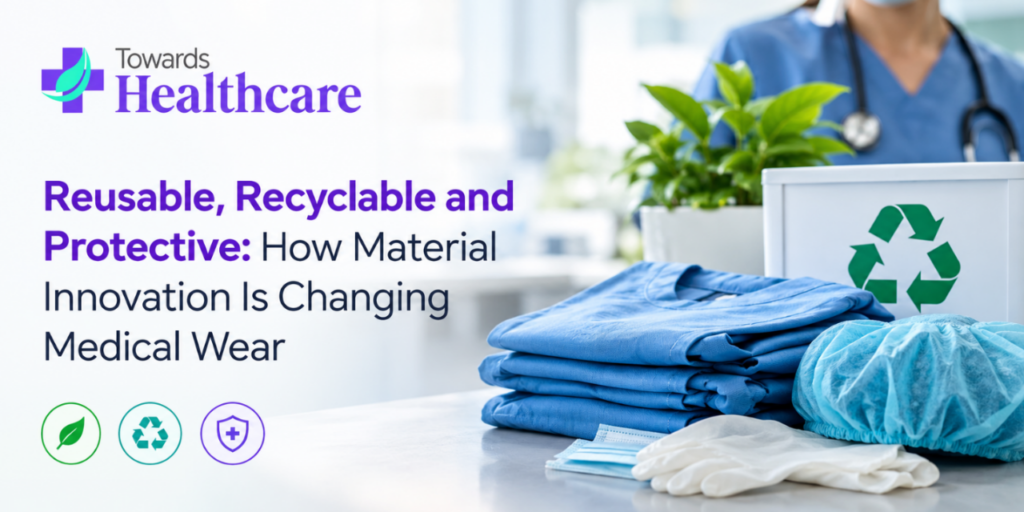
Medical gowns, scrubs, coveralls, masks and other protective garments are essential across healthcare environments. However, the widespread use of disposable medical products has increased concerns around material consumption and waste.
This is driving growing interest in reusable, recyclable and sustainable medical wear that can provide reliable protection while supporting more responsible material use.
Advances in material engineering are enabling manufacturers to explore new fibers, polymers, coatings, membranes and textile structures designed to combine healthcare performance with durability and improved sustainability.
Why Does Sustainable Medical Wear Matter?
Healthcare facilities use significant quantities of protective clothing and textiles every day. Many products are designed for single use because infection control and hygiene remain critical requirements.
While disposable products can support infection prevention, their continued use can generate substantial quantities of material waste.
As a result, manufacturers and healthcare stakeholders are exploring medical wear that can be safely reused, recycled where technically feasible, or produced using materials and structures that can reduce environmental impact.
What Makes Medical Wear Reusable?
Reusable medical clothing is designed to withstand repeated use while maintaining its required performance.
The materials need to tolerate washing, drying, sterilisation and repeated handling without losing properties such as strength, fluid resistance, comfort and dimensional stability.
Advanced textile structures, durable fibers, protective coatings and engineered polymers can help extend the useful service life of medical garments.
However, reusability depends on the intended application and the ability of the garment to meet the relevant healthcare, cleaning and sterilisation requirements.
Can Medical Wear Be Recyclable?
Recyclability presents a different material challenge.
Medical garments can contain several different components, including fibers, coatings, membranes, elastic materials and fasteners. Separating these materials after use can make recycling more difficult.
Material innovation is therefore exploring simpler material structures, recyclable polymers, recycled fibers and product designs that can facilitate processing at the end of a garment’s useful life.
How Is Material Innovation Changing Medical Wear?
According to Towards Healthcare Research and Consulting, the global medical clothing market was estimated at USD 122.74 billion in 2025. The market is projected to reach USD 130.65 billion in 2026 and approximately USD 229.31 billion by 2035, expanding at a CAGR of 6.45% from 2026 to 2035.
Several areas of material development are contributing to the evolution of medical wear.
Advanced Fibers
New fiber structures can provide combinations of strength, softness, durability and moisture management.
These characteristics can support reusable medical clothing while helping maintain comfort during extended periods of wear.
Engineered Polymers
Medical-grade polymers can be engineered to provide specific characteristics such as flexibility, durability, chemical resistance and barrier performance.
They can be used in protective clothing and components where conventional materials may not provide the required combination of properties.
Sustainable Coatings and Membranes
Coatings and membranes can provide fluid resistance and protective performance while enabling manufacturers to investigate lighter material structures and improved durability.
Future material development may also focus on coatings that are easier to remove, recover or recycle at the end of a product’s service life.
Where Can Reusable and Recyclable Medical Wear Be Used?
Sustainable medical wear can have applications across a range of healthcare products, including:
- Reusable surgical gowns
- Patient gowns
- Medical scrubs
- Protective coveralls
- Healthcare uniforms
- Reusable masks
- Hospital textiles
- Other protective medical clothing
The material requirements vary depending on the required protection level, frequency of use, cleaning and sterilisation processes, and the clinical environment.
Benefits of Sustainable Medical Wear
Reduced material waste: Reusable products can reduce the volume of single-use textiles entering waste streams.
Longer product life: Durable engineered materials can support repeated use and cleaning.
Resource efficiency: Lightweight and optimised material structures may reduce the resources required to manufacture individual products.
Performance and protection: Advanced materials can combine sustainability considerations with properties such as strength, fluid resistance, comfort and durability.
Challenges and Limitations
The transition toward reusable and recyclable medical wear also presents several challenges.
Infection control: Reusable products must meet stringent cleaning, sterilisation and hygiene requirements.
Durability: Materials need to maintain their performance through repeated washing and use.
Recycling complexity: Blended textiles, coatings, membranes and mixed components can make material recovery more difficult.
Cost: Advanced sustainable materials and specialised processing can increase initial manufacturing costs.
End-of-life management: Effective recycling requires suitable collection, separation, processing and recovery systems.
The Role of Medical Engineered Materials
The development of sustainable medical wear is closely connected with advances in medical engineered materials.
Rather than designing materials solely around protection, manufacturers can develop fibers, polymers, membranes, coatings and composites with multiple performance requirements in mind.
These requirements can include durability, fluid resistance, comfort, breathability, antimicrobial performance, recyclability and reduced material consumption.
Medical engineered materials can therefore contribute to protective healthcare clothing designed not only for its immediate application but also for longer service life and more responsible material management.
What Lies Ahead?
The future of medical wear could see greater use of durable reusable fabrics, recyclable polymers, recycled fibers, mono-material designs and improved textile recovery systems.
Material developers will need to balance sustainability with the safety, hygiene and performance requirements of healthcare environments.
The objective is not necessarily to replace every disposable medical product. Instead, opportunities may exist to identify applications where reuse, recycling, material efficiency and advanced engineering can provide practical alternatives without compromising required healthcare performance.
Conclusion
Medical wear is evolving towards a model in which protection and sustainability can be considered together.
Advances in medical engineered materials are creating opportunities for reusable, recyclable, durable and high-performance healthcare clothing. As material technologies and recovery systems develop, they could support a more resource-efficient approach to medical textiles while maintaining the performance requirements of healthcare environments.