
The solid state transformers market is gaining attention as electricity networks adapt to renewable energy, electric vehicles and changing power demand.
Solid state transformers (SSTs) use power electronics and semiconductor technology to manage electricity more actively than conventional transformers. Their ability to control power flow in real time is creating new opportunities across power grids, EV charging and industrial applications.
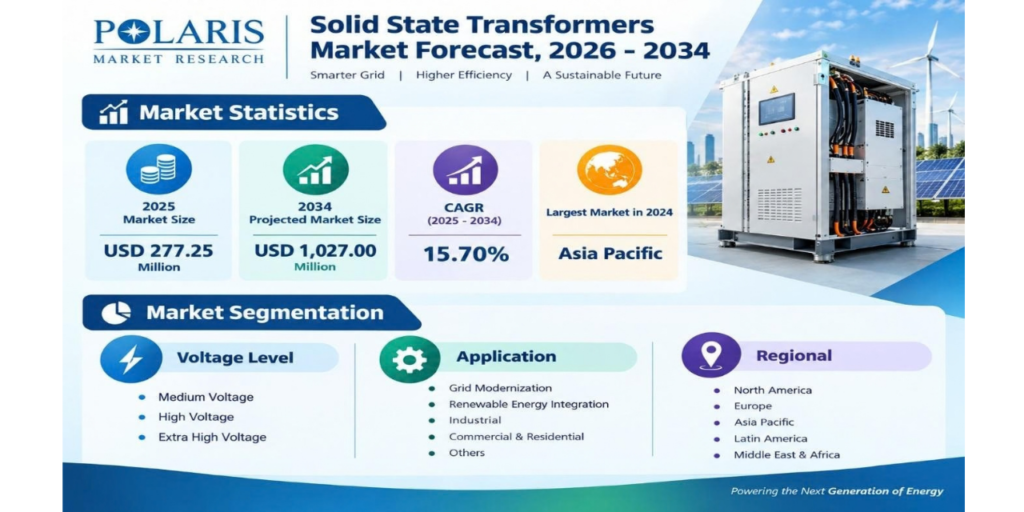
According to Polaris Market Research, the global solid state transformers market was valued at USD 240.49 million in 2024. The market is projected to reach USD 1.03 billion by 2034, growing at a CAGR of 15.7%.
Changing Power Requirements Drive SST Demand
Traditional transformers were designed for a power system in which electricity generally moved in one direction.
The growth of renewable energy is changing this model.
Rooftop solar systems can send electricity back into distribution networks. Wind farms can produce variable power. At the same time, electric vehicle charging can create large changes in electricity demand.
These changes are increasing the need for equipment that can manage power flows more dynamically.
Solid state transformers use semiconductor-based power electronics to control and redirect electricity. This bidirectional capability is one of the factors supporting interest in SST technology.
U.S. Investment Supports Transformer Technology
Government support is also contributing to development in the sector.
In 2024, the U.S. Department of Energy announced an $18 million initiative focused on advancing next-generation transformer technology.
Such programmes are supporting research and development in power equipment as electricity networks become more digital and increasingly connected to renewable energy sources.
Applications Across Energy and Industry
Solid state transformers have potential applications beyond traditional substations.
EV Charging
Electric vehicle charging is one of the areas attracting interest in SST technology.
Solid state transformers can support power conversion and help manage high-power charging requirements. Their ability to control electricity flows can also support the development of faster charging systems.
Renewable Energy
Renewable energy installations can experience variations in power generation.
SSTs can help manage these changing power flows and connect renewable generation with modern electricity networks.
This makes the technology relevant to applications involving solar and wind power.
Industrial Applications
Factories are also increasing their use of electric equipment as industrial processes become more electrified.
SSTs can provide greater control over power quality and electricity distribution within industrial facilities.
This creates opportunities for power electronics manufacturers and semiconductor companies to expand into the growing market.
Higher Cost Remains a Challenge
Despite their potential benefits, solid state transformers face an important barrier: higher upfront costs.
SSTs are currently more expensive than conventional transformers in many applications.
Businesses therefore need to consider the initial investment alongside potential benefits such as energy efficiency, power management and reduced system losses.
The economics can also vary between applications. A utility operating infrastructure over several decades may evaluate an SST differently from an EV charging network focused on high-power charging and faster deployment.
Asia Pacific Leads the Market
Asia Pacific accounted for the largest share of the solid state transformers market in 2024, according to the market information provided by Polaris Market Research.
Growth in the region is supported by industrial development in countries such as China, India and Japan.
The region is also a major centre for electric vehicle manufacturing. This creates additional opportunities for SST technology in EV charging infrastructure.
China’s development of hybrid AC/DC grid infrastructure in Jiangsu Province is another example of investment in new electricity network configurations.
North America Focuses on Early Applications
North America is following a different development path, with strong activity in research, technology development and early applications.
The region has established power equipment manufacturers and research institutions. Government support for clean-energy technologies is also contributing to development.
One example is a 400-kilowatt SST-based ultra-fast EV charger developed by Delta Electronics with U.S. Department of Energy collaborators.
These developments demonstrate how SST technology is being explored for high-power EV charging applications.
Major Companies Invest in Technology
The competitive landscape includes major power equipment and semiconductor companies such as Siemens, ABB, Toshiba, Infineon and STMicroelectronics, alongside specialised technology providers.
Innovation is increasingly taking place at the intersection of power electronics, grid technology and digital systems.
Companies are also looking at ways to reduce costs and improve the performance of SST systems.
Hitachi Energy’s WindSTAR transformer production reflects growing investment in transformer technology for offshore wind applications.
At the same time, developments in smart-grid technology are connecting power equipment with monitoring, analytics and digital control systems.
Digitalisation Creates New Requirements
As power equipment becomes more connected, cybersecurity and system monitoring are becoming increasingly important.
Modern grid equipment can incorporate sensors, analytics and digital communication. These features can improve monitoring and maintenance but also create additional requirements for cybersecurity.
This means future power infrastructure will need to combine electrical performance with digital security.
EV Charging Could Support Future Growth
The automotive sector, particularly EV charging infrastructure, is expected to be one of the faster-growing application areas for SST technology through 2034.
The development of vehicle-to-grid (V2G) systems could further increase interest in bidirectional power management.
V2G technology allows compatible electric vehicles to send electricity back to the grid. This requires systems capable of managing electricity in both directions.
SST technology is suited to this type of power management.
Grid Applications Remain Important
SST applications at high-voltage and medium-voltage levels are also expected to attract investment.
These applications can benefit from improved control of power flows and integration with modern grid infrastructure.
However, wider adoption will depend heavily on costs.
As production volumes increase and semiconductor technology develops, the cost of SST systems could become more competitive across a wider range of applications.
What Does the Future Hold?
The development of solid state transformers reflects a broader change in electricity infrastructure.
Power systems are becoming more distributed, digital and dependent on variable renewable energy sources. At the same time, electricity demand is increasing in areas such as electric transportation and industrial electrification.
SSTs offer a way to actively manage these changing power flows.
The technology still faces challenges related to cost, scalability and deployment. However, continued investment in renewable energy, EV charging and smart-grid infrastructure is creating new opportunities for solid state transformers.
Conclusion
Solid state transformers are emerging as an important technology in the development of modern power infrastructure.
Their ability to actively manage electricity flows makes them relevant to renewable energy, EV charging, industrial electrification and smart-grid applications.
With the global market projected to grow from USD 240.49 million in 2024 to USD 1.03 billion by 2034, the technology is attracting increasing attention from utilities, equipment manufacturers and power electronics companies.
The pace of adoption will depend on technological development, manufacturing scale and the ability to reduce the cost gap with conventional transformers.