
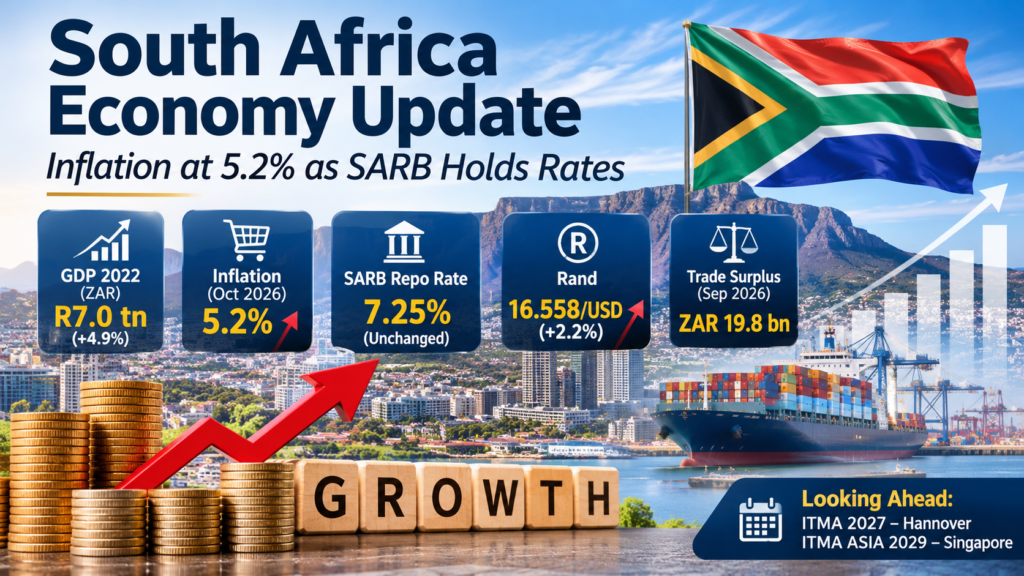
GDP rebasing increases the measured economy to ZAR 8 trillion, while rising fuel prices, rand weakness and potential US AGOA withdrawal create economic challenges.
South Africa’s economy is facing a mixed economic outlook, with higher inflation, currency weakness and uncertainty over international trade preferences. In its November 25, 2026 economic update, the country reported an increase in measured GDP following a rebasing exercise, while headline inflation climbed to 5.2% in October. The South African Reserve Bank (SARB) kept its repo rate unchanged at 7.25%. Meanwhile, a potential withdrawal of US trade benefits under the African Growth and Opportunity Act (AGOA) could affect key export industries.
South Africa’s GDP Increases Following Rebasing
Statistics South Africa (Stats SA) released its revised GDP estimates on October 29, 2026. The exercise changed the national accounts’ base year from 2015 to 2022.
The revision incorporated updated data sources, improved measurement methods and wider coverage of economic activities. It also included better estimates of the non-observed economy.
Following the revision, South Africa’s measured economic output increased by 4.9% in 2022. Nominal GDP rose from ZAR 6.7 trillion to ZAR 7.0 trillion.
The revised estimates also increased the country’s 2025 nominal GDP by 5.3%, from ZAR 7.6 trillion to ZAR 8.0 trillion.
Mining and Financial Services Drive GDP Revisions
Improved measurement of mining and financial services contributed to the upward GDP revision.
Mining GDP increased by 12.5%, reflecting better coverage of illegal mining activities. Meanwhile, finance, real estate and business services recorded a 9.1% increase due to methodological improvements in measuring owner-occupied housing.
The non-observed economy also accounted for a significant share of economic activity. It represented 8.7% of measured economic activity in 2022, equivalent to ZAR 551 billion.
GDP Rebasing Changes Debt-to-GDP Estimates
The revised GDP figures also affected South Africa’s fiscal indicators.
Following the rebasing exercise, National Treasury revised its gross debt-to-GDP estimate for 2025/26 from 78.4% to 74.6%.
However, the lower ratio does not indicate a reduction in government debt. Instead, it largely reflects the increase in measured GDP, which raises the denominator used in the calculation.
Key changes following GDP rebasing
| Indicator | Previous estimate | Revised estimate |
|---|---|---|
| 2022 nominal GDP | ZAR 6.7 trillion | ZAR 7.0 trillion |
| 2025 nominal GDP | ZAR 7.6 trillion | ZAR 8.0 trillion |
| Gross debt-to-GDP (2025/26) | 78.4% | 74.6% |
Source: Stats SA and National Treasury.
South Africa’s Inflation Rises to 5.2% in October
South Africa’s headline inflation increased to 5.2% year-on-year in October 2026, compared with 4.5% in September. This was the highest reading since May 2024.
On a monthly basis, consumer prices increased by 0.7%. Higher fuel prices and transport costs were the main contributors to the increase.
Transport remained the largest contributor to headline inflation. Prices in this category rose by 15.2% year-on-year, adding 2.1 percentage points to the overall inflation rate.
Fuel prices increased by 11.8% month-on-month and 42.9% year-on-year. Higher global oil prices and a weaker rand contributed to this increase.
Other major inflation contributors included:
- Housing and utilities: Inflation remained at 5.2%, contributing 1.3 percentage points.
- Insurance and financial services: Prices increased by 5.3%, contributing 0.6 percentage points.
- Food and non-alcoholic beverages: Inflation rose to 1.4% year-on-year, supported by higher prices for vegetables, fish and sugar-related products.
However, food inflation remained relatively contained due to continued price weakness in key staples, including cereals and meat products.
Core Inflation Remains Relatively Moderate
Despite the increase in headline inflation, underlying price pressures remained comparatively moderate.
Core inflation, which excludes food, non-alcoholic beverages, fuel and energy, edged up to 4.2% in October from 4.1% in September.
This indicates that the latest increase in headline inflation was largely driven by fuel-related price pressures rather than widespread increases across the economy.
Inflation is expected to remain above the South African Reserve Bank’s preferred 3% target in the near term. Global oil prices, exchange rate movements and the possibility of higher wage demands will remain important factors influencing the outlook.
SARB Keeps Repo Rate Unchanged at 7.25%
The South African Reserve Bank’s Monetary Policy Committee (MPC) maintained the repo rate at 7.25% during its November 2026 meeting.
The decision followed two policy adjustments earlier in the year. However, the latest vote was closely divided.
Four MPC members supported keeping the rate unchanged, while three favoured a 25-basis-point increase.
The committee described its monetary policy stance as moderately restrictive. It also indicated that further rate increases remain possible if necessary to bring inflation back towards the 3% target.
Inflation Risks Remain a Concern
The SARB expects inflation to remain above 5% into early 2027 before gradually moderating.
Its latest forecasts are:
| Economic indicator | 2026 forecast | 2027 forecast |
|---|---|---|
| Average headline inflation | 4.3% | 4.0% |
| Core inflation | 3.8% | 4.0% |
The central bank identified several risks that could push inflation higher. These include elevated global oil prices, higher international interest rates, rand depreciation and potential increases in food prices due to adverse weather conditions.
Economic Growth Outlook Remains Cautious
The SARB expects economic activity to recover gradually. Growth is projected at 1.2% in 2026, before moving towards approximately 2% annually over the 2026–2029 forecast period.
However, weak fixed investment remains a major constraint. Investment is currently estimated at around 13% of GDP.
The central bank also assessed alternative economic scenarios. A rise in oil prices to as much as USD 130 per barrel, combined with higher refinery margins, could increase inflation and weaken economic growth.
Similarly, higher global bond yields and risk premiums could create additional economic pressure.
The narrow MPC voting split highlights uncertainty over the future direction of interest rates. Rising fuel costs and potential currency weakness could delay monetary easing.
South African Rand Weakens Against the US Dollar
The South African rand weakened against the US dollar in October 2026.
The average exchange rate depreciated by 2.2% month-on-month, moving from ZAR 16.205 per US dollar in September to ZAR 16.558 in October.
Despite this decline, the rand remained stronger than its levels earlier in the year.
South Africa’s favourable interest rate differential and resilient commodity export earnings continued to provide some support.
Global Developments Put Pressure on the Rand
The currency’s depreciation was largely linked to changes in global financial conditions.
Following the US Federal Reserve’s September policy rate increase, the US dollar strengthened as investors reassessed the outlook for American interest rates.
At the same time, rising geopolitical tensions in the Middle East and higher global oil prices weakened investor sentiment. These developments also moderated capital flows towards emerging markets.
The external pressures offset some of the support provided by South Africa’s continued trade surplus.
Looking ahead, the rand will remain sensitive to global financial conditions, energy prices and US monetary policy.
A stronger US dollar, weaker commodity prices or declining global risk appetite could create further pressure. However, South Africa’s trade surplus and relatively high real interest rates are expected to offer some support.
South Africa Records ZAR 19.8 Billion Trade Surplus in September
South Africa recorded a preliminary trade surplus of ZAR 19.8 billion in September 2026, compared with a revised surplus of ZAR 19.0 billion in August.
Both exports and imports increased during the month.
Exports rose by 5.1% month-on-month to ZAR 190.6 billion. Imports increased by 5.2% to ZAR 170.8 billion.
Higher shipments of platinum group metals (PGMs), gold, and zinc ore and concentrate supported export growth.
Import growth was mainly driven by increased purchases of petroleum products, aircraft and automatic data processing machines.
Exports Maintain Growth During January–September
South Africa’s cumulative export performance remained positive during the first nine months of 2026