
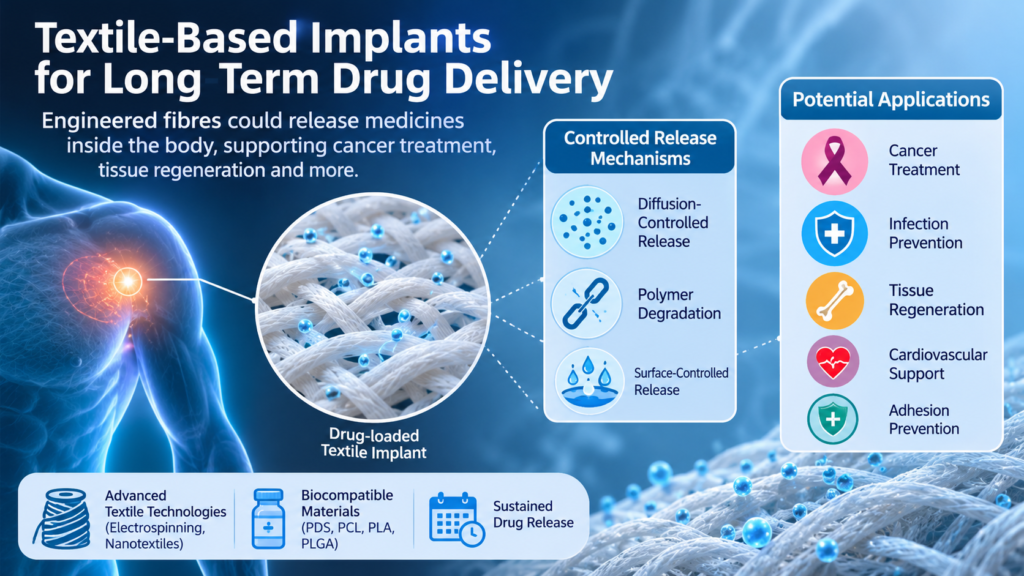
Engineered fibres, nanofibres and woven structures could support controlled medicine release inside the body, opening new research opportunities in cancer treatment, tissue regeneration and implantable medical devices.
Researchers are exploring how textile engineering can support the development of implantable drug-delivery systems. By incorporating medicines into engineered fibres and textile structures, these systems could release therapeutic compounds gradually inside the body.
Unlike conventional tablets and injections, implantable drug-delivery systems can be positioned close to a treatment site. This may help maintain local drug availability over a specific period and reduce the need for repeated administration.
The approach combines textile engineering, polymer science and pharmaceutical research. Potential applications include cancer treatment, infection prevention, tissue regeneration and other areas of long-term disease management. However, most textile-based drug-delivery technologies remain at the research and development stage.
Why Are Researchers Exploring Textile-Based Drug Delivery?
Many medicines require repeated administration to maintain effective concentrations in the body. Depending on the treatment, patients may need daily tablets, frequent injections or repeated hospital visits.
Conventional drug delivery can also create challenges. Drug concentrations may fluctuate between doses, and some medicines can cause unwanted effects when they circulate throughout the body. Delivering a therapeutic compound directly to a specific tissue can also be difficult.
Implantable systems offer an alternative approach. They can be placed near the target area and designed to release medicine over a controlled period.
Textile engineering could add new possibilities to these systems. Researchers can use polymer fibres, nanofibres, yarns and woven structures to hold therapeutic compounds within an engineered material.
How Do Textile-Based Drug-Delivery Implants Work?
A textile-based implant is not simply a conventional fabric placed inside the body. It is an engineered structure made from selected materials for a specific medical application.
Medicines can be incorporated into fibres during manufacturing or attached to their surfaces after production. Once implanted, the structure controls how the medicine moves into the surrounding tissue.
Three main mechanisms can influence drug release:
1. Diffusion-controlled release
Drug molecules gradually move from the fibre structure into surrounding body fluids. Fibre diameter, porosity, polymer composition and drug concentration can influence the release rate.
2. Polymer degradation
Some biodegradable polymers gradually break down inside the body. As the material degrades, the incorporated medicine becomes available for release.
3. Surface-controlled release
Medicines attached to or coated onto fibre surfaces can be released through dissolution, diffusion or changes in the surrounding environment.
Researchers can combine these mechanisms to develop different release profiles. These may include an initial dose followed by sustained delivery or a slower, more continuous release.
Textile Technologies Supporting Implantable Drug Delivery
Several fibre and textile manufacturing techniques can produce structures for drug-delivery research.
Electrospinning
Electrospinning uses an electric field to produce extremely fine polymer fibres. These fibres can form porous structures with a large surface area, making them suitable for incorporating therapeutic compounds.
The process can also produce core-shell fibres. In these structures, the medicine is placed inside a central core and surrounded by a protective polymer layer. This arrangement can help regulate how quickly the drug moves out of the fibre.
Woven Nanotextiles
Woven nanotextiles combine fine polymer fibres into yarns and arrange them into a textile structure. Weave density, yarn arrangement and fibre composition can influence drug loading and release.
A 2019 research study investigated paclitaxel-loaded woven nanotextiles made from electrospun polydioxanone (PDS) nanoyarns. The researchers explored their potential as implantable drug reservoirs for cancer treatment.
The study reported sustained paclitaxel release for up to 60 days in mice after the implant was attached to the peritoneal wall. It also demonstrated that drug release could be adjusted by changing the textile packing density.
The findings represent a preclinical proof of concept. They do not establish the technology as an approved or proven human cancer treatment.
Multilayer and Core-Shell Fibres
Multilayer structures can separate different medicines or control when each compound becomes available. For example, one layer could release an initial dose while another provides slower delivery.
Core-shell fibres can also protect sensitive therapeutic compounds during implantation and regulate their exposure to surrounding fluids.
These structures may be useful for treatments that require multiple medicines or different release stages.
Potential Medical Applications
Textile-based drug-delivery implants could support several areas of healthcare. However, the level of research and clinical development varies between applications.
1. Cancer Treatment
Cancer treatment is an important area of research for implantable drug-delivery systems.
A drug-loaded textile structure could potentially be positioned near a tumour or surgical treatment site. It could then release anticancer medicine locally over a controlled period.
The paclitaxel-loaded woven nanotextile study provides an example of this approach. Researchers investigated sustained drug release and implant performance in animal models.
Further research could examine other anticancer compounds, drug combinations and implant designs.
2. Post-Surgical Infection Prevention
Drug-loaded fibres could potentially deliver antimicrobial agents near surgical sites, implants or reconstructed tissues.
The aim would be to maintain local drug availability during the period when infection risk is clinically important.
However, researchers must assess drug stability, release duration, tissue compatibility and the potential risk of antimicrobial resistance.
3. Tissue Engineering and Regenerative Medicine
Some medical implants need to provide structural support while also encouraging tissue growth and repair.
Electrospun scaffolds can be designed to resemble aspects of the extracellular matrix, which surrounds cells and supports tissue function.
Researchers can incorporate growth factors and other bioactive compounds into these structures. This allows them to investigate whether the scaffolds can support tissue regeneration while gradually releasing therapeutic substances.
Potential research areas include bone repair, vascular tissue engineering, nerve regeneration and periodontal reconstruction.
4. Cardiovascular and Vascular Applications
Textile engineering already has applications in vascular grafts and certain cardiovascular medical devices.
Drug-releasing fibrous structures could add another function to these materials. Researchers are investigating how therapeutic compounds incorporated into implants might support healing and influence the surrounding tissue response.
These applications require careful evaluation of blood compatibility, clotting risk, mechanical strength and long-term performance.
5. Postoperative Adhesion Prevention
Internal tissues can sometimes develop unwanted adhesions during the healing process after surgery.
Researchers are investigating multilayer electrospun membranes that combine physical separation with the controlled release of therapeutic compounds.
Such systems could potentially help reduce postoperative adhesion formation while supporting surrounding tissue during recovery.
Materials Used in Drug-Releasing Textile Implants
Material selection plays an important role in implant performance. The material must support the required drug-release profile, maintain suitable structural properties and interact safely with surrounding tissue.
| Material | Potential role | Important consideration |
|---|---|---|
| Polydioxanone (PDS) | Biodegradable sutures and drug-loaded fibrous structures | Degradation and mechanical strength |
| Polycaprolactone (PCL) | Long-term biodegradable fibre matrices | Relatively slow degradation |
| Polylactic acid (PLA) | Drug-loaded fibres and tissue scaffolds | Degradation behaviour and drug compatibility |
| Polylactic-co-glycolic acid (PLGA) | Biodegradable controlled-release systems | Release kinetics and acidic degradation products |
| Chitosan | Bioactive fibrous structures and drug carriers | Biological compatibility and processing |
| Alginate | Drug loading and bioactive fibrous systems | Swelling, stability and release control |
The suitability of each material depends on the implant location, medicine, required release period and mechanical demands of the application.
What Determines the Drug-Release Duration?
Long-term drug delivery depends on more than the amount of medicine incorporated into a fibre. Researchers must balance several material and pharmaceutical properties.
- Fibre diameter: Smaller fibres provide a larger surface area, which can influence drug loading and release.
- Textile density: Closely packed fibres can affect fluid movement and drug diffusion through the implant.
- Polymer degradation: The rate at which a biodegradable material breaks down can influence how long it remains functional.
- Drug-polymer compatibility: The medicine must remain stable during manufacturing, storage and implantation.
- Implant location: Body fluids, tissue conditions, local pH and biological activity can affect drug release.
- Mechanical properties: The implant must maintain sufficient structural integrity throughout the required treatment period.
The main challenge is to deliver the correct medicine at the required rate and for the intended duration without causing unwanted tissue reactions.
Challenges Before Commercial Adoption
Despite promising research, several barriers must be addressed before textile-based drug-delivery implants can become widely used medical products.
Reproducible manufacturing: Small changes in fibre diameter, polymer concentration, drug distribution and textile density can alter release behaviour. Manufacturers need consistent production processes and reliable quality-control systems.
Long-term biocompatibility: Implants must be evaluated for inflammation, toxicity, tissue reactions and degradation-related effects. Materials that perform well in laboratory testing may behave differently inside a living body.
Drug stability: Some biological compounds, proteins and sensitive medicines can lose activity during fibre manufacturing or storage. Production methods must protect the therapeutic agent.
Predictable release: An initial burst of medicine may create unwanted exposure, while excessively slow release may not provide an effective therapeutic concentration. Researchers must establish reliable release profiles for each application.
Clinical validation and regulatory approval: Preclinical studies are an early stage of development. Human clinical studies are needed to demonstrate safety, performance and therapeutic benefits. Products combining a medicine with an implantable medical device may also require more complex regulatory evaluation.
Opportunities for the Medical Textile Industry
The development of implantable drug-delivery systems could expand the role of textile manufacturers beyond conventional hospital textiles, surgical fabrics and protective materials.
It could create opportunities across several parts of the healthcare supply chain:
- Advanced fibre producers: Development of medical-grade polymers and specialised fibres suitable for drug incorporation.
- Technical textile manufacturers: Production of engineered yarns, woven structures and multilayer fibrous implants.
- Pharmaceutical companies: Collaboration on drug loading, formulation development and release-profile optimisation.
- Medical device manufacturers: Integration of drug-releasing textiles into surgical implants and therapeutic devices.
- Biotechnology companies: Research into fibre-based platforms for growth factors, proteins and other biological compounds.
- Contract manufacturers: Development of specialised production capabilities for medical-grade fibrous products.
The opportunity extends beyond supplying raw materials. Expertise in fibre architecture, polymer processing, textile construction and quality control could become important in the development of advanced medical products.
What Comes Next for Textile-Based Drug Delivery?
Future research is likely to focus on more precise drug-release control, biodegradable implant structures and multifunctional materials.
Researchers may also combine textile architectures with responsive polymers. These materials could be designed to release therapeutic compounds when exposed to specific conditions, such as changes in pH or other local biological signals.
Multidrug-loaded structures could support treatments that require different compounds to be released at separate stages.
However, progress towards commercial applications will depend on more than laboratory performance. Researchers and manufacturers must establish reliable production methods, demonstrate long-term safety and generate clinical evidence.
Textile-based drug delivery therefore represents an emerging research area at the intersection of technical textiles, biomaterials and pharmaceutical science. Its future role in healthcare will depend on the results of further preclinical studies and clinical validation.
About Towards Healthcare Research and Consulting
Towards Healthcare Research and Consulting provides research and strategic consulting across the global healthcare industry. Its coverage includes pharmaceuticals, biotechnology, medical devices, clinical trials, vaccines, healthcare IT, artificial intelligence in healthcare, dental care, medical imaging, laboratory equipment, cosmeceuticals, consumer healthcare, and cell and gene therapy. The organisation supports industry stakeholders with data intelligence and specialised research to help them understand market developments and make informed business decisions.
Sources:
Drugs Market
Drug Delivery CDMO Market
Drug Delivery Devices Market
Pharmaceutical Market