
Overview
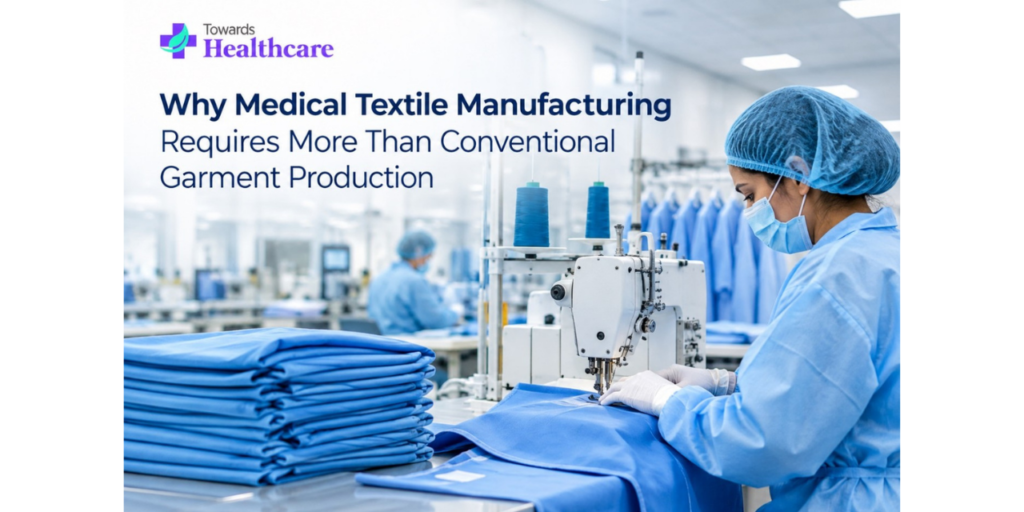
Making a medical gown, surgical drape, or protective cover all involves much more than cutting fabric and stitching pieces together. These products must meet specific requirements for hygiene, protection, durability, comfort, and performance in healthcare environments.
Unlike conventional garments, medical textiles may need to withstand fluid exposure, controlled manufacturing conditions, repeated laundering, or sterilization, depending on their intended use. Even small differences in material selection, seam construction, or production quality can affect the final product.
This makes medical textile manufacturing a specialized process where textile engineering, garment construction, quality control, and healthcare requirements must work together.
What Makes Medical Textile Manufacturing Different?
Conventional garment production generally focuses on appearance, fit, comfort, durability, and cost. Medical textile manufacturing must consider these factors alongside the product’s intended clinical function.
For example, everyday clothing can often tolerate minor variations in stitching or fabric characteristics without affecting its primary purpose. A protective medical gown, however, may need to meet defined requirements for fluid resistance, barrier performance, and seam integrity.
Manufacturers must therefore select materials and production methods based on the intended application rather than treating every medical garment as an ordinary clothing product.
Material Selection Starts With Performance
The manufacturing process begins well before a fabric reaches the cutting table.
Medical textile producers must identify materials that suit the product’s purpose. Polypropylene nonwovens, polyester fabrics, specialty polymers, films, membranes, and coated textiles can all serve different functions.
A disposable surgical gown may require fluid-resistant material with appropriate barrier performance. Reusable medical clothing may need to retain its strength, shape, and functional properties after repeated washing and processing.
The challenge is that no single material performs equally well in every application.
Manufacturers must evaluate factors such as tensile strength, tear resistance, liquid penetration, breathability, flexibility, and comfort. The right combination depends on the product’s intended use and applicable performance requirements.
Fabric Construction Can Change the Final Product
Two medical garments can use similar raw materials and still perform differently because of how their fabrics are constructed.
Woven, knitted, and nonwoven materials have different structures and characteristics. Manufacturers can also adjust fiber arrangement, fabric density, bonding methods, layering, and finishing to achieve specific properties.
For instance, nonwoven fabrics are widely used in disposable medical products because their structures can be engineered for particular combinations of filtration, strength, softness, and fluid resistance.
Multilayer constructions may combine textile layers with films or membranes to provide additional barrier properties. However, these layers must work together without creating weaknesses in the finished product.
The challenge is not simply choosing a suitable fabric. It is ensuring that the complete material structure performs as intended.
Why Cutting, Stitching and Sealing Matter
Even a well-designed fabric can lose some of its intended functionality if the garment is poorly constructed.
Cutting determines how material panels fit together. Stitching creates seams but can introduce needle holes or areas that require careful evaluation in barrier garments. Heat sealing or other bonding techniques may be used in certain products to create specific seam characteristics.
The appropriate construction method depends on the garment design and its performance requirements.
Manufacturers must also consider cuffs, closures, necklines, openings, and areas exposed to movement or fluid contact. These details influence coverage, ease of use, and the integrity of the finished garment.
For protective medical clothing, quality assessment must consider the assembled product, not only the fabric supplied by the material manufacturer.
Manufacturing Conditions and Hygiene Controls
Medical textile production may require additional controls depending on the product’s intended use, contamination risks, and whether it must be supplied sterile.
Manufacturers need procedures for handling materials, maintaining suitable production environments, preventing contamination, and controlling the movement of products through different manufacturing stages.
Sterile medical products may require validated sterilization processes and suitable packaging that maintains sterility until use. Not every medical garment is sterile, so the controls must match the product specification.
Traceability is another important consideration. Companies may need records linking finished products to material batches, manufacturing processes, inspections, and release decisions.
These requirements add operational complexity beyond conventional garment manufacturing.
Quality Control Must Go Beyond Appearance
In ordinary apparel production, inspections commonly focus on measurements, stitching, fabric defects, fit, and finishing. These checks remain important for medical clothing, but they may not be sufficient.
Depending on the product, medical textile manufacturers may also need to evaluate:
- Mechanical strength: resistance to tearing, tensile stress, and damage.
- Barrier performance: resistance to liquid penetration or other specified exposures.
- Seam integrity: whether assembled areas meet the required performance criteria.
- Dimensional stability: whether the garment maintains its intended shape and fit.
- Biological or chemical properties: where relevant to the material and intended application.
- Consistency between batches: whether products continue to meet defined specifications.
Testing requirements vary by product type, intended use, and applicable standards. A test result for the raw fabric does not automatically establish the performance of the finished garment.
Manufacturers must establish suitable inspection and validation processes to demonstrate that the final product meets its specifications.
The Challenge of Scaling Production
Producing a small batch of specialized medical garments is different from manufacturing them consistently at a large scale.
As production volumes increase, companies must maintain control over raw material quality, cutting accuracy, stitching or sealing, equipment settings, inspection, and packaging.
A change in material supplier, production equipment, or manufacturing conditions can affect the finished product. Companies therefore need change-control procedures and appropriate checks before introducing significant changes.
Production planning also matters. Manufacturers must coordinate material availability, production capacity, testing, and delivery schedules without allowing commercial pressure to compromise required quality controls.
For businesses serving hospitals and healthcare distributors, reliable production means delivering consistent products, not simply producing more units.
Cost Is More Than the Price of Fabric
Medical textile manufacturing involves costs beyond raw materials and garment assembly.
Depending on the product, expenses may include specialized equipment, performance testing, quality systems, controlled production areas, packaging, sterilization, documentation, and regulatory compliance.
Higher-performance materials can increase initial costs, while production defects or inconsistent batches can create additional expenses through rework, rejected products, or delayed deliveries.
At the same time, manufacturers cannot assume that the most expensive material is always the most suitable. Material selection should reflect the intended application, required performance, production feasibility, and total product cost.
This makes cost management a technical and operational decision as much as a purchasing decision.
Sustainability Adds Another Layer of Complexity
Medical textile manufacturers are also under pressure to consider material use, energy consumption, packaging, and waste.
Reusable garments can reduce reliance on single-use products in suitable applications, but they must withstand the required laundering and processing while maintaining their intended performance. Disposable products may be necessary for particular clinical situations, making blanket replacement with reusable alternatives inappropriate.
Manufacturers are exploring lighter material structures, more resource-efficient production, recyclable components, and alternative polymers. However, these approaches must be assessed against infection-control requirements, product safety, durability, and the practical availability of recycling systems.
The challenge is to improve environmental performance without weakening the function for which the product was designed.
The Role of Medical Engineered Materials
Medical textile manufacturing increasingly depends on collaboration between textile producers and advanced-material suppliers.
Engineered fibers, polymers, nonwovens, membranes, coatings, and composite structures can provide properties tailored to particular healthcare applications.
These materials may support improved barrier performance, flexibility, filtration, moisture management, or durability. Their benefits, however, depend on how they are processed and incorporated into the finished product.
For manufacturers, this creates an opportunity to move beyond standard garment production toward specialized, application-driven products.
It also increases the importance of working with material suppliers, testing laboratories, equipment providers, and healthcare customers during product development.
What Lies Ahead?
Medical textile manufacturing is likely to become more specialized as product requirements, material technologies, and quality expectations evolve.
Automation, improved process monitoring, digital traceability, advanced nonwovens, and more precise garment construction may help manufacturers improve consistency and production efficiency.
The industry will also need to balance innovation with practical requirements such as affordability, supply reliability, applicable standards, and clinical performance.
Companies that combine material knowledge with manufacturing expertise and disciplined quality management will be better positioned to develop products for specific healthcare needs.
Conclusion
Medical textile manufacturing requires far more than conventional garment production because the finished products must meet defined healthcare requirements alongside the usual demands of fit, comfort, and durability.
Material selection, fabric construction, garment assembly, hygiene controls, testing, and traceability all contribute to the final product’s performance.
As healthcare applications become more specialized, the real manufacturing advantage lies in connecting textile engineering with consistent production and verified product performance.
References:
https://www.towardshealthcare.com/insights/medical-engineered-materials-market-sizing
About Author
Payal Rabde is a Healthcare Market Research Analyst at Towards Healthcare Research & Consulting with over 4+ years of experience in pharmaceutical, biotechnology, medical device, and healthcare market research. She holds an MBA in Pharmaceutical-Biotechnology Management and a B.Pharm, specializing in market analysis, forecasting, competitive intelligence, and strategic healthcare insights.