
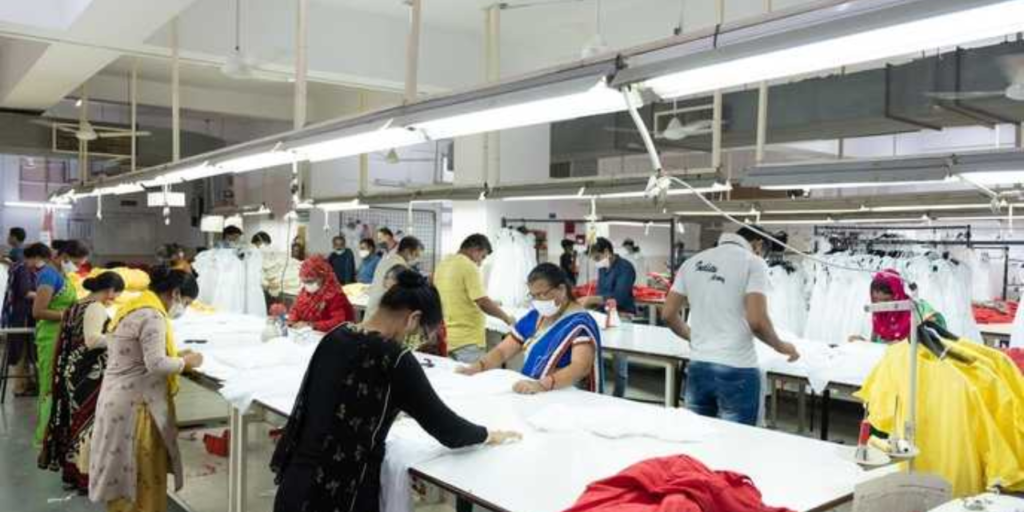
Rising wages and worker shortages are prompting garment companies to expand into Odisha, Bihar, Jharkhand and Madhya Pradesh
India’s apparel manufacturers are expanding into less industrialised states, including Odisha, Bihar, Jharkhand and Madhya Pradesh, to access workers at lower wages and benefit from state government incentives. The shift comes as rising labour costs and worker shortages in established manufacturing hubs such as the National Capital Region (NCR), Bengaluru, Tiruppur and Chennai put pressure on production costs.
According to a report published by Mint on October 9, 2026, apparel companies are evaluating new locations that offer a larger local workforce, comparatively lower wages and additional subsidies. Several manufacturers have already expanded their operations into these states.
Pulkit Seth, vice chairman of Pearl Global Industries Ltd, said the company was evaluating Bihar, Jharkhand, Odisha and Madhya Pradesh and had recently begun considering West Bengal.
Pearl Global opened its first manufacturing unit in Muzaffarpur, Bihar, with 450 machines. The company also operates 6,500 machines across eight manufacturing units in Bengaluru, Gurugram and Chennai.
Seth said lower wages in less industrialised states could help reduce production costs, even if logistics expenses increased. He noted that manufacturing costs in these regions could become comparable to those in Bangladesh.
State Subsidies Attract Apparel Manufacturers
State government incentives are emerging as another factor influencing manufacturers’ location decisions. Industry representatives said some states offer wage subsidies, power subsidies and capital investment-related incentives to attract apparel and textile companies.
Page Industries, which operates in the innerwear and athleisure segments with its Jockey brand, expanded into Odisha earlier in 2026. According to the report, the company will receive multiple state subsidies over seven years, including a wage subsidy for seven years and a power subsidy for almost five years. Capital investment-related subsidies are available for three years.
The report also highlighted the availability of workers as a consideration for companies exploring new locations.
Sivaramakrishnan Ganapathi, vice chairman and managing director of Gokaldas Exports, said labour availability was a challenge in southern India and around the NCR, where companies relied heavily on migrant workers.
He said the company had experienced greater success in Ranchi, where workers were more amenable to working a second shift. However, he noted that the same level of flexibility was not available elsewhere in India, particularly in the South.
Gokaldas Exports operates a manufacturing facility in Madhya Pradesh, in addition to its operations in other states.
KPR Mill Invests ₹450 Crore in Odisha
KPR Mill is investing ₹450 crore in a new manufacturing unit in Odisha, which the company expects to become operational in the first quarter of FY28. The company announced the investment in August and is also opening two units simultaneously in Coimbatore.
The expansion reflects the growing interest among apparel manufacturers in diversifying production locations to address labour availability and cost pressures.
Pearl Global Industries, Page Industries, Gokaldas Exports and KPR Mill were among the companies discussed in the report. Page Industries, Gokaldas Exports and KPR Mill did not respond to Mint’s queries.
Textile and Apparel Industry’s Economic Contribution
India’s textile and apparel industry employs approximately 45 million people and is the country’s second-largest employer after agriculture, according to figures reported by the Union government’s Press Information Bureau in August.
The industry contributes around 2% to India’s gross domestic product (GDP). It also plays a significant role in manufacturing, with the textile industry producing fabric that is subsequently converted into finished garments by apparel manufacturers.
The move towards new manufacturing hubs highlights how labour availability, wage levels, logistics costs and state incentives are influencing production decisions across India’s apparel sector.