
Understanding Four Important Aromatic Hydrocarbons
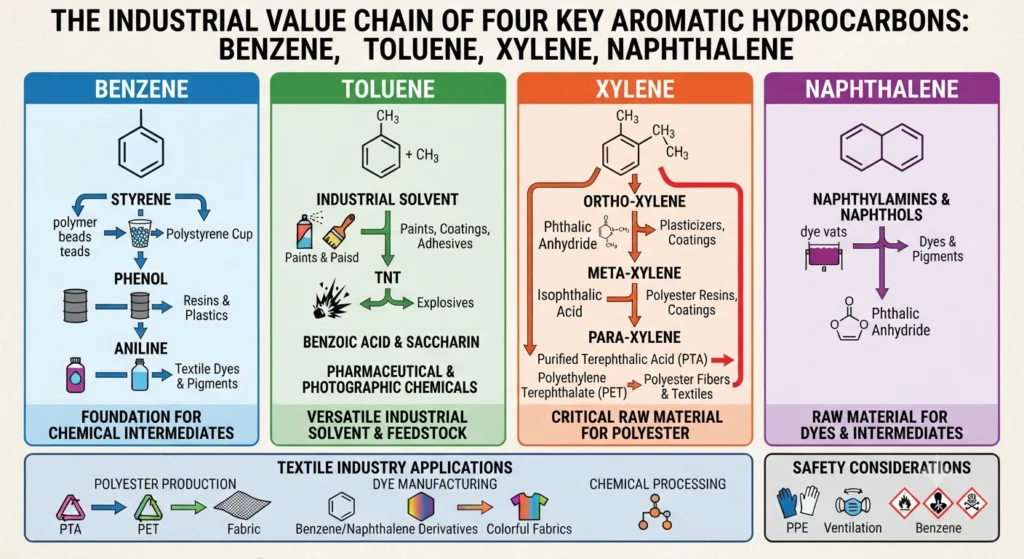
Aromatic hydrocarbons are an important group of chemicals used across several industrial sectors. Benzene, toluene, xylene and naphthalene are among the key compounds used to manufacture plastics, synthetic fibres, dyes, solvents and other chemical products.
These chemicals serve different purposes. Some are used directly as solvents, while others act as starting materials for producing more complex industrial compounds.
Their importance extends to the textile industry, particularly in polyester production, dye manufacturing and chemical processing.
1. Benzene: A Foundation for Industrial Chemicals
Benzene is a major raw material in the petrochemical industry. It is used to produce several important chemical intermediates.
One of its major applications is the production of styrene, which is then used to manufacture polystyrene plastics.
Benzene is also used to produce:
- Phenol: An intermediate used in resins, plastics and other chemical products.
- Aniline: A chemical intermediate used in the manufacture of dyes, pigments and other products.
- Dodecylbenzene: A raw material used in the production of detergents.
Through these applications, benzene supports chemical supply chains connected to plastics, coatings and textile colouration.
2. Toluene: A Versatile Industrial Solvent
Toluene is widely used as an industrial solvent. It can dissolve various organic substances and is used in manufacturing processes involving paints, coatings, adhesives and chemical formulations.
It also serves as a starting material for several chemical products, including:
- Trinitrotoluene (TNT): An explosive compound manufactured through the nitration of toluene.
- Benzoic acid: Used in chemical manufacturing and other applications.
- Saccharin: An artificial sweetener.
- Pharmaceutical and photographic chemicals: Toluene is used as a feedstock or processing solvent in the production of certain compounds.
Its solvent properties make it useful in industrial formulations, although its application depends on process requirements and workplace safety controls.
3. Xylene: An Important Raw Material for Polyester
Xylene is available in three main isomeric forms: ortho-xylene, meta-xylene and para-xylene. Each has different industrial applications.
Ortho-xylene
Ortho-xylene is primarily used to manufacture phthalic anhydride. This chemical is used in the production of plasticisers, resins and coatings.
Meta-xylene
Meta-xylene is used to produce isophthalic acid, an intermediate used in the manufacture of polyester resins and coatings.
Para-xylene
Para-xylene is particularly important to the textile value chain. It is used to manufacture purified terephthalic acid (PTA), one of the main raw materials for producing polyethylene terephthalate (PET).
PET is widely used in polyester fibres, textile filaments, films and packaging materials.
As a result, para-xylene is a key chemical link between the petrochemical industry and synthetic textile manufacturing.
4. Naphthalene: A Raw Material for Dyes and Chemical Intermediates
Naphthalene is an aromatic hydrocarbon used in the production of several industrial chemicals.
It serves as a starting material for naphthylamines and naphthols, which are important intermediates in the manufacture of dyes and pigments.
Naphthalene has also been used as a raw material for producing phthalic anhydride. Its derivatives are used in chemical manufacturing, including applications connected to colourants and synthetic resins.
These uses make naphthalene relevant to chemical supply chains serving the textile dyeing and finishing sectors.
Industrial Applications and Safety Considerations
Benzene, toluene, xylene and naphthalene are important industrial chemicals, but their handling requires appropriate safety measures.
Their health effects differ. Benzene is a recognised human carcinogen. Toluene and xylene can affect the nervous system, particularly following significant exposure. Naphthalene exposure can also cause harmful health effects and requires suitable controls.
Chemical manufacturers and industrial users must follow applicable safety procedures. These include appropriate storage, ventilation, exposure monitoring, personal protective equipment and waste management.
Importance Across the Textile Value Chain
These four aromatic hydrocarbons contribute to different stages of industrial production.
Para-xylene supports polyester fibre manufacturing through the production of PTA. Benzene provides intermediates used in dye and chemical manufacturing. Toluene serves as a solvent and chemical feedstock, while naphthalene derivatives are used in dye and pigment production.
Their applications demonstrate how petrochemical raw materials support the wider textile value chain, from synthetic fibre production to colouration and finishing.