
How Charles Tennant’s Bleaching Powder Changed Cotton Textile Processing
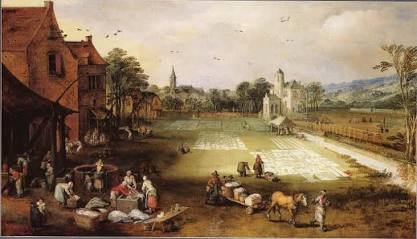
During the Industrial Revolution, cotton manufacturing expanded rapidly. However, fabric bleaching remained a time-consuming stage in textile production. Before chemical bleaching became widely available, cotton cloth was commonly treated with alkaline solutions and then spread outdoors for prolonged exposure to sunlight and air.
This traditional process, often called crofting, could take several days or even weeks. It also required large areas of land, suitable weather and access to water. As textile production increased, the slow bleaching process became a major constraint for manufacturers.
The Move Towards Chemical Bleaching
The introduction of chlorine-based bleaching offered a faster alternative. French chemist Claude Berthollet had demonstrated the bleaching properties of chlorine in the 1780s. However, early methods relied on chlorine dissolved in water or other liquid solutions.
These methods presented practical challenges. Chlorine was difficult to handle, while liquid bleaching preparations could be inconvenient to store and transport.
Charles Tennant, a Scottish manufacturer who had experience in textile bleaching, worked on improving the process. In 1798, he patented a method for producing a bleaching solution using chlorine and lime. The following year, he patented a method for manufacturing solid bleaching powder by passing chlorine gas over dry slaked lime.
The development of this solid product was a significant improvement. It provided bleachers with a more convenient form of chlorine-based bleaching material.
How Bleaching Powder Worked
Tennant’s bleaching powder, also known as chloride of lime, was produced by reacting chlorine gas with slaked lime.
When dissolved in water, the powder provided an active chlorine solution that could be used to bleach cotton fabrics. The treatment helped remove natural colouring matter and other substances responsible for discolouration.
The process was generally carried out after preliminary cleaning or scouring of the fabric. Washing and further treatment followed to remove chemical residues.
Why the Invention Mattered to Cotton Manufacturers
1. Reduced Bleaching Time
Traditional outdoor bleaching depended on sunlight and weather conditions. Chemical bleaching offered a much faster alternative, allowing textile processors to shorten finishing schedules.
2. More Convenient Storage and Transport
Earlier liquid bleaching solutions were difficult to store and transport. Solid bleaching powder was easier to package, move and distribute to textile centres.
3. Supported Larger-Scale Production
As cotton mills increased production, they needed finishing processes that could handle larger volumes of fabric. A commercially manufactured bleaching agent helped meet this demand.
4. Improved Production Planning
Reducing dependence on prolonged outdoor exposure made bleaching schedules more manageable. Manufacturers could better coordinate fabric finishing with spinning, weaving, dyeing and printing operations.
5. Encouraged the Growth of Industrial Chemistry
The commercial production of bleaching powder helped connect textile manufacturing with the expanding chemical industry. It also demonstrated the growing importance of chemical processes in industrial production.
St Rollox: From Invention to Commercial Production
In 1800, Tennant established chemical works at St Rollox, near Glasgow, with business partners. The factory produced bleaching powder on a commercial scale, along with other chemical products.
The works became an important centre for the growing alkali and chemical industries. Its production helped supply bleaching materials to textile manufacturers and other users.
The manufacturing process is also associated with Tennant’s partner Charles Macintosh, who is credited by historical accounts with contributing significantly to the development of the solid bleaching powder process.
A Turning Point in Textile Finishing
Charles Tennant’s bleaching powder helped address one of the practical limitations of cotton-textile manufacturing during the Industrial Revolution. By making chlorine-based bleaching material available in solid form, the invention improved the convenience and scalability of fabric whitening.
Although bleaching technology continued to develop and newer chemical agents later became widely used, Tennant’s contribution marked an important stage in the relationship between textile manufacturing and industrial chemistry.