

Vaibhav Vankundre
Senior Scientist,
Wool Research Association

Shishir Tyagi
Additional Joint Director,
Wool Research Association

G. S. Bhati
Executive Director,
Central Wool Development Board
Abstract
Coarser grade wool is a promising renewable material for sustainable technical applications. Its fibrous structure, thermal insulation, moisture management, acoustic performance, and biodegradability make it particularly suitable for building insulation and nonwoven materials. This article reviews the potential of coarse wool for value-added insulation products, focusing on thermal performance, sustainability, durability, processing, and future commercialization opportunities.
Keywords: Coarser wool, technical textiles, natural fibre, sustainable materials, thermal insulation, nonwoven, green building, circular economy
Introduction
The textile industry has traditionally evaluated wool primarily according to its suitability for apparel, carpets, blankets, upholstery, and other textile products. Fibre diameter, staple length, crimp, fibre type, and other characteristics strongly influence the quality and market value of wool. Fine fibres are generally preferred for applications where softness and comfort are important, whereas coarse and hairy fibres have comparatively fewer opportunities in high-value textile products. This difference in market demand creates an important technological question: can wool that is unsuitable for premium textile applications be transformed into useful technical products?
Recent research suggests that the answer is promising. Rather than treating coarse wool as an inferior or waste material, its structural and functional characteristics can be utilized in applications where fibre fineness is not the primary requirement. Nonwoven products, thermal insulation, erosion-control materials, filtration media, agricultural products, and composite materials represent several possible directions.
This approach is consistent with the principles of a circular economy, in which materials are retained within productive systems for as long as possible. The conversion of low-value wool into technical products could simultaneously create additional value for the wool sector and reduce dependence on certain synthetic materials.
From Textile Fibre to Technical Material
The performance of a natural fibre is not determined exclusively by its suitability for spinning and weaving. In technical textiles, properties such as bulk, porosity, moisture interaction, thermal behaviour, surface characteristics, biodegradability, and compatibility with other materials can become more important. Wool is a protein-based fibre with a distinctive surface morphology. Its cuticle consists of overlapping cells, while its cortex has structural regions that contribute to fibre crimp and mechanical behaviour. These characteristics are responsible for many of the unique properties associated with wool.
For coarse wool, these characteristics can be utilized through alternative processing routes. Instead of producing yarn, fibres can be converted into webs, mats, felts, nonwovens, or composite structures. Such forms can retain a significant volume of air within the material, which is particularly relevant to thermal and acoustic applications.
Consequently, the concept of wool utilization should be expanded from “fibre for textiles” to “renewable raw material for functional materials.”
Why Coarse Wool Has Technical Potential
Coarser wool offers several characteristics that may be advantageous in technical products. Its crimpy structure can provide bulk, resilience, and interconnected porosity. Wool can also absorb and manage moisture, provide insulation, and contribute to acoustic performance. The source review identifies several additional characteristics, including resistance to odour, low VOC-related concerns, UV protection, and useful fire-related behaviour.
Another important characteristic is biodegradability. Unlike many petroleum-derived polymers, wool originates from a biological resource and can eventually return to natural cycles under appropriate conditions. This characteristic becomes particularly important in applications where long-term persistence of synthetic materials creates environmental concerns. However, technical utilization requires consideration of limitations. Wool can be vulnerable to moth damage, and appropriate protection may therefore be necessary. Furthermore, the natural variability of wool requires careful control of raw material quality. Breed, nutrition, climate, animal health, and other factors can influence fibre characteristics. A successful commercial product must therefore balance natural variability with consistent manufacturing and performance requirements.
Thermal Properties of Different Materials
| Insulation Material | Thermal Conductivity (W/m.K) |
| Natural Wool | 0.040 |
| Rock /Glass Wool | 0.038 |
| EPS/ XPS | 0.029 |
| PUF (Polyurethane Foam) | 0.024 |
| Phenolic Foam | 0.020 |
Coarse Wool Supply Chain and Price
At present, India lacks an organized supply chain for coarse wool, although important wool-producing clusters exist in Kutch and Maharashtra, particularly for Panchali and Deccani wool. The current raw wool price is relatively low, typically around ₹25 – 35 per kg, depending on quality. To address this gap, the Wool Research Association (WRA), in collaboration with local NGOs, is working to develop a structured supply chain connecting sheep farmers with wool collection, grading, processing, and end-use markets. This initiative aims to improve wool utilization, promote value addition and enhance income opportunities for rural sheep-rearing communities.
Nonwoven Technology: A Major Opportunity
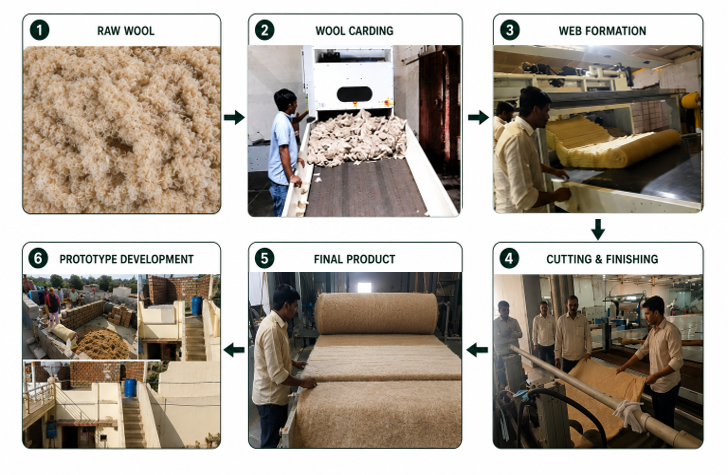
Nonwoven processing provides an effective pathway for utilizing coarse wool. In conventional textile production, fibre fineness and spinning properties can strongly influence processing efficiency. Nonwoven manufacturing does not necessarily require the production of a conventional yarn, allowing fibres with less favourable spinning characteristics to be used directly in fibrous structures. Coarse wool can potentially be converted into webs and subsequently consolidated through suitable mechanical, thermal, or chemical approaches. The resulting structure can be designed according to the intended application
Thermal Bonding of Wool
For insulation, a lightweight and porous structure may be desirable because the trapped air contributes to resistance against heat transfer. For geotextiles, a stronger and more dimensionally stable structure may be necessary. For filtration, fibre arrangement and pore distribution become critical. Thus, the same raw material can potentially be engineered into different products by modifying fibre preparation and web formation parameters.
Wool for Sustainable Building Insulation
The construction sector is a major energy consumer, making effective thermal insulation essential for reducing heat transfer and improving indoor comfort. Growing interest in sustainable buildings has increased the demand for natural and renewable insulation materials. Sheep wool is a promising option due to its fibrous structure, moisture-management ability, and natural thermal insulation properties. Coarse wool can be processed into nonwoven mats, panels, and other insulation structures for use in walls, roofs, floors, and building envelopes. Its thermal conductivity can typically be targeted in the range of 0.03–0.04 W/m·K, indicating good resistance to heat transfer. However, insulation performance depends on several factors, including density, thickness, moisture content, fibre arrangement, thermal diffusivity, fire behaviour, dimensional stability, and long-term durability. Optimizing these parameters is essential for developing efficient and sustainable wool-based insulation materials.
Wool Fibre to Building Insulation
6. Hygrothermal Behaviour and Indoor Comfort
One of the distinguishing features of wool is its interaction with moisture. Wool can absorb moisture from its surrounding environment and release it under changing conditions. This characteristic is important because building materials are exposed to variations in relative humidity and temperature. A natural insulation system therefore needs to be evaluated not simply as a barrier against heat flow but as part of a dynamic building envelope. Moisture accumulation can influence thermal performance and may create conditions favourable to biological growth. Research cited in the uploaded review indicates that wool-based insulation can contribute to stable hygrothermal conditions when appropriately designed.
This area deserves additional investigation, particularly under the climatic conditions of different geographical regions. Materials designed for cold climates may require different characteristics from those used in hot and humid regions.
7. Hybrid Materials and Composite Development
Combining wool with other fibres or matrices can expand its application range. literature includes examples involving wool and hemp, wool and polypropylene, wool with clay-based systems, and wool-reinforced polymer composites.
Hybridization can be used to overcome some of the limitations of individual materials. For example, another fibre may improve mechanical strength, dimensional stability, or processing characteristics, while wool contributes thermal or acoustic functionality.
Natural fibre combinations are particularly attractive from a sustainability perspective. Wool can potentially be combined with agricultural fibres such as hemp or other renewable materials to create multifunctional products. Such combinations also provide opportunities to utilize locally available biomass resources. Future research should therefore investigate not only individual fibres but also optimized fibre blends and composite architectures.
Acoustic and Functional Insulation
Thermal insulation is not the only building-related opportunity. Fibrous structures can also interact with sound waves, creating possibilities for acoustic treatment. Wool-based materials have been investigated as part of thermal acoustic insulation systems. The performance of such materials depends on factors such as density, thickness, porosity, fibre arrangement, and surface structure. A carefully designed wool nonwoven could therefore potentially provide more than one function within a building envelope.
This multifunctionality is important from a product development perspective. A material capable of contributing simultaneously to thermal management, sound absorption, and moisture regulation may offer advantages over a material designed for only one function.
Opportunities for Indian Coarse Wool
The development of technical applications is particularly relevant to countries where a significant proportion of wool is not suitable for premium apparel applications. India’s wool production includes substantial quantities used for carpets and coarser applications.
This presents an opportunity to develop region-specific technical products based on local fibre resources. Instead of transporting raw wool over long distances or allowing low-value fractions to remain underutilized, regional processing centres could convert coarse wool into insulation panels, nonwoven mats, geotextiles, agricultural products, and other technical materials. Such development could support rural economies, create employment, and increase the value generated from sheep farming.
Challenges to Commercialization
Despite its potential, several barriers must be addressed before large-scale adoption of coarse wool products.
- Raw-material variability must be controlled. Fibre diameter, staple length, moisture content, contamination, and other characteristics can vary considerably.
- Product durability needs to be established. Technical materials used in buildings or outdoor environments must maintain their properties throughout their intended service life.
- Wool-based products may require protection against insects and other biological agents.
- Standardized testing and certification are essential. Thermal conductivity, fire behaviour, acoustic performance, moisture behaviour, mechanical strength, and ageing characteristics should be assessed using appropriate standards.
- Finally, economic feasibility must be demonstrated. Sustainable materials cannot achieve widespread adoption unless their manufacturing cost, installation requirements, service life, and environmental advantages are competitive with existing alternatives.
Conclusion
Coarser grade wool represents an underutilized renewable resource with significant potential for technical textile and green-material development. Its characteristics make it relevant to applications where fibre fineness is less important than thermal, acoustic, moisture-management, structural, or environmental functionality.
Building insulation is one of the strongest opportunities because wool can provide useful thermal performance while offering a renewable alternative for sustainable construction. However, its potential extends considerably further. Geotextiles, filtration products, agricultural materials, erosion-control systems, composites, and other technical applications provide additional pathways for value creation.
The future of coarse wool should therefore be approached from a technology development perspective rather than solely from a conventional textile perspective. By combining nonwoven technology, natural-fibre composites, performance testing, life cycle assessment, and industrial-scale validation, low-value wool can potentially be transformed into high-value sustainable products.
The successful utilization of coarse wool can contribute simultaneously to waste reduction, renewable-resource utilization, rural economic development, sustainable manufacturing, and circular-economy goals. Continued research and collaboration between wool producers, textile researchers, material scientists, construction industries, and agricultural stakeholders will be important for converting this potential into commercially viable products.
References
- Vankundre V, Tyagi S. Evolutionary Significance and Sustainable Applications of Coarser Grade Wool Fibers: A Review. Current Trends in Fashion Technology & Textile Engineering. 2024;9(1):555751.
- Allafi F, Hossain MS, Lalung J, Shaah M, Salehabadi A, et al. Advancements in Applications of Natural Wool Fiber: Review. Journal of Natural Fibers. 2022;19(2):497–512.
- Ijjada N, Nayaka RR. Review on properties of some thermal insulating materials providing more comfort in the building. Materials Today: Proceedings. 2022;58(4):1354–1359.
- Parlato MCM, Porto SMC. Organized framework of main possible applications of sheep wool fibers in building components. Sustainability. 2020;12.
- Korjenic A, Klaric S, Hadžic A, Korjenic S. Sheep wool as a construction material for energy efficiency improvement. Energies. 2015;8:5765–5781.
- Pennacchio R, Savio L, Bosia D, Thiebat F, Piccablotto G, et al. Sheep-wool and hemp sustainable insulation panels. Energy Procedia. 2017;111:287–297.
- Chmura D, Salachna A, Broda J, Kobiela MK, Gawłowski A, et al. Multifunctional geotextiles produced from reclaimed fibres and their role in ecological engineering. Materials. 2022;15.
- Pang L, Lin S, Krakowiak J, Yu S, Hewitt J. Performance analysis of sheep wool fibres as a water filter medium for human enteric virus removal. Journal of Water Process Engineering. 2022;47.
- Juhos K, Papdi E, Kovács F, Vasileiadis VP, Veres A. The effect of wool mulch on plant development in the context of the physical and biological conditions in soil. Plants. 2023;12(3):684.
- Drury KE, Crotty FV. Developing the use of wool rope within aquaculture. Sustainability. 2022.