


Dr. Milind Khandwe
Technical Director
The Bhor Chemicals and Plastics Pvt. Ltd.
Introduction
The rapid emergence of drones as a dominant battlefield technology is transforming military operations across the world. From reconnaissance and target acquisition to precision strikes, loitering attacks, and cross-border smuggling, drones have become an increasingly accessible and effective tool for both state and non-state actors. The ongoing conflict in Ukraine has demonstrated that even heavily armoured vehicles can be vulnerable to inexpensive First-Person View (FPV) drones carrying explosive payloads. As a result, militaries worldwide are reassessing traditional protection concepts and introducing new layers of defence against unmanned aerial threats.
One of the most visible outcomes of this shift has been the widespread adoption of mesh screens, protective cages, anti-drone nets, and multispectral camouflage systems. What began as improvised battlefield solutions in Ukraine is now evolving into a comprehensive survivability philosophy that combines concealment, deception, passive protection, electronic warfare, and active counter-drone measures.
India’s Growing Counter-Drone Capability
India recognized the evolving drone threat early and has invested significantly in indigenous counter-drone technologies. The Defence Research and Development Organisation (DRDO) developed an Anti-Drone System capable of detecting, tracking, jamming, and neutralizing hostile drones. The system employs radar, electro-optical and infrared sensors, radio-frequency detectors, and laser-based hard-kill mechanisms to provide comprehensive protection against emerging aerial threats.
Building upon this capability, the Indian Navy signed a contract with Bharat Electronics Limited (BEL) for the induction of the Naval Anti-Drone System (NADS), the first indigenous comprehensive anti-drone system to enter service with the Indian Armed Forces. Developed jointly by DRDO, BEL, and the Indian Navy, the system integrates radar, EO/IR sensors, RF detection, jamming capabilities, and laser neutralization technology to provide both soft-kill and hard-kill options.
These initiatives demonstrate India’s commitment to developing advanced counter-UAS capabilities. However, recent battlefield experiences suggest that electronic and kinetic countermeasures alone may not be sufficient against increasingly sophisticated drone threats. A layered defence strategy is emerging as the preferred approach globally.
The Ukraine Lesson: Why Mesh Protection Matters
The conflict in Ukraine has revealed that small and inexpensive drones can inflict disproportionate damage on armoured vehicles worth millions of dollars. FPV drones can attack from angles traditionally less protected by armour, including vehicle roofs, engine compartments, rear sections, and open hatches. Ukrainian and Russian forces responded by improvising metal cages, chain-link fences, wire structures, slat armour, and overhead protective screens around their vehicles.
The principle behind these systems is straightforward. By creating a sacrificial standoff barrier between the drone and the vehicle, the protective structure can disrupt the drone’s flight path, prevent direct impact, or force premature detonation of the warhead. Even when a strike occurs, the reduction in explosive effectiveness can significantly improve crew survivability and vehicle endurance.
Although these systems are not designed to make a vehicle invulnerable, they provide a critical final layer of protection when electronic warfare systems fail, when drones operate autonomously, or when multiple drones attack simultaneously.
From Battlefield Improvisation to Military Doctrine
What initially appeared to be an improvised battlefield solution is now being adopted by advanced militaries. During Freedom Shield 2026 in Lithuania, Germany’s 45th armoured Brigade deployed Fuchs armoured personnel carriers and Leopard 2 tanks fitted with dedicated counter-drone mesh screens. These modifications reflected direct lessons learned from observing drone warfare in Ukraine and demonstrated how NATO forces are adapting their survivability concepts to the realities of modern conflict.
The German approach illustrates a broader global trend. Vehicle manufacturers and defence organizations are increasingly developing modular anti-drone protection kits rather than relying solely on field modifications. This transition reflects the growing recognition that physical anti-drone protection has become an important element of modern battlefield survivability.
Commercial Development of Anti-Drone Protection Systems
The private defence sector has responded rapidly to these emerging requirements. UAE-based TAC armoured Vehicles has developed a modular cable-mesh anti-drone protection system for its Jedi armoured vehicle platform. Designed as a factory-installed solution, the system seeks to combine lightweight construction with enhanced protection against FPV drones and other low-altitude threats.
Similarly, QinetiQ’s Q-Net technology, originally developed to protect vehicles against rocket-propelled grenades, demonstrates how net-based protection concepts are being adapted for modern drone threats. While the operational environment has changed significantly, the underlying concept of creating a physical standoff barrier remains highly relevant.
Materials
The material-development opportunity should therefore extend well beyond conventional UHMWPE-based nets. Candidate systems can include metallic-fibre and metal-wire composites, smart metallic wires, self-healing compounds, and hybrid constructions combining aramid, high-tenacity nylon, carbon fibres and ceramic components. The objective should be to engineer a multi-functional net capable not only of physically entangling the drone but also of absorbing, distributing, and mitigating impact or blast energy. The overall performance can be represented conceptually as Rₘ = 1 − (Rᵣₑₛᵢdᵤₐₗ / Rᵢₙᵢₜᵢₐₗ), where Rₘ is the risk-reduction factor, Rᵢₙᵢₜᵢₐₗ is the threat risk without protection, and Rᵣₑₛᵢdᵤₐₗ is the remaining risk after deployment of the net system. Thus, future anti-drone-net qualification should combine material-level characterisation with realistic threat-level testing, allowing the material, architecture, and deployment mechanism to be optimized against defined projectile, payload, and explosive-risk scenarios.
Testing
Anti-drone net testing can be broadly classified into two segments: material characterisation and system-level performance testing. Material characterisation involves evaluating tensile strength, elongation, tear resistance, abrasion, UV/weathering, impact resistance, and other properties of the yarns, fibres, coatings, and net constructions. However, for a practical anti-drone system, material properties alone are insufficient. The net must be evaluated against the actual threat scenario, such as a projectile, bomb-carrying UAV, explosive payload, or high-energy impact event, and its ability to prevent or mitigate the associated risk. This is analogous to the testing philosophy used for explosion-proof casings, blast protection, and bullet-resistant structures, where the complete system is evaluated under representative threat conditions. A simplified mathematical representation can therefore be expressed as: Rₘ = f (P, E, M, G, V, T), where P = projectile/threat characteristics, E = explosive or impact energy, M = material/construction parameters, G = net geometry and deployment configuration, V = velocity/impact conditions, and T = target/protected-asset characteristics. Advance Composite Material Test and Characterisation Centre Pvt Ltd (ACMATEC), DRDO, and CSIR labs can be used for such testing.
Companies Working in This Area
Several companies are active in the development of drone nets, passive shields, and physical counter-UAS protection systems. Frictape has developed SpiderNet, a modular textile-based passive protection system designed to arrest and contain incoming UAVs, while MKU in India develops specialized anti-drone nets intended to physically entangle and neutralize small-to-medium tactical and FPV drones. DONET provides customized high-strength safety and containment nets for drone-testing enclosures and secure training areas, whereas Locker Architectural manufactures high-security composite and wire-mesh solutions, including Gladiator netting, for protection against aerial incursions. Just For Nets (JFN) supplies heavy-duty polyethylene and nylon containment nets and cages for drone testing, flight training and controlled environments, while Brite Rigid Frame Buildings offers structural Drone Strike Mitigation Systems integrated into building envelopes to provide passive overhead protection against drone impacts.
Internationally, similar approaches include Fortem’s DroneHunter, ParaZero’s DefendAir Net Pod, and OpenWorks Engineering’s SkyWall. These systems represent a growing shift toward low-cost, passive or hybrid kinetic counter-drone solutions that can complement conventional electronic warfare systems.
The Role of Multispectral Camouflage and Signature Management
While anti-drone mesh screens, cages, and physical barriers provide a final layer of protection against FPV drone attacks, modern conflicts have demonstrated that survivability increasingly depends on preventing detection in the first place. The widespread use of drones equipped with high-resolution cameras, thermal sensors, and advanced reconnaissance payloads has made concealment and signature management just as important as physical protection.
The Ukraine conflict has repeatedly shown that vehicles and positions that cannot be detected are significantly less likely to be targeted. Consequently, military planners are increasingly integrating camouflage, concealment, deception, and passive protection into a unified survivability architecture.
What is Multispectral Camouflage?
Traditional camouflage primarily aims to reduce visibility in the visual spectrum by matching surrounding terrain and vegetation. However, modern surveillance drones and reconnaissance systems operate across multiple portions of the electromagnetic spectrum, including:
- Visible light
- Near-infrared
- Thermal infrared
- Radar frequencies
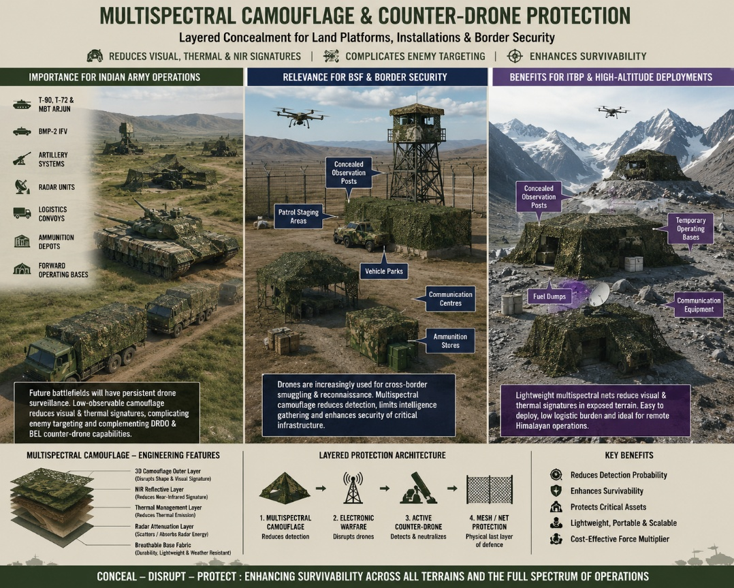
Multispectral camouflage systems are designed to reduce signatures across several detection bands simultaneously. By lowering visual, thermal, and radar signatures, these systems make it significantly more difficult for drones and surveillance platforms to identify, classify, and track targets. Such technologies are increasingly viewed as essential for operations in drone-dominated environments.
Camouflage Nets as a First Layer of Defence
Advanced camouflage nets can serve as an effective first layer of defence against drone reconnaissance and attack. Modern multispectral nets are lightweight, portable, and capable of concealing:
- Tanks and armoured vehicles
- Artillery systems
- Command posts
- Ammunition storage areas
- Observation posts
- Logistics assets
By breaking the visual outline of military assets and reducing their thermal contrast with the environment, these systems significantly increase the difficulty of detection and target identification. In many situations, preventing detection may be more valuable than intercepting a drone after it has already located its target.
Integration of Camouflage and Anti-Drone Mesh Protection
Perhaps the most effective survivability approach is the integration of multispectral camouflage with anti-drone mesh or net-based protection systems.
In this layered architecture:
- Multispectral camouflage reduces the probability of detection.
- Electronic warfare systems attempt to disrupt hostile drones.
- Active counter-drone systems engage airborne threats.
- Mesh screens and cages provide the final physical layer of defence.
For example, a vehicle concealed under a multispectral camouflage system may evade reconnaissance drones entirely. If detected and attacked, anti-drone mesh installed around vulnerable areas may still disrupt the incoming FPV drone or reduce the effectiveness of its warhead. Together, these measures significantly increase survivability and operational flexibility.
Technical Textiles as Enablers of Next-Generation Survivability
Technical textiles are emerging as a critical component of modern military survivability systems because they enable the development of lightweight, deployable, and multifunctional protection solutions. Advanced fibres such as aramids, UHMWPE, high-tenacity polyester, and specialized coated fabrics can be engineered into camouflage nets, anti-drone barriers, portable shelters, concealment screens, thermal signature management systems, and lightweight protective structures. Unlike conventional metallic solutions, technical textile-based systems offer significant advantages in terms of weight reduction, portability, corrosion resistance, weather resistance, and ease of deployment. These characteristics are particularly important for mobile forces, border-security units, and high-altitude deployments where transportation and logistics are often challenging. The increasing use of modular anti-drone netting, lightweight mesh barriers, and multispectral camouflage systems worldwide demonstrates how technical textiles are becoming an integral part of modern counter-UAS architectures and battlefield protection concepts.
Multifunctional Camouflage Nets for Counter-Drone Operations
Modern camouflage nets have evolved far beyond traditional visual concealment systems. Advanced multispectral camouflage nets manufactured using specialized technical textiles can simultaneously reduce visibility in the visual, near-infrared, thermal infrared, and in some cases radar bands. Such systems can be used to conceal armoured vehicles, artillery positions, command posts, logistics hubs, radar installations, ammunition depots, border outposts, and critical infrastructure from drone-based surveillance. When integrated with lightweight anti-drone mesh layers or suspended protective textile barriers, these systems provide a dual benefit: they reduce the probability of detection while also offering a degree of physical protection against drone-delivered munitions and FPV drone attacks. For India, this approach is particularly relevant because domestically developed technical-textile-based camouflage and counter-drone net systems could provide an economical, scalable, and rapidly deployable solution for the Indian Army, BSF, ITBP, and other security forces operating across deserts, plains, forests, and high-altitude Himalayan regions.
Importance for Indian Army Operations
For the Indian Army, multispectral camouflage could be particularly valuable for:
- T-90, T-72 and MBT Arjun
- BMP-2 infantry combat vehicles
- Artillery systems
- Radar units
- Logistics convoys
- Ammunition depots
- Forward operating bases
Future battlefields are expected to feature persistent drone surveillance. Low-observable camouflage systems can reduce signatures in visual and thermal bands, complicating enemy targeting cycles while complementing existing counter-drone capabilities developed by DRDO and BEL.
Relevance for BSF and Border Security
The growing use of drones for cross-border smuggling and reconnaissance along the India–Pakistan border creates an increasing requirement for concealment and signature management. Observation posts, patrol staging areas, vehicle parks, communication centres, and ammunition stores can all benefit from multispectral camouflage systems.
Concealed infrastructure is inherently more difficult for hostile actors to monitor, reducing intelligence-gathering opportunities and improving security against drone-delivered payloads. Alongside anti-drone detection and interception systems, camouflage can provide an important passive layer of security.
Benefits for ITBP and High-Altitude Deployments
For ITBP deployments along the India–China border, lightweight multispectral camouflage systems offer advantages. Observation posts, shelters, fuel dumps, communication equipment, and temporary operating bases are often located in exposed mountainous terrain where natural concealment is limited.
Portable multispectral camouflage nets can reduce both visual and thermal signatures while imposing minimal logistical burden. Combined with lightweight modular anti-drone mesh systems, they may provide cost-effective protection for critical assets in remote Himalayan regions.
Future Direction: Layered Counter-Drone Defence and Survivability
The future battlefield will increasingly require a combination of passive and active defensive measures. Mesh screens, anti-drone barriers, electronic warfare systems, radar detection networks, laser interceptors, multispectral camouflage, deception technologies, and tactical mobility should not be viewed as separate solutions but as mutually supporting components of a layered defence architecture. [iamd-coe.org]
The ability to remain undetected, disrupt hostile drone operations, and physically survive an attack when necessary will collectively determine battlefield survivability in the drone era. Lessons emerging from Ukraine, NATO exercises, and India’s evolving border-security challenges all point toward the same conclusion: survivability is no longer determined by armour alone, but by effective integration of concealment, signature management, electronic warfare, and physical protection.
Conclusion
The rise of drone warfare has fundamentally altered the modern battlefield. Nations around the world are responding by integrating advanced counter-drone technologies, mesh-based protection systems, and multispectral camouflage solutions into their military doctrine. India has already developed sophisticated indigenous counter-drone capabilities through DRDO and BEL, but lessons from Ukraine and NATO demonstrate that passive protection and signature management are equally important components of modern survivability.
For the Indian Army, BSF, ITBP, and other security agencies, the combination of indigenous anti-drone systems, modular anti-drone mesh protection, and multispectral camouflage technologies offers an opportunity to develop a truly layered defence architecture. Such an approach would enhance the survivability of military platforms, border-security infrastructure, and critical assets while addressing the rapidly evolving threat posed by reconnaissance, attack, and smuggling drones across both conventional and internal-security environments.
Further Readings:
- https://www.csis.org/analysis/russia-ukraine-drone-war-innovation-frontlines-and-beyond
- https://iamd-coe.org/wp-content/uploads/2024/02/The-Evolving-UAS-Threat-Lessons-from-the-Russian-Ukrainian-War-Since-2022-on-Future-Air-Defence-Challenges-and-Requirements.pdf
- https://css.ethz.ch/en/center/CSS-news/2024/09/learning-from-the-ukrainian-battlefield-tomorrows-drone-warfare-todays-innovation-challenge.html
- https://www.defensenews.com/global/mideast-africa/2025/11/12/vendors-push-to-drone-proof-vehicles-with-nets-goes-beyond-ukraine/
- https://pib.gov.in/PressReleasePage.aspx?PRID=1750830
- https://bel-india.in/news-bel/indian-navy-signs-contract-with-bel-for-supply-of-naval-anti-drone-system/
- https://www.mdpi.com/2504-446x/6/3/65
- https://ieeexplore.ieee.org/document/9374654
- https://en.defence-ua.com/news/tacs_new_active_q_net_system_looks_familiar_and_not_exactly_unique-16286.html
- https://defensefeeds.com/news/army-news/uae-firm-debuts-anti-drone-mesh/
- https://equipment.adsinc.com/qinetiq-q-net/ecomm-product-detail/410892/
- https://carnegieendowment.org/posts/2023/07/drone-intrusions-along-the-india-pakistan-international-border-countering-an-emerging-threat
- https://www.orfonline.org/research/countering-hostile-drone-activity-on-the-india-pakistan-border
- https://timesofindia.indiatimes.com/city/chandigarh/spurt-in-drone-intrusions-bsf-battles-cross-border-smuggling/articleshow/116839721.cms