
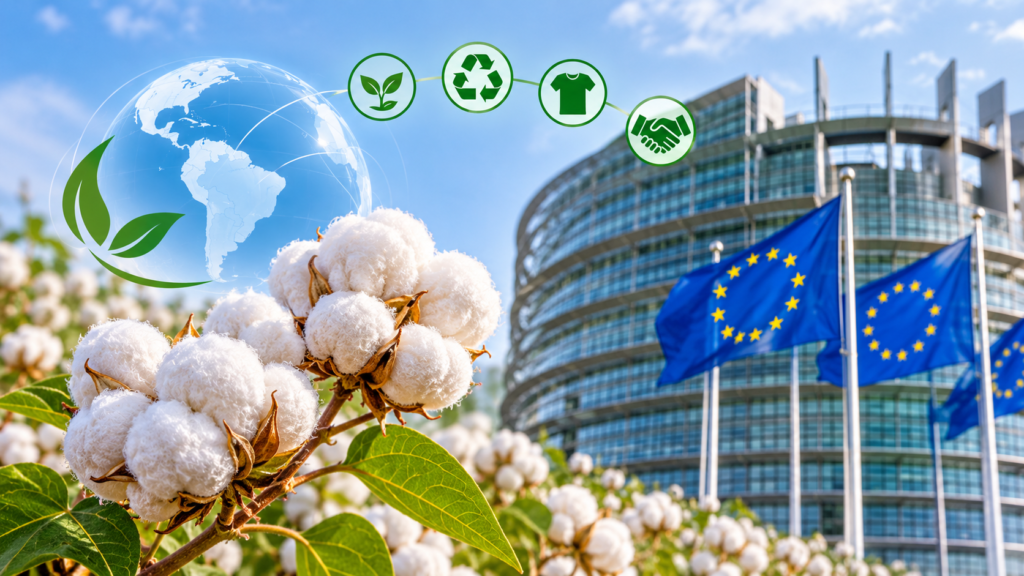
From November 16–18, Brazil will engage European policymakers and textile industry leaders in Brussels to discuss responsible cotton production, climate resilience and sustainability.
Cotton Brazil will take its sustainability agenda to Brussels, Belgium, from November 16 to 18, 2026. The initiative aims to strengthen ties with European policymakers and industry stakeholders. It will also highlight Brazil’s experience in responsible cotton production and explore opportunities for international cooperation.
Cotton Brazil to Discuss Sustainability at European Parliament
A key highlight of the programme will be a roundtable titled “The Critical Role of Cotton in Europe’s Sustainable Ambitions” on November 17.
The event will take place at the European Parliament. Member of the European Parliament (MEP) Hélder Sousa Silva will host the discussion, with support from Cotton Brazil.
The roundtable will bring together cotton producers, industry representatives and European policymakers. They will discuss how large-scale cotton production can support sustainability, climate resilience and natural resource protection.
The discussions come at an important time for the European textile industry. The European Union is developing policies that will influence how textiles are produced, sourced, used and recycled.
Initiatives such as the Circular Economy Act and the EU Bioeconomy Strategy are placing greater focus on resource efficiency, sustainable materials and responsible sourcing.
Cotton Brazil aims to highlight how natural fibres can contribute to these goals.
Lisa Ventura, Head of International Partnerships at the Brazilian Cotton Growers Association (Abrapa), said that producing countries must be part of Europe’s sustainability discussions.
She also highlighted the importance of cooperation between producers, policymakers and industry stakeholders.
Cotton Supports Millions of Livelihoods Worldwide
The initiative will also highlight cotton’s contribution to global employment and economic development.
Cotton supports the livelihoods of approximately 100 million families worldwide. According to the United Nations, its wider value chain supports an estimated 300–350 million jobs.
These jobs span several activities, including farming, processing, ginning and logistics.
The discussions will examine how responsible cotton production can support rural development, food systems and climate resilience.
They will also explore opportunities to improve sustainability across the global textile value chain.
Brazil to Share Experience in Responsible Cotton Production
Brazil’s experience in tropical agricultural systems will be an important part of the Brussels discussions.
The Brazilian delegation will present examples of responsible agricultural practices, innovation and traceability. These approaches can help improve sustainability across cotton production.
The delegation will also discuss the different environmental and agricultural conditions in which cotton is grown worldwide.
Cotton Brazil aims to demonstrate that large-scale production and responsible farming practices can work together.
Brazil and European Union to Strengthen Cooperation
The programme will also include meetings with Brazilian diplomatic representatives and agricultural attachés.
On November 17, the delegation will meet H.E. Pedro Miguel da Costa e Silva, Brazilian Ambassador to the European Union.
The meeting will focus on challenges and opportunities for Brazilian commodities under EU policies. It will also provide an opportunity to strengthen cooperation between Brazil and Europe.
On November 18, the delegation will meet agricultural attachés from other natural fibre-producing countries. A working lunch with representatives of these countries will follow.
The discussions will cover regulatory and commercial challenges in the European market. They will also explore opportunities for cooperation among natural fibre-producing nations.
Focus on Traceability and Responsible Sourcing
As European textile policies continue to evolve, sustainability standards are becoming increasingly important.
Cotton Brazil will highlight the need for transparent, science-based and consistent approaches. The discussions will focus on circularity, traceability and responsible sourcing.
The delegation will also emphasise the importance of recognising different global cotton production systems. This will help ensure fair and consistent standards across the textile value chain.
Lisa Ventura also highlighted the opportunities created by the EU-Mercosur Agreement. She noted that stronger trade relations could support greater cooperation between Brazil and Europe.
She further stressed that sustainability policies should recognise different production conditions and encourage continuous improvement.
Through its Brussels programme, Cotton Brazil aims to strengthen international partnerships and promote responsible cotton production. The initiative will also support wider discussions on sustainable materials, traceability and the future of natural fibres.