
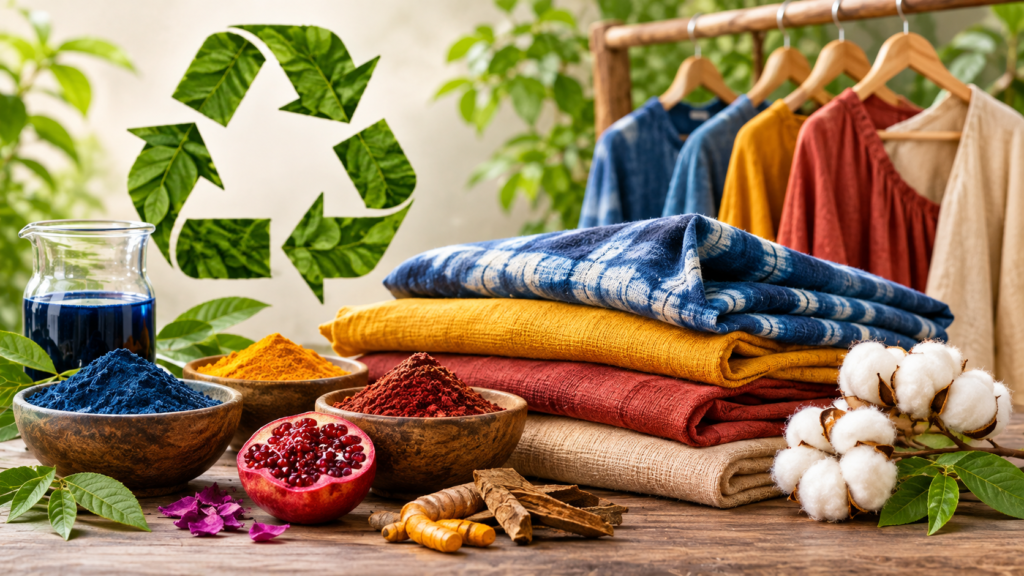
Natural dyes are gaining attention in fashion, but responsible sourcing, colour consistency and the complete garment lifecycle remain key challenges.
By Rochelle Crasto
Long before synthetic dyes became common, Indian artisans used nature to colour textiles. Indigo created deep blues, turmeric produced golden yellows and madder gave fabrics earthy reds. Pomegranate rind and other botanical materials also added colour to traditional textiles.
Today, these techniques are attracting renewed interest from the fashion industry. However, switching from synthetic dyes to natural alternatives is not as simple as it may seem. Their environmental impact depends on how the raw materials are sourced, processed and used.
Rethinking the Dyeing Process
Bhoomi Dave, Associate Professor of Textile Design at Pearl Academy, Mumbai, says a garment must be assessed as a complete product.
“From a textile artisan’s point of view, a garment should be judged as a complete object—not only by the fibre named on its label. The dye, mordant, sewing thread, finish, elastic, print and fastenings all determine whether it can safely return to the earth.”
This means that choosing a natural dye alone does not make a garment sustainable. Every component and production process also matters.
Natural Dyes and Their Environmental Impact
Natural dyes come from renewable biological sources. These include plants, roots, flowers, leaves, fruits and bark. However, collecting and processing these materials also requires resources.
Growing or gathering dye plants can place pressure on agricultural land and wild plant populations. According to Dave, the land, water and labour needed to produce or collect dye materials are major challenges to wider adoption. Seasonal changes can also affect the final colour.
The use of mordants is another important factor. Mordants help dyes bond with textile fibres. Their selection and handling can influence the environmental impact of dyeing.
“Alum and iron are commonly used by responsible natural dyers, but even these require controlled quantities and responsible wastewater treatment,” Dave explains.
She also warns against heavy-metal mordants such as chromium, copper and tin because they can create toxicity concerns.
In addition, natural dyeing may involve repeated dye baths, heating and washing. These steps can increase water and energy consumption. Therefore, a dye is not automatically environmentally harmless simply because it comes from a plant.
The Challenge of Colour Consistency
Maintaining consistent shades across production batches remains one of the biggest challenges for natural dyes.
Plant varieties, growing conditions, extraction methods and dyeing techniques can all affect the final colour. These variations may add character to handcrafted textiles. However, they can create difficulties for fashion brands that need uniform shades across large collections.
Even so, natural dyes can deliver good results when the right fibres, dyeing methods and after-treatments are selected.
Indigo, madder, pomegranate rind and tannin-rich dye systems can produce effective results when processed carefully. Some dyes may fade more quickly, so brands and consumers may need to accept gradual colour changes.
Archana Jaju, a creative director who has worked with handloom textiles and hand-painted Kalamkari, highlights the importance of informed material choices.
“It is important to understand the material we work with and make thoughtful choices at every stage.”
Why the Entire Garment Matters
A garment’s environmental impact goes beyond its main fabric. Its stitching, buttons, lining, elastic, embroidery and finishes also affect what happens at the end of its life.
Natural fibres such as cotton, linen, hemp, jute, wool and silk can biodegrade under suitable conditions. Regenerated cellulosic fibres, including viscose, modal and lyocell, can also break down biologically.
In contrast, synthetic fibres such as polyester, nylon, acrylic and elastane do not readily biodegrade.
This creates a challenge when a garment combines natural and synthetic materials. For example, polyester stitching, plastic buttons, synthetic linings and elastic may remain long after the main fabric has deteriorated.
Some chemical finishes can also interfere with microbial activity. These include wrinkle-resistant treatments, antimicrobial coatings and water-repellent finishes.
Deepra Gagneja, Founder of Ambrea Image Consultancy and an alumna of the London College of Fashion, recommends natural fibres such as cotton, linen, pure silk, wool, jute and hemp. She also suggests exploring plant-based fabrics such as lyocell.
However, she warns consumers not to rely on marketing claims alone.
“A brand may use earthy colours, leaf motifs or green packaging to create the impression that a product is sustainable, but that does not necessarily tell you anything about how it was made.”
Check Materials and Certifications
Consumers can make more informed choices by checking product information, manufacturing details and relevant certifications. These may include GOTS, OEKO-TEX and applicable Ecocert standards.
Gagneja also points out that some materials may be marketed in ways that hide their processing requirements.
“Bamboo, for example, is often promoted as a sustainable fabric, but most bamboo textiles are processed into rayon or viscose, which can involve chemicals and significant resource use. Similarly, recycled polyester makes use of existing plastic but remains a synthetic fibre that can release microplastics during washing.”
These examples show why consumers need to look beyond a fabric’s name or sustainability claims. The manufacturing process and the complete product should also be considered.
Scaling Up Natural Dyeing
Moving natural dyeing from small artisan operations to large-scale production remains difficult. Limited raw material availability, the need for skilled workers, higher costs and challenges with shade consistency can make natural dyeing more expensive than conventional methods.
Jaju says, “One of the biggest challenges is making responsible material choices viable at scale while maintaining quality, consistency and affordability.”
India’s textile heritage offers valuable examples of traditional production skills. These include handloom weaving and hand-painted techniques such as Kalamkari. Such practices also highlight the time and skill involved in mindful textile production.
Consumers have a role to play in this transition. Gagneja advises people to make gradual changes rather than replace their entire wardrobes.
“Start slowly. You do not need to replace your entire wardrobe or buy everything in natural fabrics overnight. Sustainability should also make sense for your budget, lifestyle and personal style,” she says.
She also stresses the value of buying versatile garments that can be worn for years.
“A well-chosen garment that you enjoy wearing for years is often a better investment than something you replace after a few uses.”
A More Thoughtful Approach to Colour
Natural dyes offer the fashion industry an opportunity to revisit traditional materials and techniques. They also encourage closer attention to the environmental impact of textile production.
However, no single ingredient or process can make fashion sustainable on its own. Responsible sourcing, suitable mordants, efficient dyeing, durable materials and thoughtful garment construction all matter.
Nature may provide the colours, but the responsibility for managing the process lies with the textile and fashion industry. The real challenge is to create garments that consider the environment at every stage, from the source of the pigment to the final stitch.