
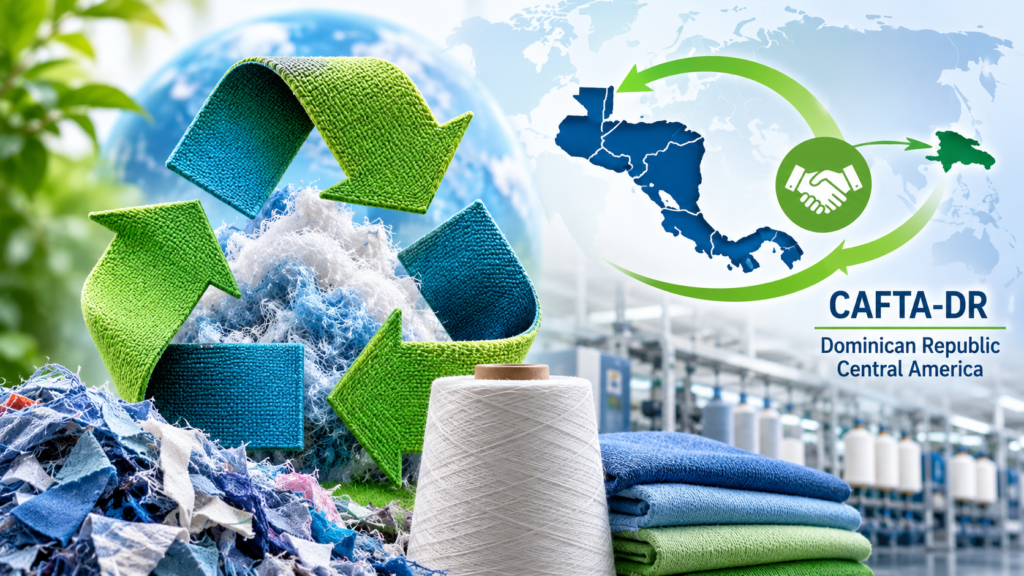
A new study identifies the region’s potential to expand textile-to-textile recycling through trade policy, stronger supply chains and increased investment.
The American Apparel & Footwear Association (AAFA) has released a new study examining opportunities to expand textile-to-textile (T2T) recycling in the Dominican Republic-Central America Free Trade Agreement (CAFTA-DR) region.
Published on 16 November 2026, the report examines the region’s existing recycling capacity, identifies barriers to further development and recommends ways to strengthen its textile recycling ecosystem.
The study, titled Strengthening Textile to Textile Recycling Capacity in the U.S.-Dominican Republic-Central America Free Trade Agreement (CAFTA-DR) Region, was written by Emilie Delaye and Dr. Sheng Lu.
It explores how trade policy and regional manufacturing capabilities could support textile recycling while creating new sourcing opportunities for American apparel companies.
Growing Need for Textile-to-Textile Recycling
More than 90 million tonnes of textile waste are produced globally each year. As a result, fashion and apparel companies are increasingly exploring textile-to-textile recycling as a way to reduce the environmental impact of discarded textiles.
T2T recycling involves processing used textile materials into fibres and other inputs that can be used to manufacture new textile products.
At the same time, changes in trade policy are influencing sourcing strategies among American companies. Countries within the CAFTA-DR region are emerging as important nearshoring destinations.
The region could help apparel companies address both sustainability and sourcing priorities by connecting existing textile manufacturing capacity with recycling operations.
CAFTA-DR Region Has Potential for Recycling Growth
The AAFA study identifies several advantages that could support the development of an integrated textile-to-textile recycling ecosystem in the region.
These include:
- Existing manufacturing capacity: The region already has textile and apparel manufacturing facilities that could support recycling-related activities.
- Geographic proximity: Its location provides access to the US market.
- Preferential trade access: The CAFTA-DR agreement offers preferential market access that could support regional supply chains.
- Growing nearshoring interest: American companies are exploring sourcing opportunities closer to their markets.
Together, these factors provide a foundation for expanding textile recycling and connecting recyclers with textile manufacturers and apparel companies.
Trade and Supply Chain Challenges
Despite these advantages, the study identifies several challenges that could affect the region’s competitiveness in textile-to-textile recycling.
One key issue is the compatibility of existing CAFTA-DR rules of origin with products containing recycled materials. Greater clarity may be needed to determine how recycled-content products qualify under the agreement.
The report also highlights uncertainty around customs classifications for recycled materials. Clearer procedures could help businesses move recycled inputs across borders more efficiently.
Another challenge is the need for stronger regional supply-chain integration. Recyclers, textile manufacturers, apparel brands and other industry participants need better coordination to develop commercially viable recycling networks.
AAFA Recommends Three Measures to Support Growth
The study outlines three key recommendations to strengthen textile-to-textile recycling in the CAFTA-DR region.
1. Use Trade Policy to Encourage Demand
The report recommends using market-based incentives and tariff reductions to encourage demand for recycled materials and products. Such measures could help create stronger commercial opportunities for textile recycling businesses.
2. Clarify Rules of Origin and Customs Procedures
The study calls for clearer rules of origin and customs procedures for recycled-content products. This could help businesses understand trade requirements and support the development of regional T2T recycling supply chains.
3. Strengthen Regional Partnerships and Investment
The report recommends stronger partnerships across the region and the exploration of innovative financing mechanisms. These measures could attract investment and help accelerate the commercial development of textile-to-textile recycling.
Study Draws on Industry Interviews
The research combines an analysis of publicly available industry information with 12 in-depth interviews.
Participants included textile-to-textile recyclers, textile manufacturers, US apparel brands and retailers, and other stakeholders involved in or closely following the development of T2T recycling.
The interviews provided industry perspectives on existing recycling capabilities, operational challenges and opportunities for future investment.
Commenting on the study, Chelsea Murtha, AAFA Senior Director of Sustainability, said:
“As companies continue to look for practical sustainability solutions and new nearshoring opportunities, there is a clear opportunity to support American apparel businesses in advancing both goals within one region.”
She added that the study examines how trade policy could help expand textile-to-textile recycling capacity. It also identifies areas where the region is making progress and where further development is needed.
Building a Regional Textile Recycling Ecosystem
The AAFA study highlights the potential for the CAFTA-DR region to connect textile manufacturing, recycling and international sourcing.
However, realising this opportunity will require clearer trade rules, stronger regional partnerships and investment in recycling infrastructure.
For textile manufacturers, recyclers and apparel companies, these developments could create new opportunities to incorporate recycled materials into supply chains.
The report also highlights the role of trade policy in supporting the commercial growth of textile recycling and strengthening links between the US apparel market and manufacturing partners in the CAFTA-DR region.
Read the full study: Strengthening Textile to Textile Recycling Capacity in the CAFTA-DR Region.
About AAFA
The American Apparel & Footwear Association (AAFA) represents companies across the apparel, footwear and related industries. The association works on industry issues, including trade, sustainability and supply-chain development.