
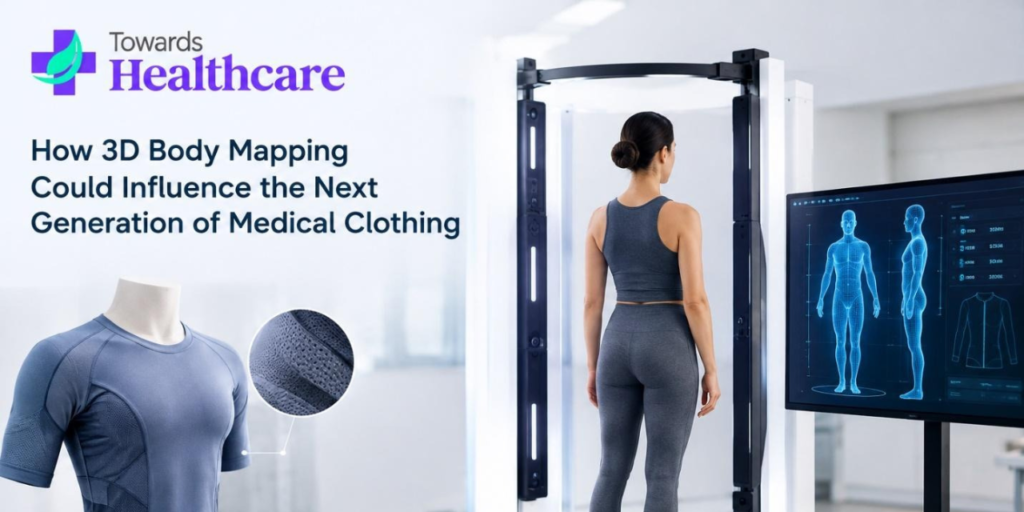
How 3D Body Mapping Could Shape the Future of Medical Clothing
Subtitle: Digital body scanning and garment simulation could help medical textile manufacturers improve fit, comfort, mobility and product development.
Medical clothing must meet more than basic coverage needs. Surgical gowns, compression garments, patient clothing, protective coveralls and rehabilitation wear must fit different body shapes while supporting comfort, movement and healthcare requirements.
Traditional garment development often relies on standard size charts, physical measurements and repeated fitting trials. These methods may not fully account for differences in body proportions, posture and movement.
3D body mapping offers another approach. By creating a digital model of the human body, it can help designers understand body dimensions and develop garments that better match specific needs.
Combined with textile engineering and digital garment simulation, this technology could influence how the next generation of medical clothing is designed and manufactured.
What Is 3D Body Mapping?
3D body mapping is a digital process that captures and analyses the shape and dimensions of the human body. Depending on the system, it may use optical scanners, cameras or depth sensors to create a three-dimensional model.
Traditional measurements record individual values, such as chest circumference, waist size and limb length. A 3D model provides a broader view of body shape and proportions.
Designers can use this information to assess garment fit, compare body dimensions and develop digital patterns for specific applications.
In medical textiles, potential uses include:
- Compression and support garments
- Postoperative clothing
- Rehabilitation wear
- Adaptive patient clothing
- Selected types of protective medical clothing
The objective is not simply to improve fit. It is to understand how a garment interacts with the body during everyday movement and healthcare activities.
Why Standard Sizing May Not Be Enough
Standard sizing helps manufacturers produce garments efficiently. However, people assigned the same size may have different body proportions.
One person may have broader shoulders, while another may have a longer torso or different limb dimensions. These differences can affect how a medical garment fits and performs.
In healthcare settings, poor fit can create practical problems. A protective gown that pulls across the shoulders may restrict movement. Patient clothing that fits poorly around a wound dressing may cause discomfort. An incorrectly designed compression garment may not deliver the intended pressure.
Standard sizing remains suitable for many medical clothing products. However, garments designed for specific clinical needs or unusual body proportions may benefit from more detailed measurements.
3D body mapping could help manufacturers identify gaps in existing size ranges and determine where alternative sizes or customized designs may be useful.
How 3D Body Mapping Could Improve Medical Clothing
1. More Accurate Garment Fit
3D body mapping can provide detailed measurements of the torso, shoulders, limbs and other body regions. Designers can use these measurements to adjust digital patterns before producing physical samples.
For example, a patient recovering from surgery may need extra room around a dressing without making the rest of the garment loose. A digital body model could help designers position openings and adjust garment dimensions to accommodate this requirement.
The same approach could support rehabilitation clothing for people whose body proportions fall outside conventional size ranges.
A better fit may reduce unnecessary fabric folds, pulling and pressure points. The outcome will still depend on accurate measurements, suitable garment construction and testing with intended users.
2. Greater Comfort During Movement
Medical clothing must accommodate movement, not just a standing posture.
Healthcare workers bend, reach and lift equipment. Patients may sit, lie down, walk with assistance or perform rehabilitation exercises. These activities change body shape and fabric tension.
A static 3D scan captures the body in a particular position. It cannot fully show how a garment will behave during movement.
To address this limitation, designers can combine body mapping with motion analysis, movement studies and digital garment simulation. These methods may help identify areas where clothing pulls, bunches, stretches excessively or restricts mobility.
For example, rehabilitation wear designed for repeated knee bending must accommodate changes around the joint. Body measurements and movement analysis could help engineers select suitable stretch materials, panel shapes and seam positions.
This approach could support garments designed around the activities users need to perform.
3. More Targeted Compression and Support
Compression garments are used in selected healthcare applications, including swelling management, circulation support and postoperative care. Their design requires careful attention to fit and pressure.
Performance depends on several factors, including body circumference, fabric elasticity, garment construction and how the garment is worn.
3D body mapping could capture limb contours and differences in circumference along the arms or legs. These measurements may help designers develop patterns that follow individual body shapes more closely.
However, a 3D scan does not directly measure the pressure a garment applies. Pressure also depends on fabric properties, garment tension, movement and the interaction between the textile and the body.
Compression products therefore require appropriate engineering calculations, pressure assessment and clinical validation. Body mapping can support the design process, but it cannot replace professional clinical judgment.
4. Better Access Around Wounds and Medical Devices
Patients may need to wear clothing alongside wound dressings, monitoring equipment, drainage systems and other medical devices. Conventional garment patterns may not always provide sufficient space or convenient access.
3D body mapping could help designers identify where additional room or carefully positioned openings are needed.
For example, a postoperative garment may need an opening that allows a clinician to inspect a dressing without removing the entire garment. Patient clothing may also require access points for monitoring leads or other equipment.
A digital model could help designers evaluate the placement and dimensions of these openings before cutting fabric.
Safety must remain a priority. Garments should also provide secure closures, support infection-control practices, maintain modesty and avoid unnecessary gaps or snagging hazards.
The Role of Digital Garment Simulation
3D body mapping becomes more useful when combined with computer-aided design (CAD) and digital garment simulation.
A body scan provides a digital model on which designers can develop a garment. Software can then simulate how garment panels may fit around the body.
Depending on the software and available material data, simulations may help evaluate dimensions, fabric deformation, tension and potential fit problems before physical samples are produced.
For manufacturers, this could reduce some pattern adjustments and support faster design iterations.
However, simulation results depend on the accuracy of the body measurements, material properties and model assumptions. Medical textiles can behave differently according to their structure, thickness, elasticity, coatings and finishing processes.
Digital simulation should therefore be treated as a design tool, not proof of final product performance. Physical fitting, material testing and application-specific validation remain essential.
Why Textile Material Selection Still Matters
A body model alone cannot determine which textile will perform best. Material selection remains central to medical clothing design.
Woven fabrics, knitted structures, nonwovens, elastomeric fibres, films and multilayer composites behave differently when stretched, bent or placed against the body.
For example:
- Stretch garments: Flexible knitted fabrics may suit products that need to accommodate repeated movement.
- Protective clothing: Barrier materials may be required where resistance to liquid penetration is important.
- Compression garments: Materials need suitable elasticity and recovery to support the intended garment performance.
Designers must understand how these materials interact with the body’s shape.
A fabric may fit smoothly around a digital model when the wearer is standing but behave differently when the wearer sits or raises an arm. Seams and panel boundaries can also affect comfort and local pressure.
Combining body measurements with reliable textile-property data could help manufacturers make more informed decisions about fabric selection, panel placement and garment construction.
This is where 3D body mapping could contribute to medical textile engineering: it provides a more detailed understanding of the shape the material must accommodate.
Potential Applications Across Medical Clothing
The benefits of 3D body mapping will depend on the garment’s purpose and the consequences of poor fit.
Patient clothing: Digital measurements could support hospital gowns, adaptive garments and clothing for people with mobility limitations. Designers could also assess access points for examinations and care procedures.
Compression and support garments: Body-shape information could help develop patterns suited to individual limb contours. Further assessment would be required to verify pressure and support.
Rehabilitation wear: Combining body measurements with movement analysis could help designers accommodate exercise routines, joint movement and assistive devices.
Protective medical clothing: Body mapping could help assess fit around the shoulders, torso, arms and legs. Manufacturers must still verify the garment’s required barrier and protective performance.
Postoperative garments: Digital design could support adjustable closures, garment openings and additional space around treatment areas, depending on patient needs.
Clothing for children and older adults: Body proportions, mobility and dressing requirements may differ from those assumed by standard adult patterns. Digital measurements could help manufacturers develop more suitable sizes and designs.
Not every application requires a fully customized garment. In some cases, body mapping may help manufacturers improve standard size ranges or create more effective sizing categories.
Could 3D Body Mapping Reduce Manufacturing Waste?
Medical clothing development can involve repeated sampling, fitting and pattern adjustments. When a design does not fit as expected, manufacturers may need to produce additional samples and repeat parts of the development process.
Digital body models could help identify some design problems earlier. Evaluating dimensions and fit before physical production may reduce unnecessary prototypes and material use.
Improved pattern development could also support more efficient fabric layouts and fewer avoidable design changes.
However, waste reduction is not guaranteed. Scanning equipment, software, training and digital infrastructure involve costs. Customized production may also increase the complexity of cutting, inventory management and quality control.
Manufacturers should compare the cost of adoption with measurable outcomes, such as:
- Fewer physical samples
- Shorter product development cycles
- Lower material consumption
- Improved fit-test results
- Reduced manufacturing costs
- Better user feedback
The business case may be strongest for specialized garments where fit is particularly important or repeated product development is common.
Key Challenges for Manufacturers
Despite its potential, 3D body mapping presents several challenges.
Measurement accuracy: Results can be affected by posture, movement, clothing, equipment and scanning methods. Inaccurate models may lead to unsuitable garment designs.
Changes in body dimensions: A person’s body shape may change during recovery, pregnancy, swelling, rehabilitation or treatment. A single scan may not remain suitable throughout garment use.
Textile performance: Body measurements alone cannot predict fabric stretch, pressure, drape, moisture management or barrier performance. Material-specific testing remains necessary.
Cost and scalability: Advanced scanners and software may be difficult to justify for inexpensive, high-volume disposable garments. Specialized or higher-value products may offer a stronger business case.
Workflow integration: Manufacturers must connect scanning, digital pattern design, production equipment and quality systems. Incompatible software or disconnected data can limit the benefits.
Privacy and data protection: Detailed body scans can contain sensitive personal information. Healthcare applications may require strict controls over consent, access, storage, retention and sharing. Organizations should collect only the information necessary for the intended purpose and follow applicable privacy requirements.
Addressing these challenges will be important for moving the technology from experimental projects into routine medical textile production.
What Should Manufacturers Consider Before Adoption?
Manufacturers should begin with a specific product challenge rather than investing in scanning technology without a defined objective.
The first step is to identify garments where fit-related issues create meaningful problems. These may include specialized compression products, rehabilitation clothing, adaptive patient wear or protective garments with demanding movement requirements.
Next, manufacturers should determine which body measurements are essential for the product’s function. The process should avoid collecting unnecessary personal information.
Companies should also assess whether their existing design software can use the measurements and whether reliable textile-property data are available. They must establish how digital designs will be checked through physical samples and appropriate testing.
A controlled pilot project can help compare the new workflow with existing methods. Useful measures include development time, sample numbers, fit-test results, material consumption, production costs and user feedback.
This allows manufacturers to evaluate practical benefits before making a larger investment.
What Lies Ahead for Medical Clothing?
Future medical clothing development could increasingly combine digital body measurement, CAD, advanced textiles and flexible manufacturing.
Emerging workflows may connect 3D body scans with digital pattern generation and automated cutting. Motion analysis could help designers account for changing body positions, while improved material models may support more realistic garment simulations.
In specialized applications, these technologies could make it easier to develop clothing that accommodates individual body shapes and specific clinical requirements.
Wider adoption will depend on affordable systems, reliable data, skilled teams, appropriate privacy controls and clear methods for verifying product performance.
Standardized sizing will continue to serve many medical clothing applications. A more practical future may combine mass production with targeted customization where it provides a clear benefit.
Conclusion
3D body mapping could influence medical clothing design by helping manufacturers understand body shape in greater detail and translate that information into more suitable garments.
When combined with digital simulation, textile engineering and physical validation, the technology may support improved fit, greater freedom of movement, more practical access to medical devices and more efficient product development.
Its value will depend on the application. A digital body scan cannot replace textile testing, clinical assessment or protective-performance validation. It can, however, provide more detailed information at the design stage.
For the medical textile industry, the opportunity lies in connecting body data with material performance and manufacturing expertise. Together, these capabilities could help create medical clothing that better addresses the needs of healthcare workers and patients.
About the Author
Payal Rabde is a Healthcare Market Research Analyst at Towards Healthcare Research & Consulting. She has over four years of experience in pharmaceutical, biotechnology, medical device and healthcare market research. She holds an MBA in Pharmaceutical-Biotechnology Management and a B.Pharm. Her areas of expertise include market analysis, forecasting, competitive intelligence and strategic healthcare insights.
About Towards Healthcare Research & Consulting
Towards Healthcare Research & Consulting is a global strategy consulting firm with a presence in Canada and India. The company provides solutions for the healthcare sector, helping business leaders address challenges and support growth.
Its services include technology solutions, clinical research and data analytics. The company focuses on building partnerships and delivering insights to support decision-making and innovation.