
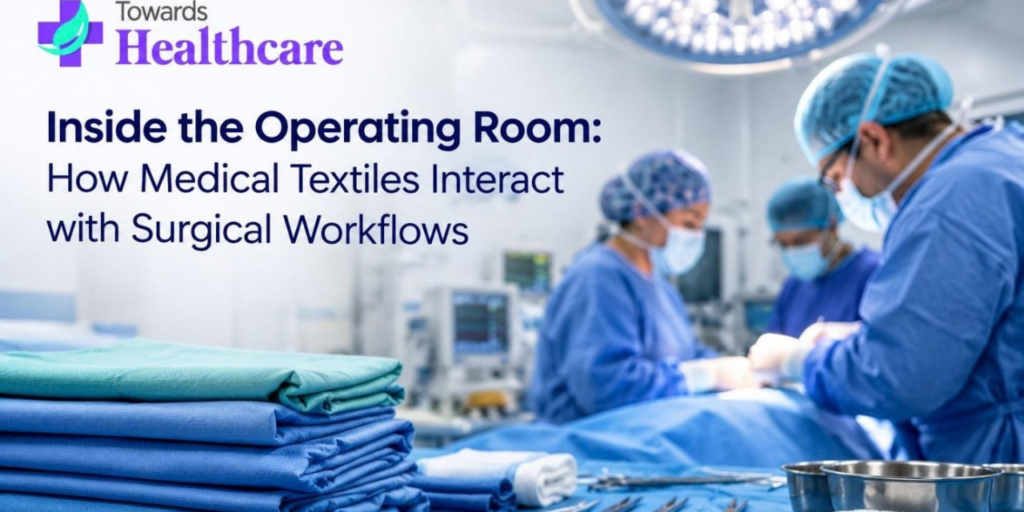
From surgical gowns and drapes to sterile covers, medical textiles are designed to provide protection while supporting movement, comfort and efficiency inside the operating room.
Medical Textiles in the Operating Room
Every movement matters inside an operating room. Surgeons need freedom to work, nurses need to move around equipment, and patients need protection throughout a procedure.
Medical textiles support these requirements in several ways. Surgical gowns, drapes, masks, caps and sterile covers help create protective barriers around patients and healthcare workers.
However, protection is only one part of the requirement. Medical textiles must also work within the surgical workflow without unnecessarily restricting movement or creating discomfort.
Medical Textiles Become Part of the Surgical Environment
Medical textiles are often viewed mainly as protective products. Their role, however, extends beyond barrier protection.
A surgical gown needs to provide an appropriate barrier while allowing the wearer to move freely. A surgical drape needs to help establish a sterile field while remaining stable around the patient and surgical equipment.
According to CDC guidance, surgical gowns and drapes should provide resistance to liquid and microbial penetration. Performance can depend on factors such as fabric repellency, pore size, design and construction.
This makes textile selection an important part of operating-room product design.
From Preparation to the Surgical Procedure
The interaction between medical textiles and surgical workflows begins before the procedure starts.
Healthcare workers use appropriate protective clothing, including gowns, masks and other protective equipment. Sterile gowns and drapes are used when required.
For reusable products, the textile’s performance also depends on cleaning, processing, packaging and sterilisation.
Medical textile performance is therefore connected to the complete product lifecycle. The material must perform before, during and after the surgical procedure.
How Textiles Respond to Movement
An operating room is a highly active environment. Surgeons may bend, stretch, turn and reach while working for extended periods. Nurses and other healthcare workers also move around the operating table while handling equipment and assisting with instruments.
A garment that restricts movement can affect its practical usability.
Textile construction can influence flexibility, drape, tensile strength, seam performance, air permeability and surface characteristics.
Research on surgical gowns has also examined how fabric structure and joining methods influence properties such as air permeability, drape, tensile strength and seam performance.
The Role of Surgical Drapes
Surgical drapes perform a different function from gowns, but they are closely linked to the surgical workflow.
They help define the operative field and create a barrier between the surgical area and surrounding surfaces.
A drape needs to remain in position while accommodating the patient’s position and medical equipment. It may also need to manage exposure to blood and other fluids.
Material properties such as fluid resistance, absorbency, surface friction and fabric construction can therefore influence drape performance.
Research is also examining how different drape materials affect fluid management and the stability of devices placed on the surgical field.
Managing Fluids During Surgery
Blood and other body fluids are common exposures during many surgical procedures.
Medical textiles must manage these exposures while maintaining the required protective barrier. This creates a balance between protection and comfort.
Additional layers or reinforcement can improve resistance to liquid penetration. However, they may also affect breathability and comfort.
The CDC notes that reinforced gowns can improve resistance to liquid strike-through but may be less comfortable.
The objective is therefore not maximum protection in every situation. It is appropriate protection for the clinical task.
Balancing Protection and Comfort
Long surgical procedures can place physical demands on healthcare workers.
A garment that traps excessive heat or moisture may become uncomfortable over time. At the same time, reducing material layers can affect protective performance.
Medical textile design must therefore balance several requirements:
- Barrier protection
- Breathability
- Flexibility
- Moisture management
- Strength
- Weight
- Comfort
- Sterility requirements
This makes surgical textile design different from conventional apparel development.
Designing Textiles Around Surgical Workflows
Medical textile manufacturers increasingly need to consider how products are used in actual clinical environments.
Key questions include:
- Where does the surgeon require greater freedom of movement?
- Which parts of a gown face higher fluid exposure?
- Where can fluid accumulate on a drape?
- How does the material respond when equipment is placed over it?
- Which areas require additional reinforcement?
These considerations connect textile engineering with clinical workflows.
The approach can support the development of application-specific products rather than relying on a single material for every surgical situation.
Why Seams, Layers and Construction Matter
Fabric performance alone does not determine the performance of a medical garment.
A surgical gown includes seams, closures, cuffs, layers and reinforcement zones. Each element can affect the final product.
A high-performing fabric may not deliver the expected protection if garment construction creates weak points.
Medical textile development therefore increasingly considers the complete product architecture rather than evaluating the fabric in isolation.
Disposable or Reusable Medical Textiles?
Operating rooms also face a choice between disposable and reusable textiles.
Both approaches involve different considerations related to performance, processing, cost, waste and resource use.
Reusable gowns and drapes must withstand repeated cleaning and, where required, sterilisation while maintaining their functional properties.
Disposable products reduce the need for reprocessing but introduce additional considerations around material consumption and waste management.
The CDC notes that healthcare facilities evaluating disposable and reusable surgical textiles need to consider protection alongside costs and environmental implications.
The Next Stage of Medical Textile Innovation
Future surgical textiles are likely to focus on more precise performance.
Manufacturers are exploring advanced nonwovens, engineered fibre structures, specialised membranes, coated materials, multifunctional fabrics and improved reusable textile systems.
The objective is not simply to make medical clothing stronger.
The focus is on developing textiles that respond more effectively to the demands of surgical environments.
Future materials could combine barrier protection with improved airflow, moisture management, flexibility, durability and resource efficiency.
According to the market data provided by Towards Healthcare, the global medical clothing market was estimated at USD 122.74 billion in 2025. It is projected to reach approximately USD 229.31 billion by 2035, growing at a CAGR of 6.45% from 2026 to 2035.
Why Medical Clothing Requires Application-Specific Design
The operating room shows why medical clothing cannot be treated like conventional apparel.
A surgical gown or drape must function within an environment involving people, movement, fluids, equipment, sterility and time-sensitive procedures.
Medical textiles are part of these interactions.
Their performance can affect how comfortably healthcare workers move, how effectively protective barriers function and how smoothly products integrate into clinical workflows.
Conclusion
Medical textiles may not be the most visible components of an operating room, but they have an important role throughout a surgical procedure.
From the gown worn by a surgeon to the drape surrounding the operative field, each textile product has a specific function.
The future of medical clothing will depend on designing materials around real clinical requirements. Protection will need to work alongside movement, comfort, durability and workflow compatibility.