
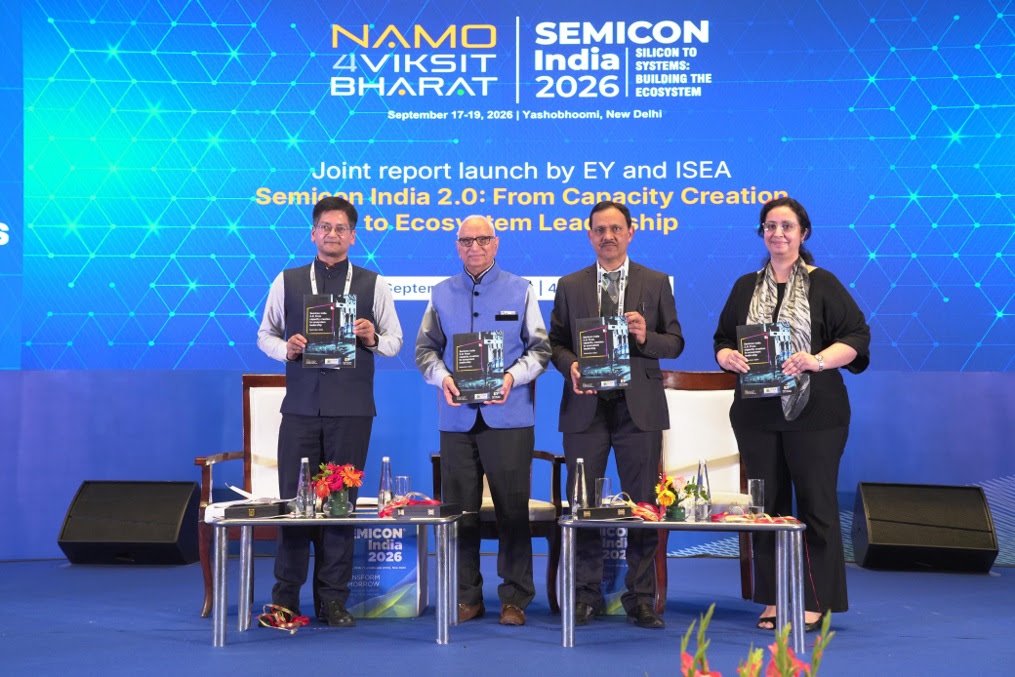
India’s semiconductor market is projected to grow more than threefold, from nearly USD 64 billion in 2026 to USD 200 billion by 2035, according to the EY–IESA report Semicon India 2.0: From Capacity Creation to Ecosystem Leadership. The report was unveiled during the SEMICON India 2026 industry event.
The report highlights the opportunity for India to convert rising domestic semiconductor demand into greater manufacturing capacity, innovation and supply-chain resilience.
Consumer electronics, automotive and industrial sectors drive demand
According to the EY–IESA report, consumer electronics accounts for 30% of India’s semiconductor market, followed by automotive at 16% and industrial applications at 15%. Artificial intelligence, data centres, telecommunications, electric mobility and advanced manufacturing are also creating additional demand for semiconductor technologies.
India’s semiconductor imports increased more than fivefold, from USD 5.7 billion in FY17 to USD 30.3 billion in FY25, representing a 23% CAGR. The increase highlights the scale of domestic demand and the potential for greater local manufacturing and value addition.
India also accounts for nearly 20% of the world’s chip design engineers, providing an established talent base for semiconductor design, manufacturing and commercialisation.
Focus on ecosystem development and commercialisation
Ashok Chandak, President, India Electronics and Semiconductor Association (IESA), said India has an opportunity to combine its engineering talent, electronics demand, design capabilities and emerging manufacturing capacity with global supply-chain partnerships.
He identified execution, innovation, technology commercialisation, indigenous intellectual property, specialised talent and ecosystem development as important areas for the next phase of India’s semiconductor growth.
Aisha Ali Hussaini, Partner and Semiconductor Tax Leader, EY India, said India’s market scale, engineering talent, policy momentum and expanding electronics ecosystem provide a foundation for further semiconductor development.
According to her, electronics production increased from INR 1.9 lakh crore in FY15 to INR 11.3 lakh crore in FY25, while electronics manufacturing and exports grew sevenfold and elevenfold, respectively.
She highlighted the need for a predictable fiscal and regulatory environment, stronger coordination between central and state policies, and targeted support for emerging technologies to improve project viability and accelerate commercialisation.
Policy and infrastructure priorities
The EY–IESA report identifies several areas for the next phase of ecosystem development. These include strengthening and aligning state semiconductor policies with the broader scope of Semicon 2.0, developing integrated semiconductor manufacturing clusters with shared infrastructure, and introducing dedicated talent-certification programmes covering semiconductor design, fabrication and advanced packaging.
The report also points to the importance of collaboration among government, industry and academia to develop capabilities across the semiconductor value chain.
Advanced packaging and photonics among opportunity areas
As global semiconductor supply chains undergo diversification and technology transitions, the report identifies advanced packaging, compound semiconductors, photonics and chip-to-system integration as potential opportunity areas for India.
These segments can build on India’s existing chip-design capabilities, expanding electronics and AI demand, and emerging manufacturing base.
The report notes that investors will consider policy certainty, cluster readiness and implementation timelines when evaluating opportunities. Industry will also need stronger partnerships with suppliers, academic institutions and technology providers to develop local capabilities.
For policymakers, the report highlights the importance of streamlined approvals and sustained support for research, talent development and supplier ecosystems as India seeks to expand its role across the global semiconductor value chain.