
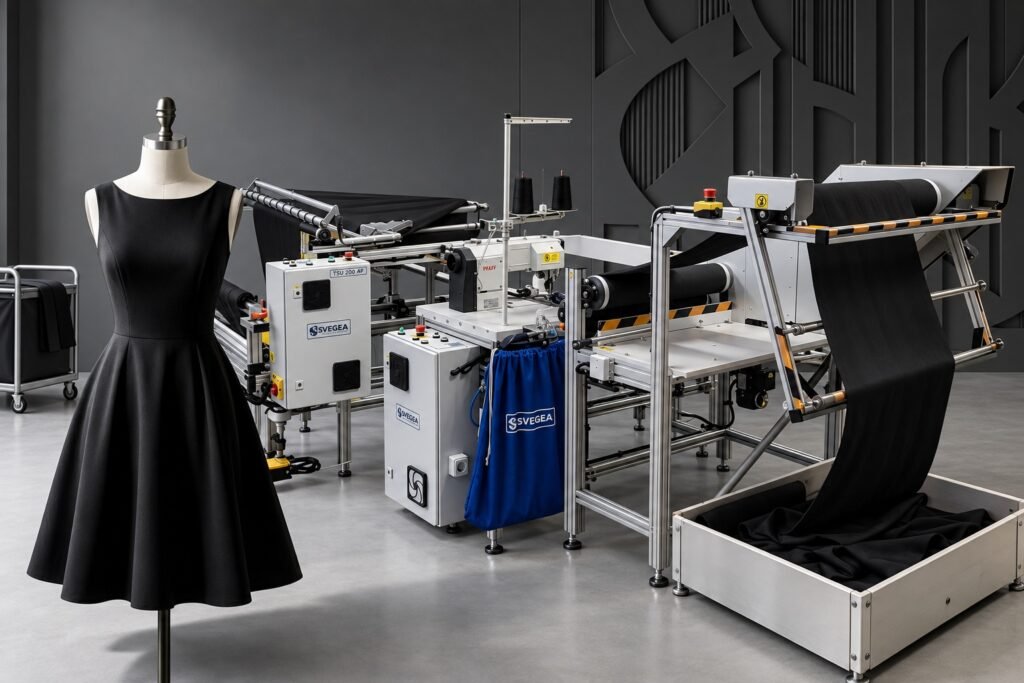
Svegea’s automated bias cutting and binding equipment supports the precision and consistency required for clean garment finishes, including curved necklines and armholes.
The little black dress (LBD) is recognised as one of fashion’s enduring garments, but its apparently simple construction depends on precise manufacturing processes. According to the Swedish Textile Machinery Association (TMAS), technology supplied by TMAS member Svegea plays a role in producing bias binding used in garment finishing.
The LBD became particularly associated with Audrey Hepburn’s appearance in Givenchy’s creation in Breakfast at Tiffany’s. While its visual appeal comes partly from its simplicity, producing a garment that retains its shape, sits cleanly around the neckline and withstands repeated wear requires attention to construction and finishing details.
One such detail is bias binding.
Why Bias Binding Matters
Bias binding is made from fabric strips cut diagonally across the material rather than along its straight grain. This cutting direction gives the strips greater flexibility, allowing them to follow curved areas such as necklines and armholes without puckering or distorting the garment.
The binding can be used to enclose raw edges, reinforce areas exposed to movement and provide a clean internal finish. Although it is generally not visible to the wearer, accurately produced and applied binding can contribute to the appearance and durability of a garment.
For home sewing, bias strips can be cut and prepared manually. Industrial garment manufacturing presents a different requirement, particularly when thousands of identical components are needed.
Manufacturers need to maintain consistent widths and cuts while controlling material consumption and production speeds. This is where automated equipment can support repeatable production.
From Fabric Roll to Bias Binding
TMAS member Svegea has developed automated equipment for bias binding and other fabric cutting operations.
Its system converts fabric rolls into continuously produced bias material through a series of automated processes. The operation begins with the Tube Sewing Unit, which joins open-width fabric to form a continuous tube.
The material is then handled by the Bias Cutter and Winder, which opens and rewinds the fabric in preparation for accurate slitting.
The equipment can produce narrow strips down to 6 mm, as well as wider bindings for heavier fabrics and more structural applications.
Automating these processes allows manufacturers to maintain consistent dimensions during long production runs while reducing variations that can occur when materials are prepared manually.
Precision for Curved Garment Areas
Consistency is particularly important when binding is used around curved sections of a garment. Necklines and armholes can have a direct visual impact on the fit and appearance of a finished garment.
The little black dress provides a clear example because its relatively simple design leaves fewer decorative elements to distract from construction details and finishing quality.
Accurate preparation of bias binding can therefore support the consistent finishing of prominent curved edges.
Applications Beyond Dresses
Industrial bias cutting is used in a wide range of textile and garment applications beyond dresses. Bias binding can be used in blouses, childrenswear, activewear, bags, accessories and home textile products, particularly where flexible edge finishing is required.
Svegea’s machinery portfolio also includes collarette cutters for applications such as waistbands and roll slitters for handling larger fabric rolls.
Across these applications, repeatability remains a key requirement. As garment manufacturing has become increasingly automated, processes that previously relied heavily on manual skills have increasingly been engineered to deliver consistent results at industrial production volumes.
Swedish Textile Machinery Expertise
The technology also highlights the specialised role played by Swedish textile machinery manufacturers.
TMAS – the Swedish Textile Machinery Association – brings together manufacturers supplying technologies across textile and garment production. Its members work across individual stages of manufacturing, including processes that may not be visible in the final textile or garment.
In Svegea’s case, the company specialises in the accurate preparation and cutting of textile materials for subsequent garment assembly.
“The enduring little black dress provides a particularly neat illustration,” says Therese Premler-Andersson, secretary general of TMAS. “Its apparent simplicity depends on getting a succession of small manufacturing details right – from the way the fabric is cut and assembled to the finishing of its curved edges. The wearer may never notice the bias binding around a perfectly finished neckline, but in many ways, that is precisely the point.”