
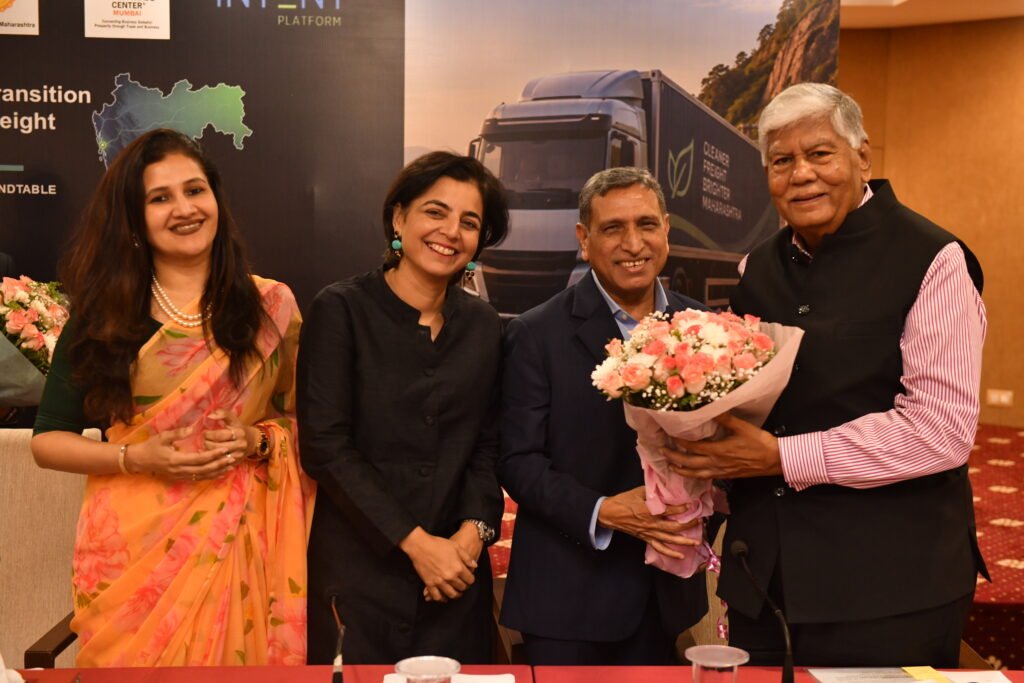
MAHAPREIT and INTENT convene industry stakeholders to discuss charging infrastructure, financing and demand aggregation for electric trucks.
Maharashtra is exploring measures to accelerate the transition to electric road freight as part of broader efforts towards India’s Net Zero 2070 goal.
A round table titled “Accelerating the Transition to Electric Road Freight in Maharashtra” was organised by MAHAPREIT (Mahatma Phule Renewable Energy and Infrastructure Technology Limited) and INTENT at MVIRDC World Trade Center Mumbai.
The discussion brought together stakeholders from government, financial institutions and freight-intensive industries to examine the infrastructure, financing and commercial requirements for scaling electric truck adoption.
Maharashtra Seeks Electric Freight Models
Bipin Shrimali, IAS, Managing Director, MAHAPREIT, said Maharashtra has an opportunity to develop commercially viable models for electric road freight because of its industrial and logistics base.
“Maharashtra has the opportunity to take a leadership position in the transition towards electric road freight. With its strong industrial and logistics base, the State is well placed to create commercially viable models that can enable industry to adopt electric trucks at scale. The focus must now be on building an ecosystem that brings together cargo owners, fleet operators, vehicle manufacturers, financial institutions, energy providers and infrastructure developers, while ensuring that the transition is technically feasible, financially bankable and commercially attractive.”
He said the sector currently faces a demand and infrastructure gap.
Users need adequate charging infrastructure before committing to electric trucks, while infrastructure developers require sufficient demand to justify investment.
64 EV Charging Stations Under Development
Shrimali said MAHAPREIT is developing 64 large EV charging stations, with the National Highways Authority of India (NHAI) enabling right-of-way access.
He added that MAHAPREIT is also exploring green freight corridors that could aggregate demand from ports, fertiliser companies, mining operations and other freight-intensive sectors.
According to Shrimali:
“The electric-trucking ecosystem currently faces a “chicken-and-egg” challenge, with users seeking adequate charging infrastructure before committing to vehicles, while infrastructure developers require sufficient demand to justify investment.”
Demand aggregation could therefore help coordinate vehicle deployment, charging infrastructure and freight requirements along selected routes.
Commercial Viability Remains Key
Mahua Acharya, Founder & CEO, INTENT, highlighted the scale of the opportunity in India’s road freight sector.
“India has approximately 4 million registered trucks, while fewer than 1,000 are electric, this highlights the scale of the opportunity before us. Transport contributes about 10% of India’s overall emissions, with road transport accounting for the dominant share.”
She said policy support and incentives are becoming more favourable, but electric trucking will ultimately need to demonstrate commercial viability.
Factors such as total cost of ownership, assured freight demand, financing and charging infrastructure will influence adoption.
Acharya also highlighted demand aggregation as a way to make electric trucking projects more bankable across specific sectors and freight corridors.
Energy Security and Logistics Competitiveness
Dr. Vijay Kalantri, Chairman, MVIRDC World Trade Center Mumbai and President, All India Association of Industries, linked freight electrification with India’s energy security and logistics competitiveness.
“As India moves towards the vision of Viksit Bharat 2047, our logistics system must become more efficient, sustainable and globally competitive. In comparison to China which has a sale of nearly 400 thousand electric truck sales, India had a sale of mere 1000 units.”
He noted India’s dependence on imported crude oil and said freight electrification has implications for energy security, logistics costs and competitiveness.
Kalantri said the transition would require an ecosystem covering vehicle manufacturing, raw materials, charging infrastructure, electric freight corridors, port connectivity and supporting logistics infrastructure.
Maharashtra’s Industrial Base Offers Opportunity
Kalantri said Maharashtra’s ports, industrial clusters and automotive ecosystem provide a foundation for electric freight development.
He also highlighted the need for:
- Talent mobilisation
- Workforce skilling
- Financing mechanisms
- Support for small and medium fleet operators
- Charging infrastructure
- Electric freight corridors
- Port connectivity
He added:
“The real success will come when electric trucking becomes not only the greener option, but also the better business option.”
Industry Stakeholders Discuss Adoption
The round table included senior representatives from NABARD and freight-intensive industries, including Tata Steel.
Stakeholders from the cement, chemicals, fertilisers, pulp and paper, and tyre sectors also participated.
Discussions covered industry readiness, procurement plans and barriers to electric-truck adoption.
Participants also explored potential commercial trials, partnerships, financing mechanisms and expressions of interest for demand aggregation.
The discussions are aimed at developing scalable electric road freight models for Maharashtra while addressing the infrastructure and commercial requirements needed for wider adoption.
The initiative connects electric freight adoption with broader objectives around energy security, logistics efficiency, economic competitiveness and decarbonisation.