
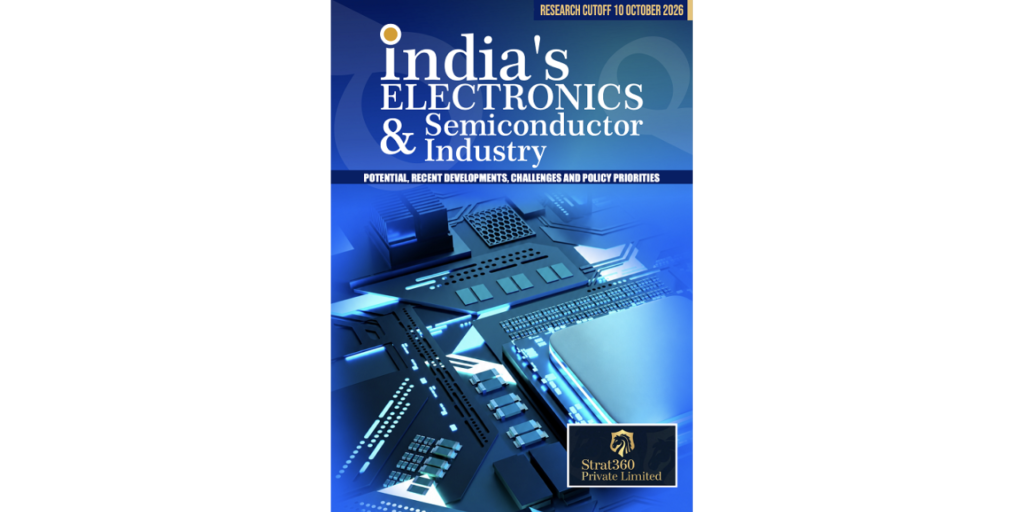
Strat360 Private Limited, a research-led strategic advisory firm, has released India’s Electronics and Semiconductor Industry: Potential, Recent Developments, Challenges and Policy Priorities. The report assesses India’s current position in global electronics and identifies opportunities to deepen its manufacturing capabilities over the next five years.
According to the report, electronics production reached an estimated ₹13.11 lakh crore in FY 2025–26, registering 15.8% growth from ₹11.32 lakh crore in FY 2024–25. Electronics exports touched ₹4.24 lakh crore, equivalent to approximately US$47.96 billion, making electronics India’s third-largest export category. Mobile phones accounted for the country’s largest electronics export product category.
“India has built a world-class assembly base, and its semiconductor journey has begun. The opportunity now is to build depth on that foundation, in components, packaging and mature-node chips. The next five years will reward what customers qualify and reorder, and India is well placed to deliver on that,” said Santosh Tiwari, Founding Chair, Strat360 Private Limited.
Semiconductor Packaging and Component Manufacturing Gain Momentum
The report states that five semiconductor packaging and testing units have started commercial production under the India Semiconductor Mission. It also highlights Semicon 2.0, which was approved in July 2026 with an outlay of ₹1,27,500 crore, as part of the support for India’s semiconductor ambitions.
Component manufacturing is another area of progress. By August 2026, the Electronics Component Manufacturing Scheme (ECMS) had approved 106 projects, with 38 plants reportedly producing.
The report identifies ECMS as a key mechanism for increasing domestic value addition in mobile phones. It estimates that local value addition could rise from approximately 18–20% towards 35–40% as domestic component manufacturing capabilities expand.
India’s Next Opportunity Lies in Manufacturing Depth
Strat360 identifies components, materials, manufacturing equipment, front-end fabrication and the commercialisation of Indian chip designs as areas with significant growth potential.
India’s first commercial semiconductor fabrication facility at Dholera, Gujarat, is expected to begin operations around mid-2028, focusing on mature process nodes, according to the report.
For the next five years, the report identifies semiconductor packaging and testing, electronics components, and selected mature-node and compound-semiconductor production as realistic areas for expansion. It recommends aligning these capabilities with demand from the automotive, power electronics, industrial and strategic sectors.
The report also calls for a stronger commercialisation focus in chip design, with progress assessed through market adoption and business outcomes rather than headcount alone.
Policy Priorities for the Next Five Years
The report outlines several priorities to translate investment and manufacturing approvals into lasting competitiveness:
- Measure manufacturing outcomes: Track qualified output, production yields and domestic value addition alongside investment allocations and project approvals.
- Improve data transparency: Publish regular, verifiable information on customer qualification, order books, fund disbursement and actual spending.
- Strengthen component manufacturing: Sustain the momentum of ECMS to increase domestic value addition.
- Set clear project timelines: Communicate the expected mid-2028 start of the Dholera fabrication facility and its mature-node focus.
- Link subsidies to milestones: Connect government support to measurable outcomes and time limits, with incentives tapering as competitiveness improves.
- Prioritise customer qualification: Support manufacturers in securing customer approvals and orders, as operational credibility depends on more than building production facilities.
- Build supplier and customer networks: Draw lessons from Vietnam and Malaysia by attracting suppliers and customers alongside manufacturing investments.
Focus on Resilient Electronics Supply Chains
“The goal for India is resilience: credible, alternative capacity in assembly, test and components that global customers trust. With milestone-linked policy and a sharp focus on qualified output, India can move from assembly to advantage,” added Santosh Tiwari.
The report concludes that India’s next phase of electronics and semiconductor development will depend on building reliable domestic capabilities that global customers can qualify and source from consistently. It emphasises the importance of production outcomes, customer adoption and deeper component manufacturing in moving beyond an assembly-led model.
The research draws on government documents, trade data, company disclosures, working papers and independent research. Its research cut-off date is 10 October 2026. Figures follow India’s financial year, from April to March, or the calendar year, as specified in the report. The report also identifies instances where evidence could not be verified.
The report summary is available on LinkedIn. For the full report, contact chairmanoffice@strat360.co.in.