
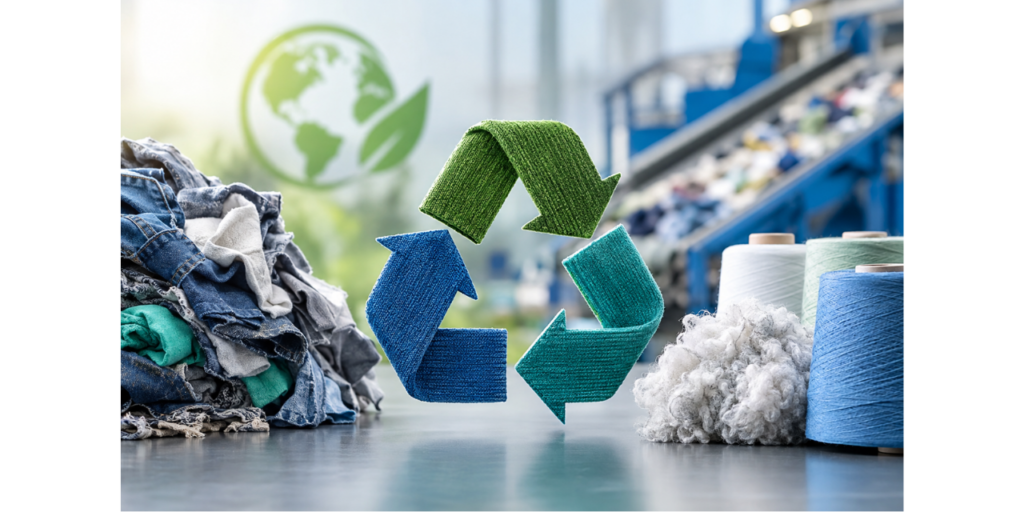
Textile-to-textile recycling has made technological advances in recent years, but significant economic and infrastructure challenges continue to limit its expansion to commercial scale, according to a 19-page report, “Textile-to-textile recycling: the business case,” published by global business information company Textiles Intelligence.
The report notes that executive attention to sustainability has declined as companies place greater emphasis on margins, budgets and investment returns. At the same time, climate change is disrupting supply chains, raw material prices remain volatile, and regulations governing textile waste and circularity are becoming increasingly stringent. As a result, sustainability is increasingly being considered a financial and strategic issue rather than solely an environmental concern.
Business Benefits of Textile Recycling
According to the report, textile-to-textile recycling can deliver three key business benefits: creating new revenue opportunities through circular products, reducing exposure to supply chain risks, and helping companies meet emerging regulatory requirements.
However, the commercial case remains challenging. Recycled fibres are generally more expensive than virgin alternatives, while the infrastructure required to collect, sort and process textile waste is still developing.
Less than 1% of global fibre production currently comes from recycled pre-consumer and post-consumer textiles. Most recycled fibre continues to be sourced from other materials, particularly plastic bottles. In addition, only around 11% of post-consumer textile waste was collected and sorted into streams suitable for recycling last year, limiting the availability of appropriate feedstock.
Chemical Recycling Technology Continues to Develop
Technological development in textile-to-textile recycling is continuing, with chemical recycling offering the potential to produce fibres with properties comparable to virgin materials.
Companies including Ambercycle, Circ, Circulose and Syre are developing and scaling textile-to-textile recycling technologies. However, high investment costs, limited feedstock availability, infrastructure requirements and energy consumption remain significant barriers to wider adoption.
The cost difference between recycled and virgin fibres also remains substantial. Recycled polyester is estimated to cost 2.6 times more than virgin polyester.
In Europe, achieving a 15% textile-to-textile recycling rate by 2035 would require an estimated Euro8 bn-11 bn (US$9.2 bn-12.7 bn) in capital expenditure and Euro5 bn-6.5 bn in annual operating expenditure, according to the report.
Policy Could Support Commercial Viability
Policy measures are expected to play an important role in improving the commercial viability of textile-to-textile recycling.
The EU’s Ecodesign for Sustainable Products Regulation (ESPR) and extended producer responsibility (EPR) requirements are expected to increase pressure on companies to address the end-of-life impacts of textile products.
Under the existing timetable, national textile EPR schemes should be operational by April 2028, while several countries have already introduced such schemes.
Companies can also help reduce investment risks by providing greater certainty around future demand. Offtake agreements and collaborative purchasing arrangements could give recycling companies greater confidence to invest in additional capacity while helping brands secure supplies of recycled fibres.
Investment and Feedstock Remain Critical
The report concludes that the business case for textile-to-textile recycling is becoming clearer, but achieving commercial scale will require more than technological progress.
Greater investment, reliable supplies of suitable feedstock, stronger demand for recycled fibres and supportive policy measures will all be necessary to narrow the gap between the technological potential of textile-to-textile recycling and its commercial reality.