
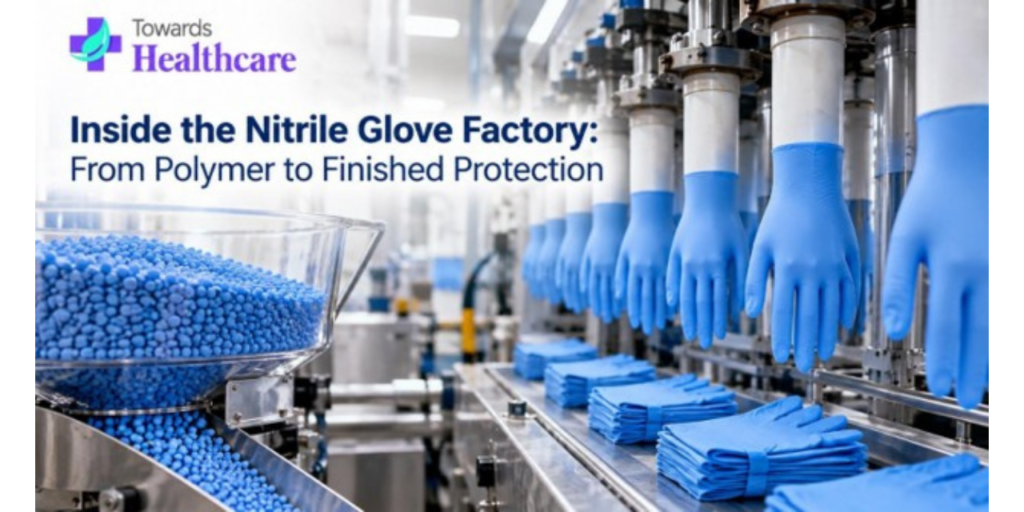
Overview
A nitrile glove may look like a simple disposable product, but its manufacturing process involves polymer chemistry, mold design, dipping technology, heat treatment, surface engineering, quality testing, and strict production controls.
From the initial nitrile compound to the finished glove packed for healthcare use, every stage affects the glove’s strength, flexibility, barrier performance, and comfort.
Understanding this manufacturing journey also explains why not all nitrile gloves perform the same way, even when they appear similar.
What Is a Nitrile Glove?
Nitrile gloves are made from nitrile butadiene rubber (NBR), a synthetic rubber material.
They are widely used in healthcare, laboratories, pharmaceutical manufacturing, food handling, industrial environments, and other settings where hand protection is required.
Compared with natural rubber latex, nitrile can offer useful resistance to many oils and chemicals and avoids the natural rubber proteins associated with latex allergy.
However, performance depends heavily on formulation, manufacturing quality, thickness, design, and intended application.
According to Towards Healthcare, the global nitrile gloves market size is calculated at USD 5.54 billion in 2025, grew to USD 6.07 billion in 2026, and is projected to reach around USD 13.9 billion by 2035. The market is expanding at a CAGR of 9.64% between 2026 and 2035.

Step 1: Preparing the Nitrile Compound
The manufacturing process starts with the preparation of the liquid nitrile compound.
NBR is combined with other ingredients needed to give the material the required properties. These can include curing agents, stabilizers, pigments, processing chemicals, and other formulation components.
The exact formulation is important because it influences properties such as elasticity, tensile strength, tear resistance, softness, and chemical resistance.
The compound must also remain consistent throughout production. Changes in viscosity, temperature, or chemical balance can affect how the material behaves during dipping.
Step 2: Preparing the Glove Former
Before the glove itself is created, manufacturers prepare glove-shaped molds known as formers.
These formers are commonly made from ceramic or other suitable materials and are shaped to represent the human hand.
Their surface condition matters.
The former needs to be properly cleaned and prepared so that the nitrile compound can form a consistent layer across the fingers, palm, thumb, and cuff.
The design of the former also influences the final glove’s fit, finger shape, thickness distribution, and dexterity.
Step 3: Cleaning and Coating the Former
The formers pass through cleaning and preparation stages before entering the dipping process.
In some manufacturing systems, a coagulant is applied to the former.
This helps the liquid nitrile compound deposit onto the former surface and begin forming the glove layer.
Temperature and chemical concentration need to be controlled carefully. Small changes can affect how quickly and evenly the nitrile layer develops.
Step 4: Dipping Into Nitrile
This is where the glove begins to take shape.
The prepared former is immersed into the nitrile compound. As it comes out, a layer of nitrile remains on its surface.
The process may be repeated or adjusted depending on the required glove construction.
Manufacturers carefully control factors such as dipping speed, compound viscosity, former temperature, immersion time, and withdrawal conditions.
These variables influence the final thickness and consistency of the glove.
Step 5: Creating the Right Thickness
Glove thickness is not simply about making a glove thicker.
A thicker glove may provide greater durability in some applications, but it can also affect flexibility and tactile sensitivity.
Healthcare applications often require a balance between barrier performance, strength, comfort, and dexterity.
Manufacturers therefore design glove thickness according to the intended application rather than relying on one universal specification.
Different parts of a glove may also experience different stresses during use, making thickness distribution an important manufacturing consideration.
Step 6: Heat Treatment and Curing
After dipping, the nitrile layer needs to develop its final rubber properties.
This happens through curing, where controlled heat causes chemical reactions within the rubber compound.
The curing process affects elasticity, strength, durability, and overall glove performance.
Too little curing can leave the material with inadequate mechanical properties. Excessive or poorly controlled curing can also affect performance.
This makes temperature, time, and process control critical inside the factory.
Step 7: Washing and Chemical Treatment
Freshly manufactured gloves can contain residual processing chemicals and other materials from production.
Washing stages can help remove unwanted residues and improve the final product.
Manufacturers may use multiple washing processes depending on the product specification and production system.
For medical and laboratory applications, controlling residues can be particularly important because the glove comes into close contact with the user’s skin and may be used in controlled environments.
Step 8: Surface Treatment
The glove surface can be modified depending on its intended use.
Some nitrile gloves have a textured surface on the fingers and palm to improve grip, particularly when handling instruments or materials in wet conditions.
Manufacturers can also apply different finishing treatments to improve donning, handling, or surface characteristics.
Powder-free gloves require particular attention to surface treatment because they need to be easy to put on without relying on powder.
Step 9: Removing the Glove From the Former
Once the nitrile has been fully processed, the finished glove must be removed from the former.
Automated stripping systems can remove gloves efficiently from the molds while minimizing damage.
This stage may appear simple, but the glove must be removed without creating tears, stretching defects, or deformation.
Production speed therefore needs to be balanced with product integrity.
Step 10: Inspection and Quality Control
Quality control is one of the most important stages of nitrile glove manufacturing.
A glove can look perfectly normal but still contain a microscopic defect that compromises its protective function.
Manufacturers therefore use visual inspection and physical or automated testing methods to identify problems.
Depending on the product and applicable standards, testing can include water-leak testing, tensile strength, elongation, dimensions, thickness, visual defects, and other performance characteristics.
Testing helps manufacturers identify issues such as pinholes, tears, weak areas, inconsistent thickness, poor cuff formation, or surface defects.
Why Manufacturing Consistency Matters
A nitrile glove is only as reliable as the manufacturing process behind it.
Variations in raw materials, dipping conditions, curing, washing, or handling can create differences between production batches.
For healthcare organizations purchasing large quantities, consistency becomes especially important.
The objective is not simply to produce millions of gloves. It is to produce gloves that deliver predictable performance from one batch to the next.
Automation Is Changing Glove Manufacturing
Modern nitrile glove factories increasingly rely on automated production systems.
Automation can help control dipping speeds, temperatures, chemical concentrations, former movement, curing conditions, inspection, and packaging.
Machine vision and automated inspection systems can also help identify defects that are difficult to detect through manual inspection alone.
This is gradually changing glove manufacturing from a highly repetitive production process into a more controlled and data-driven manufacturing environment.
Sustainability and the Nitrile Glove Factory
Disposable nitrile gloves create an important sustainability challenge because their primary purpose is often single use.
Manufacturers are therefore looking at ways to reduce material consumption, improve production efficiency, reduce manufacturing waste, and optimize energy and water use.
Using the right amount of material is particularly important.
A glove does not necessarily become better simply because more material is used. The challenge is to achieve the required protection and durability while avoiding unnecessary material consumption.
End-of-life management remains more complicated because used healthcare gloves may be contaminated and cannot always be handled like ordinary plastic waste.
What Lies Ahead?
The future of nitrile glove manufacturing is likely to focus on better process control, improved formulations, thinner high-performance gloves, automation, defect detection, resource efficiency, and application-specific designs.
Manufacturers are also exploring ways to improve comfort and tactile sensitivity while maintaining the protective properties expected from nitrile gloves.
As healthcare, pharmaceutical, laboratory, and industrial applications become more specialized, glove manufacturers will increasingly need to engineer products for specific performance requirements rather than producing one standard glove for every use.
Conclusion
A nitrile glove is the result of a carefully controlled manufacturing journey that begins with polymer chemistry and ends with inspection and packaging.
Formulation, former design, dipping, thickness control, curing, washing, surface treatment, stripping, and quality testing all contribute to the final product.
Behind every disposable nitrile glove is therefore a combination of material science, manufacturing engineering, automation, and quality control working together to create a reliable protective barrier.
About Author
Payal Rabde is a Healthcare Market Research Analyst at Towards Healthcare Research & Consulting with over 4+ years of experience in pharmaceutical, biotechnology, medical device, and healthcare market research. She holds an MBA in Pharmaceutical-Biotechnology Management and a B.Pharm, specializing in market analysis, forecasting, competitive intelligence, and strategic healthcare insights.