
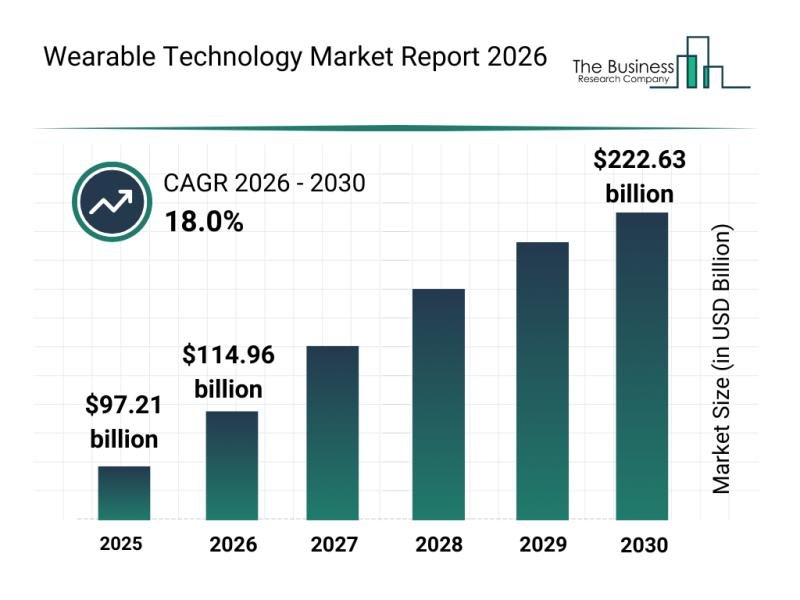
The Business Research Company projects an 18.0% CAGR through 2030, with growth supported by health monitoring, AI-powered analytics, smart textiles and connected wearable devices.
The global wearable technology market is projected to grow from US$97.21 billion in 2025 to US$114.96 billion in 2026, representing a compound annual growth rate (CAGR) of 18.3%, according to The Business Research Company’s Wearable Technology Market Report 2026.
The report attributes recent market growth to rising consumer interest in health and wellness, widespread adoption of fitness trackers and smartwatches, sports performance monitoring, remote patient monitoring and improved connectivity between wearable devices and smartphones.
Looking ahead, the market is forecast to reach US$222.63 billion by 2030, registering a projected CAGR of 18.0%. Increasing demand for personalised health insights, clinical-grade wearables, workplace safety solutions and immersive augmented reality (AR) and virtual reality (VR) technologies are among the factors expected to support expansion.
Health Monitoring and Connected Devices Support Market Growth
Wearable devices are increasingly being used to monitor fitness, sleep, heart rate and other health indicators. In healthcare, connected wearables can support remote patient monitoring and provide data that healthcare professionals may use alongside other clinical information.
The report also identifies corporate investment in employee wellness and safety as a potential growth driver. At the same time, subscription-based digital coaching and cloud services are creating additional revenue opportunities for wearable technology providers.
Advances in Bluetooth connectivity and smartphone integration have also helped make wearable devices more accessible to consumers.
Smart Textiles and AI Emerge as Key Trends
Developments in artificial intelligence (AI), smart textiles and sensor technologies are expanding the potential applications of wearable devices.
Key trends highlighted in the report include:
- AI-powered health analytics: Using data from wearable devices to generate more personalised insights and support predictive analysis.
- Smart textiles and e-clothing: Integrating sensing and functional capabilities into garments for applications in sports, healthcare and workplace monitoring.
- Multimodal biometrics: Combining different biometric measurements to support monitoring and analysis.
- Non-invasive medical sensors: Developing wearable technologies that can collect selected health measurements without invasive procedures.
- Energy-efficient components: Improving battery performance and using ultra-low-power chips to support device operation.
- AR and VR wearables: Expanding applications in entertainment, enterprise environments and immersive training.
These developments connect the consumer electronics market with the textile, healthcare, sports and industrial sectors.
Major Companies in the Wearable Technology Market
The report identifies a broad group of companies operating across wearable devices, connected electronics, sports technology and smart eyewear.
Among the companies listed are Google, Samsung Electronics, Huawei Technologies, Sony, Xiaomi, Garmin, Adidas, Nike, OPPO, OnePlus, Withings, Vuzix, Fitbit, Fossil Group, Casio America, ASUSTeK Computer, LG Electronics, Michael Kors Holdings, hDrop Technologies and Bearmind.
Competition spans several product categories, including smartwatches, fitness trackers, medical wearables, smart glasses, hearables and smart clothing.
Acquisitions and Neural Interface Technology
Strategic acquisitions and product development are also contributing to changes in the wearable technology landscape.
According to the report, TDK Corporation acquired SoftEye Inc., a US-based smart eyewear technology company, in June 2025. The financial terms were not disclosed. The acquisition was intended to strengthen TDK’s capabilities in smart glasses hardware, software and augmented reality solutions for consumer and enterprise applications.
Another development highlighted in the report is the Mudra Link neural gesture-control wristband, introduced by Wearable Devices Ltd. in January 2025. The device is designed to interpret signals associated with nerve activity to enable gesture-based control of compatible digital devices. Reported compatibility includes Android, macOS and Windows.
These developments illustrate how wearable technology is expanding beyond conventional activity tracking into new approaches to human-computer interaction.
Market Segmentation Across Products and Applications
The report divides the wearable technology market into several product categories, connectivity technologies, distribution channels, applications and end-user groups.
Product categories include smartwatches, fitness and activity trackers, smart clothing and e-textiles, AR/VR headsets and smart glasses, medical and clinical wearables, hearables and other wearable accessories.
Connectivity options include Bluetooth, Wi-Fi, cellular networks such as LTE and 5G, near-field communication (NFC) and other low-power Internet of Things networks.
Applications span health and fitness monitoring, remote patient monitoring, sports performance analytics, gaming, entertainment, immersive training, workplace safety, productivity, personal assistance and defence-related uses.
End-users include individual consumers, healthcare providers and patients, enterprise and industrial users, and athletes and sports organisations.
Within smart clothing and e-textiles, applications include smart sportswear, workwear, military apparel, fashion garments and thermally regulating clothing. Other wearable categories include smart rings, helmets, belts, connected jewellery and smart insoles.
Expanded Analytical Coverage in the 2026 Report
The Business Research Company states that its 2026 market reports include additional analytical features such as market attractiveness assessments, total addressable market (TAM) analysis, company scoring matrices, Excel-based forecasting dashboards, market hotspot infographics and updated analysis of technologies and future trends.
The report provides a market outlook for businesses assessing opportunities across connected devices, smart textiles, medical wearables and other emerging applications.
Report links: