
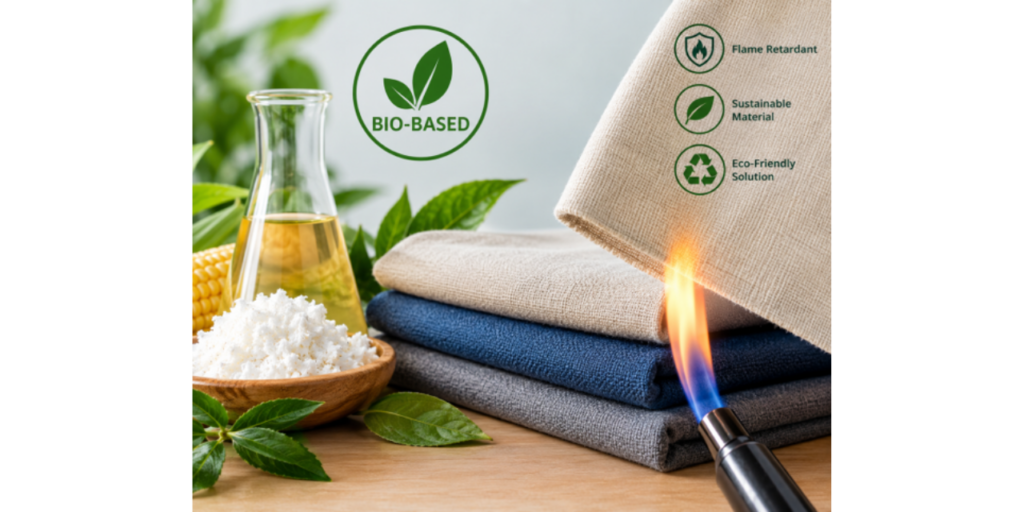
The global bio-based flame-retardant textile market is valued at USD 1.58 billion in 2025 and is projected to reach USD 3.11 billion by 2034, according to research by Growth Market Reports. The market is expected to register a CAGR of 8.2% from 2026 to 2034.
Market growth is being supported by increasing demand for sustainable flame-retardant solutions in textile manufacturing, alongside stricter regulatory requirements and changing consumer preferences toward environmentally conscious products.
Bio-based flame-retardant textiles use renewable materials and naturally derived compounds to reduce the flammability of fabrics. Textile manufacturers are increasingly exploring alternatives to conventional formulations as sustainability, safer chemical systems and resource efficiency become more important considerations in textile processing.
Research into bio-based flame-retardant systems includes materials such as lignin, chitosan, phytic acid, tannins, amino-acid derivatives and other biomass-based compounds.
Demand for Sustainable Textile Chemistry
The shift toward more environmentally conscious textile production is one of the key factors supporting market development.
Manufacturers are evaluating flame-retardant systems that can reduce dependence on conventional petroleum-derived or halogen-containing formulations. Bio-based alternatives are being explored as part of circular-material strategies while continuing to meet the functional requirements of protective and performance textiles.
Expanding Fire-Safety Applications
Flame-retardant textiles are used across a range of applications, including protective clothing, transportation interiors, furnishings, industrial fabrics and selected residential products.
As fire-safety requirements evolve, textile manufacturers are seeking treatments that provide fire resistance while maintaining properties such as softness, strength, appearance and comfort.
Durability Remains a Market Challenge
Maintaining flame-retardant performance throughout the useful life of a textile remains a significant technical challenge.
Repeated washing, abrasion, moisture exposure and everyday use can affect the effectiveness of surface treatments. Active compounds may migrate or detach from textile fibres over time, reducing performance.
Research is therefore examining approaches such as chemical bonding, cross-linking, multilayer coatings and other treatment technologies designed to improve durability. Wash durability is also highlighted as an important consideration for practical textile applications.
Balancing Fire Safety With Fabric Performance
Flame-retardant treatments need to provide effective protection without adversely affecting other textile properties.
High levels of coatings or treatment chemicals can influence hand feel, breathability, flexibility, colour and mechanical performance. Developing formulations that maintain these characteristics while delivering reliable flame resistance remains an important area of research.
Biomass-Derived Flame-Retardant Systems
Technological development is increasingly focused on combining bio-derived components to achieve improved flame-retardant performance.
Materials including phytic acid, lignin, chitosan, tannic acid and plant-based compounds are being investigated as components of flame-retardant formulations. Researchers are also studying combinations involving phosphorus, nitrogen and boron to support char formation and reduce heat release.
These approaches are expanding the range of biomass-derived materials being considered for textile flame-retardant applications.
Advanced Coating Technologies
New coating technologies are creating opportunities for multifunctional flame-retardant textiles.
Developments include intumescent systems, chemically bonded finishes and layered coatings designed to provide flame resistance alongside additional textile properties such as water repellency.
A 2026 study demonstrated a fully bioderived intumescent coating for polyamide textiles using tannic acid, chitosan and guanidine phosphate.
Competitive Landscape
The companies identified in the market research include:
- BASF SE
- Clariant AG
- DuPont de Nemours, Inc.
- ICL Group Ltd.
- Lanxess AG
- Thor Group Limited
- Italmatch Chemicals S.p.A.
- TEIJIN Limited
- Milliken & Company
- Solvay S.A.
Future Outlook
The development of the bio-based flame-retardant textile market will depend on combining renewable sourcing with consistent fire performance, durability, scalability and competitive manufacturing costs.
Continued research into biomass-derived additives and multifunctional coating technologies is expected to expand the range of textile substrates that can use bio-based flame-retardant systems.
As sustainability becomes increasingly integrated into material selection and textile processing, bio-based flame-retardant technologies could expand from specialized applications into broader commercial use. The projected market growth reflects increasing interest in textile solutions addressing both fire safety and environmental performance.
Source: Growth Market Reports