
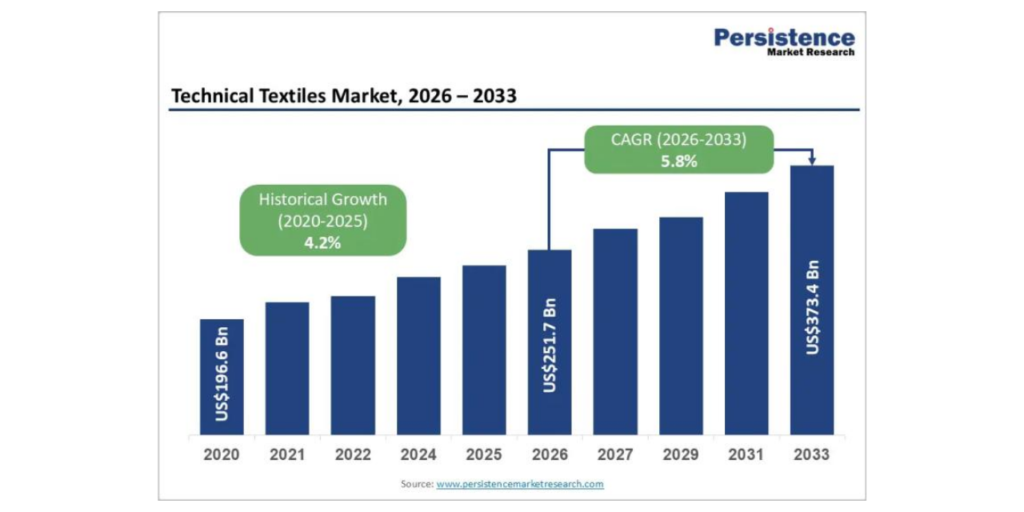
Persistence Market Research projects the global market to grow from US$251.7 billion in 2026 to US$373.4 billion by 2033, at a CAGR of 5.8%.
The global technical textiles market is projected to grow from US$251.7 billion in 2026 to US$373.4 billion by 2033, registering a compound annual growth rate (CAGR) of 5.8% during the forecast period, according to Persistence Market Research.
Technical textiles are engineered textile products developed primarily for functional performance rather than decorative purposes. They are used across a range of industries, including automotive, construction, healthcare, agriculture, filtration, protective equipment, packaging and industrial manufacturing.
These materials can offer properties such as high strength, durability, heat and chemical resistance, flame retardancy, water resistance, filtration efficiency and lightweight construction. Their application-specific characteristics support their use in demanding industrial and commercial environments.
Advanced Materials and Manufacturing Technologies Support Market Development
Developments in high-performance fibres, coatings, composites, nonwoven technologies and smart textiles are shaping the technical textiles market. Manufacturers are working to meet specialized end-use requirements while balancing material costs, manufacturing complexity, sustainability expectations and regulatory compliance.
High-performance materials such as aramid, carbon fibre, glass fibre, advanced polymers and specialty synthetic fibres are used in applications requiring strength, durability, temperature resistance and chemical resistance. Engineered fibre blends and composite textile structures are also being developed to combine multiple functional properties within a single product.
Nonwoven technologies are important in filtration media, medical textiles, hygiene products, geotextiles, insulation, automotive components and protective products. Coating and lamination processes can add properties such as waterproofing, flame resistance, chemical protection and abrasion resistance.
Automotive, Construction and Healthcare Remain Key Application Areas
The automotive sector uses technical textiles in vehicle interiors, filtration systems, insulation, reinforcement and safety components. Demand for lightweight materials is encouraging manufacturers to explore engineered textile solutions for applications where weight reduction and functional performance are important.
Construction and infrastructure are additional areas of demand. Geotextiles, roofing materials, insulation and reinforcement textiles are used in infrastructure projects to support structural performance, drainage, filtration, durability and material efficiency.
Healthcare applications include wound-care products, hygiene materials, surgical textiles, implants, protective garments and other medical products. Agriculture, meanwhile, uses technical textiles in crop protection, irrigation and shade systems, while industrial applications include conveyor systems, filtration, packaging, insulation and protective equipment.
Sustainability and Smart Textiles Create New Opportunities
Sustainability is influencing the development of technical textile materials and manufacturing processes. Producers are exploring recycled fibres, bio-based materials, environmentally responsible coatings and processes intended to reduce resource consumption.
Environmental concerns relating to synthetic fibres, chemical treatments, production waste and end-of-life disposal remain challenges for manufacturers. High production costs, specialized equipment, technical expertise, testing requirements and regulatory certifications can also affect the commercial adoption of advanced products.
Smart technical textiles represent another area of development. The integration of sensors, conductive materials, electronic components and functional coatings could enable textiles to monitor parameters such as temperature, movement, mechanical stress and environmental conditions. Potential applications include healthcare, protective equipment, transportation, sports and industrial monitoring.
Asia Pacific Offers Growth Opportunities
The report identifies Asia Pacific as a significant growth opportunity, supported by expanding industrialization, manufacturing capacity, infrastructure investment, automotive production, healthcare development and demand for advanced textile materials. The region’s established textile manufacturing ecosystem also provides a foundation for technical textile production and supply-chain development.
North America benefits from advanced manufacturing, automotive production, healthcare applications, industrial filtration and demand for protective materials. Europe’s established automotive and industrial sectors, infrastructure activity and emphasis on sustainability support opportunities for specialized and recyclable technical textiles.
Across Latin America, the Middle East and Africa, infrastructure development, industrial activity, healthcare investment, agriculture and transportation requirements provide additional potential for market expansion.
Market Outlook Through 2033
According to Persistence Market Research, the global technical textiles market outlook covers technological developments, product categories, applications, regional performance and competitive developments for 2026–2033.
Market development will depend on continued material innovation, manufacturing efficiency, cost competitiveness, sustainability improvements and the ability of producers to deliver application-specific solutions. Key areas covered in the report include woven, knitted, nonwoven, coated, laminated and composite textiles, serving industries ranging from automotive and healthcare to construction, agriculture, filtration and industrial manufacturing.